Bill Gates' AI Tax Would Protect Big Tech, Not Workers

 |
| By Jurica Dujmovic |
Bill Gates wants governments to tax AI tokens and robots.
After all, employers pay payroll taxes on workers while generally deducting investments in automation.
It is a dishonest rhetorical shortcut. It is also an incomplete description of how technology affects employment.
Gates’ argument focuses on AI replacing a worker. But it gives too little attention to:
- The employee who uses AI to produce more,
- The independent developer building a business with an open AI model or
- The small company using automation to compete with bigger corporations
AI can eliminate positions.
It can also improve the output of existing workers … reduce the cost of starting a company … and place capabilities once reserved for large firms into the hands of individuals.
A tax on every unit of AI usage would affect all those activities.
The result could be greater centralization of AI under the tech companies already rich enough to own the models, chips and data centers.
AI Use Does Not Automatically Mean Worker Replacement
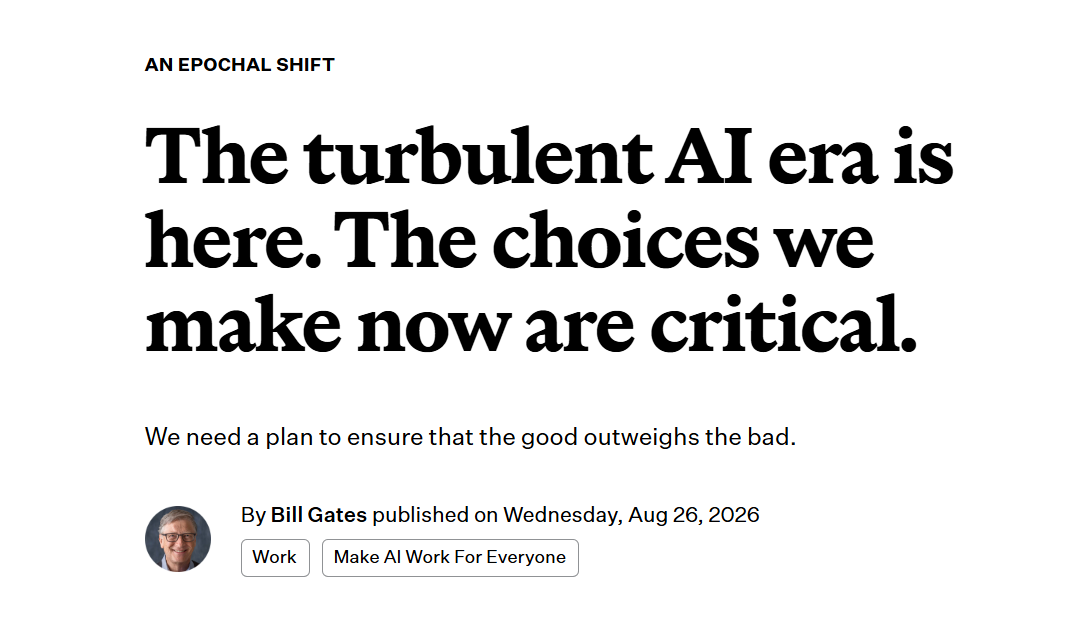
In his essay proposing taxes on tokens and robots, Gates argues that the tax system encourages companies to replace people with machines.
Employers incur payroll taxes when they hire workers. But they can write off investments in automation. That seems to be his main argument.
That framing assumes a relatively simple substitution …
One machine enters and one worker leaves.
However, most business adoption is less predictable.
AI can automate part of a job while making the person performing the remaining work more productive.
It can help a programmer test more code … allow a designer to explore more concepts … help a financial analyst examine more documents … or let a one-person company serve customers without a full administrative staff.
Inference is also a continuing expense.
Advanced reasoning, image generation, video and autonomous agents can consume substantial computing resources every time they are used.
A company deciding whether to remove employees must weigh those costs against quality, reliability and the value of human judgment.
Klarna’s AI Agent Experiment Shows Humans Aren’t Replaceable Yet
Klarna provides a useful warning against reducing that decision to a cost comparison.

In early 2024, Klarna said its AI assistant was performing the equivalent work of 700 full-time customer-service agents.
The company reported that the system could:
- Handle two-thirds of its customer-service conversations,
- Reduce average resolution time from 11 minutes to less than two and
- Improve annual profit by $40 million
That sounded great on paper. However, Klarna’s experience shows how misleading assumptions can be.
The company shrank its workforce while using AI to handle a large share of routine customer-service volume.
But after pushing automation too far, Chief Executive Sebastian Siemiatkowski acknowledged that service quality had suffered.
Humans: 1, AI: 0
He restored greater access to human support. And by September 2025, Reuters reported that Klarna was redirecting its AI strategy from cost reduction toward growth.
The lesson is not that AI cannot replace workers. It is that AI usage does not reveal what is happening to labor.
The same technology can eliminate routine tasks, increase the output of remaining employees and help a business expand into work that would otherwise be uneconomic.
A token tax would ignore those distinctions. It would impose the same charge whether:
- AI replaces an employee or
- It helps that employee resolve a difficult case, serve more customers or build a new product
Token volume measures computational activity, not job destruction.
Congress Already Has a Possible Blueprint
Gates has not explained precisely how his tax would operate. But Congress is already considering one version.
Reps. Greg Casar, Valerie Foushee and Sara Jacobs introduced the AI Tax and Work Protection Act in August.
It would tax companies that develop large foundation models, sell access to them or modify open-weight models.
When the relevant unemployment rate is 5% or lower, the proposed tax would equal the greater of:
- 2% of the government-determined value of tokens processed or
- 3% of covered AI transactions
The rates would increase if unemployment rose.
Revenue would support employment in education, healthcare, childcare, infrastructure, scientific research, local journalism and other public services.
The objectives are politically attractive. The mechanics create a different set of incentives.
When an independent developer buys model access from Microsoft Azure, Amazon Web Services or Google Cloud, the transaction is already measured.
The provider counts the tokens and sends an invoice.
Calculating and passing along the tax would be relatively straightforward.
Internal AI use is harder to observe.
Who Decides When AI Actually Cost Someone Their Job?
The bill attempts to cover models that a company uses internally when that use enables or causes a workforce reduction.
Regulators would then have to determine whether a smaller workforce resulted from AI, weak demand, an acquisition, ordinary restructuring, employee attrition or several causes at once.
Large corporations continually move employees among divisions and replace some departures while leaving other positions vacant.
Connecting a particular model to a particular reduction would be harder than taxing a visible API transaction.
The companies renting AI would consequently present the clearest tax base. The companies owning the infrastructure would possess more room to absorb, restructure or distribute the cost.
A Tax on Access Becomes a Competitive Moat
AI providers may write the initial checks, but their customers would bear much of the burden.
The Bipartisan Policy Center concluded that taxes on AI developers or adopters would probably be passed through to users.
That could mean higher API prices, more expensive software subscriptions or smaller usage allowances.
Microsoft, Alphabet and Amazon already meter cloud and model consumption. They can add the cost to customer bills.
Companies building products on those platforms must then increase their prices or accept lower margins.
The vertically integrated platforms occupy a more defensible position.
They own data centers, secure chips in enormous volumes, operate models and distribute AI through established cloud, software, advertising and consumer businesses.
They can spread compliance costs across several sources of revenue.
Independent model developers, small software companies and individual entrepreneurs do not possess those advantages.
They pay the retail price for intelligence before they have acquired customers or produced profits.
Increasing the marginal cost of that resource would make independent AI ownership and development less attractive.
Some businesses would remain with the largest providers because those companies can handle the reporting, auditing and tax collection.
Others would abandon products whose economics no longer work.
A policy promoted as worker protection could therefore reduce the number of people capable of building AI businesses of their own.
Tokens Measure the Wrong Thing
Token consumption also bears little relationship to worker displacement.
A lawyer might use a few thousand tokens to produce an analysis that saves several hours.
A scientist could consume millions of tokens screening medical research without eliminating a single job.
The scientific project could generate the larger tax bill despite creating less labor-market disruption.
Different models also divide the same information into different numbers of tokens.
Languages are not treated equally.
A 2026 analysis of 10 models and 25 European languages found a roughly 2.5-fold difference between the tokens required per word in English and in some other languages.
Reasoning Models Create Additional Complications
They can generate internal tokens users never see.
Providers can route queries among models, cache information, compress prompts and change how data is represented.
Even an Oxford position paper supporting token taxes acknowledges that providers could misreport usage, manipulate tokenization or hide reasoning tokens.
Its proposed enforcement tools include model-specific rates, black-box testing, white-box audits, hardware monitoring and international registries of advanced GPUs.
Those measures would create privacy and security risks of their own.
Monitoring privately owned processors and auditing activity inside models could expose proprietary workloads, sensitive usage information and details about how companies operate.

The registries, reporting systems and audit interfaces would also become valuable targets for hackers.
A system intended to monitor AI usage could grow into both a surveillance mechanism and another store of sensitive data requiring protection.
Protect Workers by Widening Ownership
The strongest protection for workers would give more people the ability to use and own productive technology.
That could include reducing taxes on labor and newly formed businesses, making it easier for employees to acquire ownership stakes, supporting access to training and computing resources and preserving the ability to run open models independently.
If AI produces extraordinary profits, governments can tax those profits, capital gains or monopoly rents after the economic gains appear.
The International Monetary Fund has warned that a special AI tax could impede productivity, including applications that complement workers.
Its alternatives include reconsidering incentives for labor-displacing investments and strengthening taxation of capital income and excess profits.
Those approaches place the burden closer to the wealth produced by automation.
The Investor Angle
Investors should not read a token tax as uniformly negative for Microsoft, Alphabet, Amazon and Meta.
It could reduce AI consumption and weaken demand for their infrastructure.
Relative to smaller competitors, however, those companies would retain control of the models, cloud platforms, distribution and compliance systems.
AI application providers with heavy usage and limited pricing power would be more exposed.
Software companies such as Salesforce, Adobe and ServiceNow could face higher inference expenses as customers use their AI features. Their margins would depend on how successfully they meter and pass along those costs.
Nvidia and AMD would face two competing effects.
- Lower AI consumption could reduce accelerator demand.
- At the same time, companies seeking more control over usage, privacy and long-term costs could invest in their own hardware and local models.
The broader investment signal would be consolidation.
Regulation that makes intelligence more expensive to rent and more complicated to own favors the companies that already control it.
Although Gates presents his proposal to stop the tax system from favoring machines over people, that framing is deceptive.
It treats AI mainly as a replacement for labor, obscuring how the technology can help workers produce more and give independent developers and entrepreneurs the means to compete with the largest corporations.
A tax on AI use would fall hardest on those least able to absorb it while strengthening the platforms that already own the infrastructure.
AI is becoming one of the economy’s most valuable productive resources.
The best way to protect workers is to give more people the opportunity to use it, own it and build businesses with it.
Gates’ proposal moves in the opposite direction.
It places another tollbooth in their way and calls that worker protection.
In practice, it protects the tollbooth owners.
That's not a tax on machines. It's a tax on everyone who doesn't already own one.
For investors, be mindful that any policy that raises the cost of building with AI tends to reward the companies that already own the infrastructure …
Not the ones trying to compete with it.
Best,
Jurica Dujmovic