 |
| By Marija Matic |
Crypto is ripping higher.
Bitcoin (BTC, “A-”) just cleared resistance and pushed above $86,000, all while the Fed raised rates.
Not exactly the backdrop you’d expect for a breakout, but here we are.
Last week, Congress killed the long-awaited crypto Clarity bill.
In response, the SEC moved in a different direction.
It effectively opened a five-year pathway for tokenized U.S. equities to trade on blockchain-native venues.
That’s a $77 trillion market getting a bridge to crypto rails.
Related story: Crypto’s Biggest Regulatory Week of 2026
The demand is already there. Tokenized stocks are trading billions on weekends when traditional markets are closed.
According to Token Terminal, there are over 3.7 million on-chain holders.
The SEC simply acknowledged the trend.
Now volumes and use cases (lending, collateral, structured products) are likely to expand.
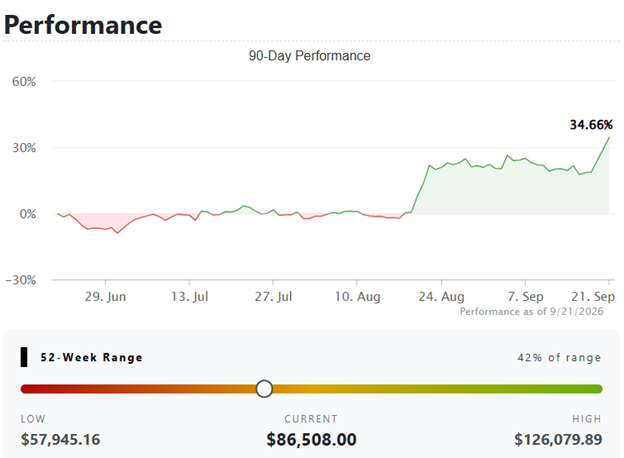
This shift, combined with a short squeeze, pushed BTC through the $83K level, a key resistance throughout September.
Once that broke, momentum spilled into alts: Sui (SUI, “B-”), Render (RNDR, “B-”), Bittensor (TAO, “E+”), STONK (STONK, Unrated) and anything tied to tokenization.
Speaking of which …
Tokenization is the trade right now.
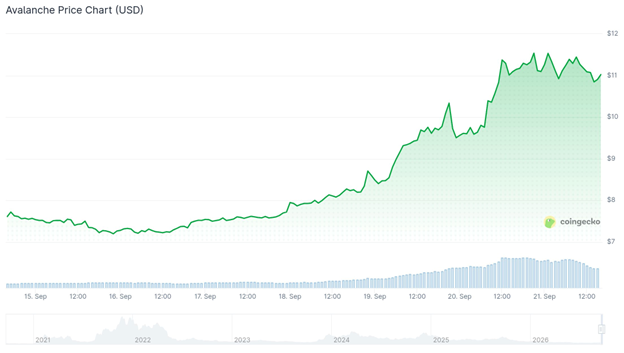
Avalanche (AVAX, “B”) is up 45% on the week and sits right at the center of it.
A stack of good news stood out during Avalanche Summit NYC, which just concluded a few days ago …
The NYSE spent a full year testing Avalanche for its future tokenized-securities platform.
No chain has been finalized, but the relationship runs deep.
Michael Blaugrund of the Intercontinental Exchange (the NYSE's parent) said Avalanche "checks a lot of the boxes" they're weighing across platforms.
Aave (AAVE, “C”) is preparing to launch a specialized RWA lending market on Avalanche as it positions the lending platform for the tokenization wave.
New York Life Investment Management ($807B AUM) is bringing its first tokenized fund to Avalanche.
On the back of FIFA using Avalanche for parts of 2026 World Cup ticketing, loyalty and digital collectibles, David Lane, CEO of Sports Illustrated Tickets, teased that "multiple Premier League stadiums" will go fully on-chain in 2027.
Bloxtel is bringing its 5G infrastructure on-chain with Avalanche.
Hyundai laid out next steps after its successful proof-of-concept payments on Avalanche earlier this year.
Janus Henderson, a $500B global asset manager, became a validator on the network.
Arbitrum (ARB, “C-”): +59% on the week. The Ethereum Layer-2 had a monster stretch.
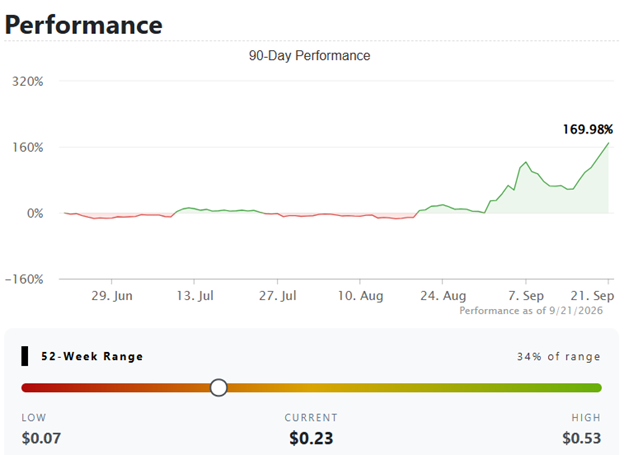
Arbitrum One's RWA market cap grew over $76M in seven days, on par with BNB Chain. And tokenized funds on Arbitrum One hit a new high above $800M.
Robinhood Chain, built on Arbitrum tech, has now processed 750M transactions and $60B in cumulative DEX volume, with 10% of its revenue flowing back into the Arbitrum ecosystem.
On heavy days, Robinhood Chain has generated over $6M in fees (versus under $1M normally).
That makes it one of crypto's top fee-earning networks.
It pushes real revenue back to the Arbitrum DAO.
Perp DEX Variational, also on Arbitrum, cracked the top 3 for trading TradFi on-chain, hitting $2.81B in 24h volume last week.
And Bitget Wallet's tokenized stocks are now live on Arbitrum (rTokens like $rAAPL and $rSPCX), with on-chain liquidity for DeFi composability.
Bitcoin-adjacent plays are moving, too.
Bitway (BTW, “E+”) hit a new all-time high, up as much as 30% today.
The project focuses on connecting fragmented Bitcoin liquidity with broader financial markets — enabling non-custodial lending, yield strategies, and cross-chain infrastructure.
AI narratives are catching a strong bid as well.
NEAR Protocol (NEAR, “C”) is up 60% this week.
NEAR is a versatile play. It started as an L1 and has since spread into privacy, interoperability and DeFi.
The focus now is squarely on AI, helped by the fact that a NEAR co-founder was a 2017 co-author of the Transformer paper.
That’s the blueprint behind modern generative AI, ChatGPT and Claude included.

The pitch: NEAR provides the infrastructure AI agents need to transact, operate and interact across Web2 and Web3, unifying liquidity across 35+ chains and theoretically scaling to over 1 million transactions per second.
The token has matured, too — supply is fully unlocked, inflation is capped at 2.5%, and growing protocol revenue feeds NEAR buybacks.
It has raised $640M across nine rounds (Messari), saw 700k+ unique users on NEAR Intents in August, and just published a post-quantum security roadmap.
Related story: Developers Are Already Solving Bitcoin’s Quantum Problem
The ecosystem is filling in.
Confidential perps trading is now live on Near.com, powered by Hyperliquid.
NEAR also gives privacy token Zcash (ZEC, “B-”) confidential, cross-chain rails and liquidity access. So, some treat NEAR as a ZEC beta play, though it's much more than that.
There's also a real spike in NEAR AI cloud signups as people realize they need to encrypt their prompts. Keeping AI private is becoming as basic as operational security.
Even Venice (VVV, “B”) AI uses NEAR AI's private inference for verifiably private text and image generation. Prompts get processed inside hardware-enforced enclaves.
Governments are showing up as well …
Bermuda partnered with NEAR AI to deploy confidential AI for public services. They started with a secure assistant for handling sensitive citizen data.
Venice (VVV, “B”) AI gained +41% on the week. It hit a new all-time high of $34.53 today.
Venice is a privacy-focused AI network that lets users tap various LLMs and image tools without centralized surveillance or data storage — essentially a privacy wrapper.
Rather than paying to use AI, many users prefer to stake VVV for the same purposes.
Since late 2025, it has run a "Buy and Burn" program that uses platform revenue to permanently pull tokens out of circulation.
Its own pitch — "They all track your thoughts … steal your ideas … train on your art … except Venice" — lands on a real problem with large language models.
The thesis is simple: If AI adoption keeps climbing, VVV supply shrinks while demand grows.
DeFi Plays
Ethena (ENA, “A-”): +45% on the week.
Ethena issues the synthetic dollar USDe, the so-called "Internet Bond" — a dollar-denominated savings instrument with DeFi's upside.
Its strategies lean heavily on funding rates. So, the project and its holders benefit from today's elevated rates.
The staked version, sUSDe, has seen average yields climb to 10.5% across DeFi protocols, with room to rise if funding stays hot.
Ethena has distributed over $781M in rewards to date.
It has also launched Ethena Pay, an "internet money" neobank built on Avalanche.
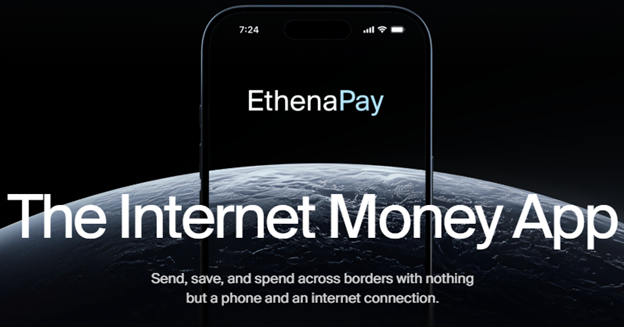
Ethena Pay offers 5% cashback on card spend, a best-in-class 6% dollar savings rate, free instant global transfers, and free onramps in USD, GBP, EUR and local FX.
On top of that, Ethena completed a SOC 2 Type II audit against the Security Trust Services Criteria and got a clean opinion — zero exceptions — covering the operational security, exactly what most crypto audits skip.
The risk I see is the upcoming Oct. 5 unlock of 14% of supply.
The buyback program meant to offset it doesn't kick in until USDe's market cap hits $7.5B. That currently sits at $4.87B, so it needs time.

One cushion: ENA unlock holders were offered a buyback, and around a third of eligible accounts accepted. This should soften the selling pressure on the 5th.
Hitting $7.5B in market cap is the next bullish catalyst — at last month's pace (~$0.75B added), USDe is about three and a half months away, though I'd expect faster given high funding and yields.
What's Next
Three things are holding the market up:
- ETF demand has improved,
- Much of the regulatory uncertainty has been absorbed (and what's left will get sorted out at the agency level), and
- Macro pressure hasn't intensified as much as feared.
The legislative backdrop is turning favorable, too.
The American Reserve Modernization Act (ARMA) cleared the House Financial Services Committee last week.
ARMA is one step from a full House vote. If passed, it would establish a Strategic Bitcoin Reserve.
Timing is now the key — with this Congress ending on 2 January 2027, a floor vote before then would materially improve ARMA's near-term odds, especially if Democrats take the House in the midterms.
The driver is also shifting — from the war trade toward U.S. dollar liquidity and risk appetite. This makes front-end funding conditions matter more for crypto.
You can see it in the flows: Spot ETFs have flipped from outflows back to inflows, with over $590M net across Thursday and Friday alone.
On the chart, holding above $83k opens the door toward $90k, with $95k and $100k in play.
BTC accelerated through a wall of short liquidations to get here — shorts had piled in between $82k and $86k for months, and the rejection from that zone was shallow.
Those shorts are now the fuel, forced to buy back BTC to cover.
The next test is whether the gains can hold once the squeeze burns out.
Regards,
Marija Matić
P.S. My colleague, Juan Villaverde, puts his Crypto Timing Model to work each month in Weiss Crypto Investor, helping readers navigate the crypto market with a long-term strategy.
In each issue, I highlight the latest DeFi trends, yield opportunities and ways to stay safe on the blockchain.
For my latest column — and to see what the Timing Model is telling us about the market now — click here.