Developers Are Already Solving Bitcoin's Quantum Problem

 |
| By Mark Gough |
Every few months, the same headline comes back around.
Quantum computers will break Bitcoin.
A real issue underlies that headline, but it usually gets presented in the most dramatic way possible.
To put it more accurately, quantum computing does not directly threaten Bitcoin’s transaction history or fixed supply.
The primary risk is to the cryptography used to prove Bitcoin ownership and authorize transactions.
A sufficiently powerful quantum computer could potentially derive a private key from an exposed public key.

If that became possible, it could create a valid signature and move the coins associated with that key.
That is a very different problem from someone simply "hacking Bitcoin."
A recent report from Fidelity Digital Assets brought the issue back into focus. It examined how Bitcoin could move toward quantum-resistant signatures and the trade-offs that would come with it.
As my colleague Chris Graebe said in his Fall 2026 Private Investment Summit, quantum is the next frontier.
Chris revealed that he’s getting ready to invest in a company that’s building the protection against inevitable attacks.
There’s a short window of time to learn about this opportunity. Watch this video now, before we pull it offline at midnight tonight.
Research in the field has continued to advance.
- Google researchers have produced new estimates for the computing power required to attack the cryptography Bitcoin uses.
- Project Eleven has demonstrated a tiny version of that attack on real quantum hardware.
- Bitcoin (BTC, “A-”) developers are looking at ways to reduce quantum exposure.
- Meanwhile, Blockstream has already tested post-quantum Bitcoin transactions on a live network.
So I don't think the useful question is whether quantum computing creates a problem for Bitcoin holders.
The better question is whether Bitcoin has enough time to upgrade the way ownership is secured before that problem becomes serious.
Right now, I think the answer is yes.
What Would Quantum Actually Break?
When you own Bitcoin, you control a private key. That key allows you to create a digital signature that proves you have permission to move your coins.
Bitcoin currently uses Elliptic Curve Digital Signature Algorithm (ECDSA) and Schnorr signatures.
Both rely on elliptic-curve cryptography.
With conventional computers, deriving a private key from a public key is considered practically impossible.
A sufficiently powerful quantum computer could change that.
Using Shor's algorithm, it could theoretically derive a private key from its corresponding public key.
To recover a Bitcoin private key this way, an attacker would need the corresponding public key to be exposed.
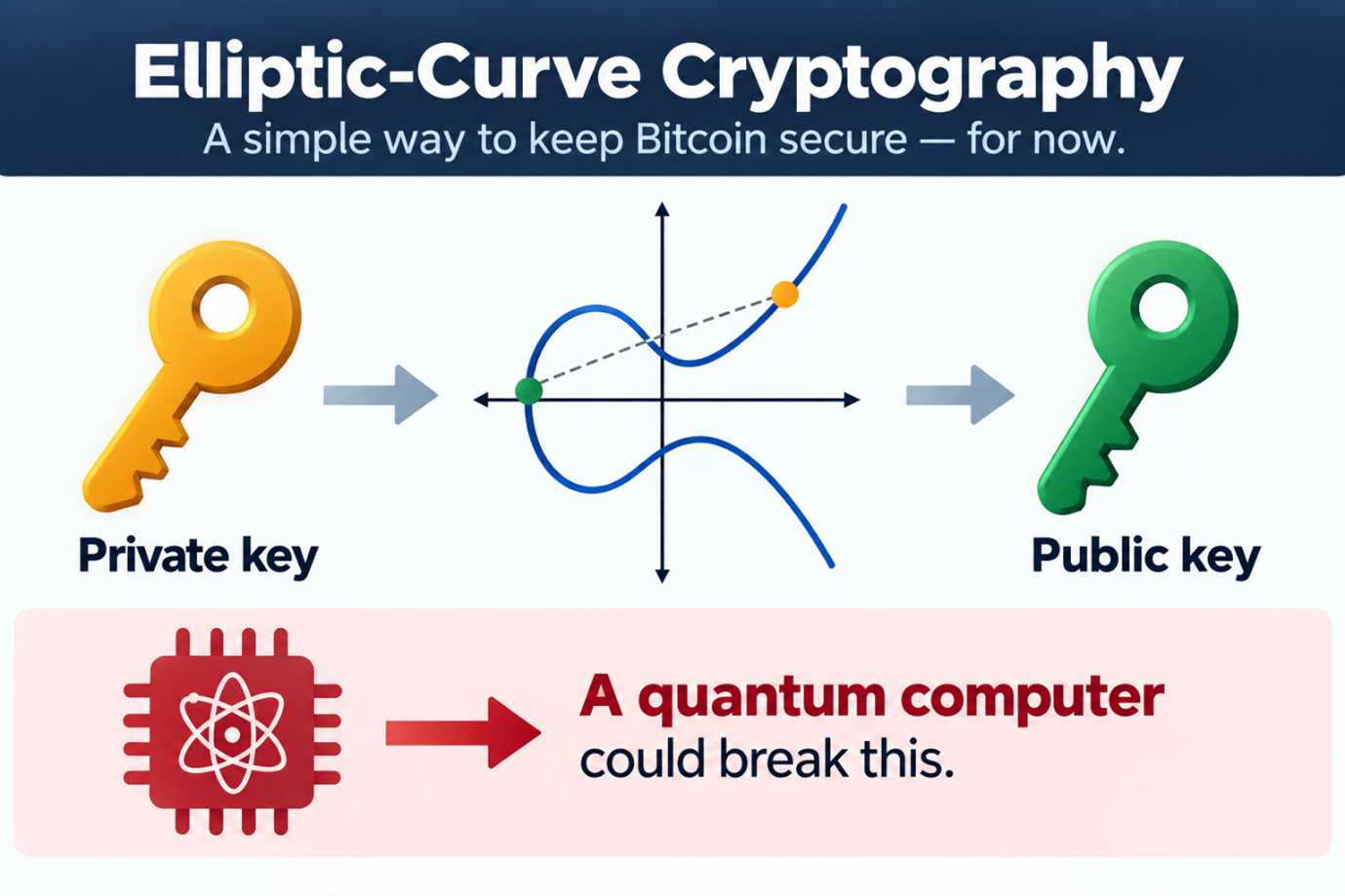
If that happened and the quantum computer was powerful enough, your seed phrase or hardware wallet wouldn't stop that attack.
The cryptography proving ownership would have been compromised.
That would not mean Bitcoin's blockchain had suddenly been broken.
The immediate threat is to the signature system used to prove ownership and authorize spending. Not to Bitcoin's transaction history or supply rules.
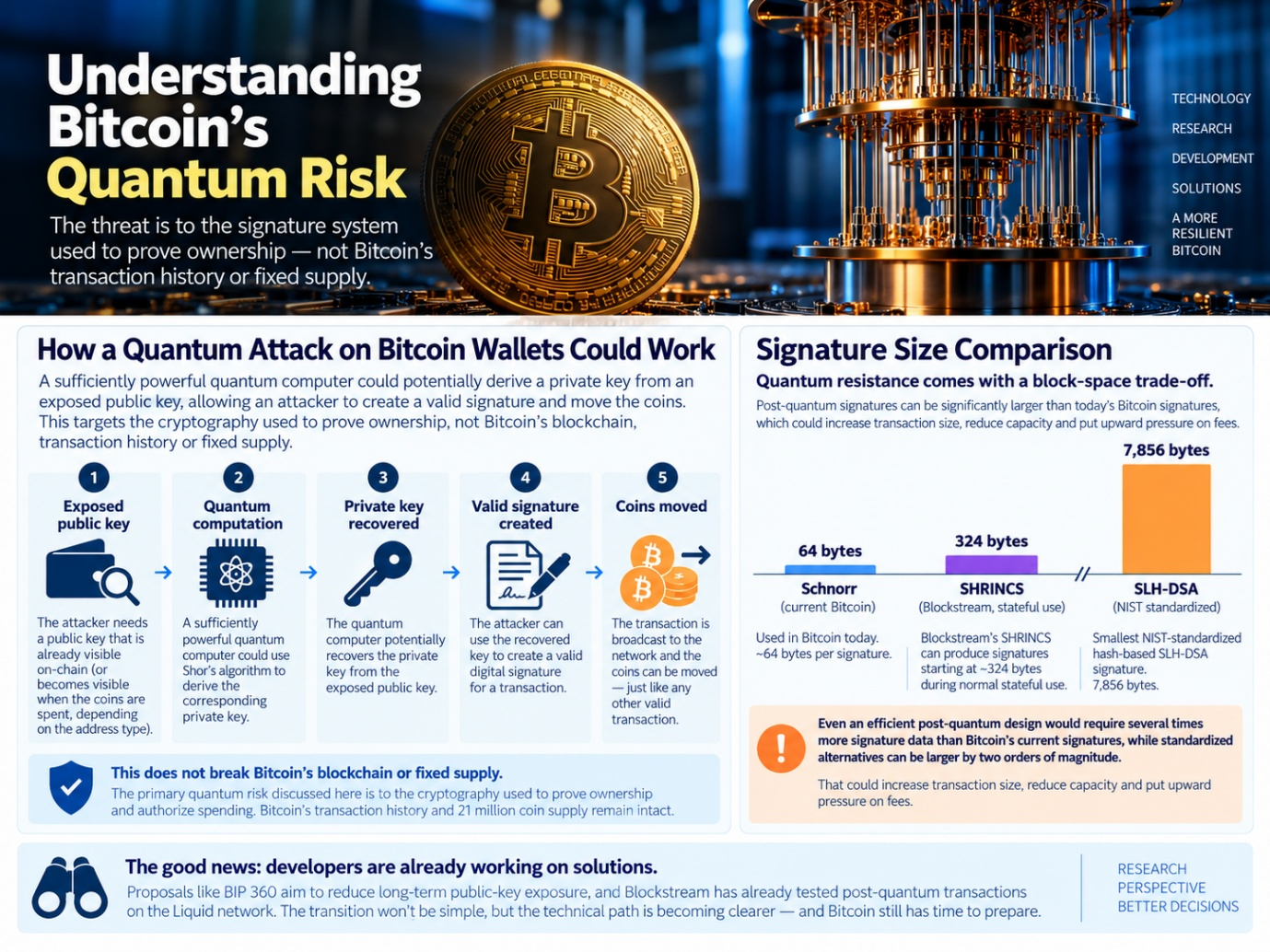
That is the problem Bitcoin eventually has to solve.
Google Has Brought the Numbers Down
We are still a long way from a machine capable of doing this to Bitcoin wallets.
But the estimates for how powerful that machine needs to be are falling.
Researchers from Google Quantum AI, Stanford and others recently worked out what an attack on Bitcoin's 256-bit elliptic-curve cryptography could look like.
They estimated this could potentially be carried out using around 1,200 to 1,450 logical qubits, depending on the implementation.
Under one set of superconducting quantum-computer assumptions, that could translate into fewer than 500,000 physical qubits.
That sounds close until you compare it with where quantum hardware is today.
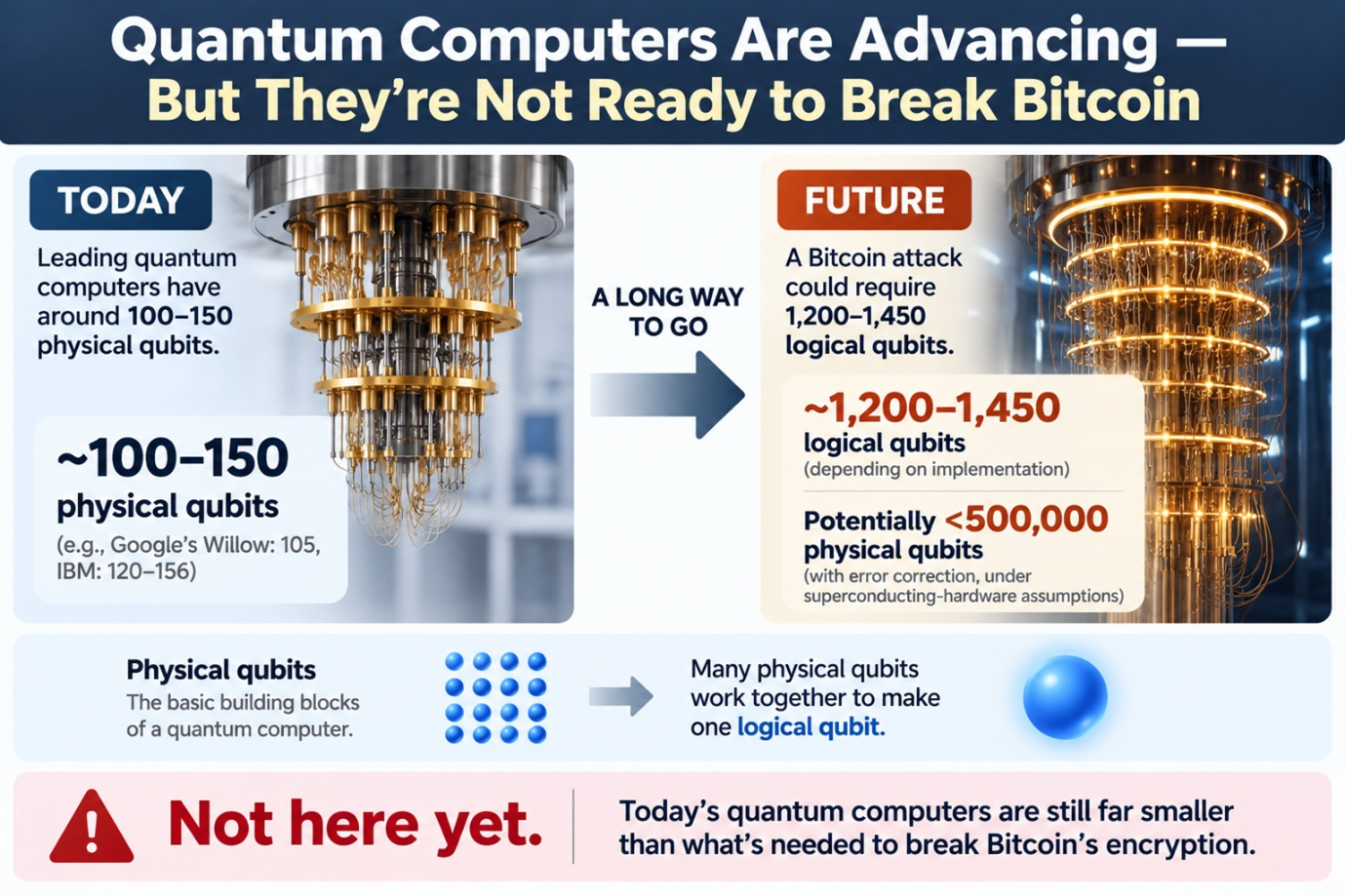
A physical qubit is not the same thing as a useful, error-corrected logical qubit.
Building hundreds of thousands of reliable qubits remains a major engineering challenge.
Nobody knows whether practical quantum attacks on Bitcoin are decades away or potentially closer.
That uncertainty is exactly why developers are starting to think about solutions long before the threat becomes immediate.
(Like this startup Chris Graebe is getting ready to reveal to Weiss Members in the coming days.)
When you are talking about protecting an asset worth trillions of dollars, you don't wait until the threat is on your doorstep before thinking about the fix.
We've Already Seen a Small Version of the Attack
Project Eleven gave us a real-world demonstration this year.
Its Q-Day Prize challenged researchers to break progressively larger elliptic-curve keys using quantum hardware.
In April, researcher Giancarlo Lelli successfully broke a 15-bit elliptic-curve key using publicly accessible quantum hardware.
That is nowhere near Bitcoin's 256-bit cryptography. The gap is enormous. But it does show the basic attack is no longer confined to academic papers.
Researchers can already run small-scale versions on real hardware.
The real challenge is scaling them to cryptographic systems as large as Bitcoin's.
Not Every Bitcoin Is Exposed the Same Way
This is where the wallet side of the problem becomes important.
To recover a Bitcoin private key using Shor's algorithm, an attacker would need the corresponding public key to be exposed.
Depending on the type of Bitcoin address being used, that public key may remain hidden until the owner spends the coins.
That means some coins are more exposed than others.
A public key already revealed on-chain could give a future attacker a long window to work with.
Meanwhile, a coin whose public key remains hidden is harder to attack until it is spent.
That is why one proposal under discussion, BIP 360, aims to reduce long-term public-key exposure.
It would not make Bitcoin fully quantum-proof. But it could remove one of the easier attack surfaces.
The more complete fix would require a new type of digital signature.
Fidelity Points to One Possible Fix
Fidelity looked at a proposal known as SHRINCS, which uses hash-based cryptography instead of the elliptic-curve cryptography Bitcoin relies on today.
Hash-based signatures are not vulnerable to Shor's algorithm in the same way.
The problem is size.
Bitcoin block space is limited, and bigger signatures mean bigger transactions.
A Schnorr signature is around 64 bytes, while Blockstream says SHRINCS can produce signatures starting at roughly 324 bytes during normal stateful use.
By comparison, the smallest NIST-standardized hash-based SLH-DSA signature is 7,856 bytes.
Even an efficient post-quantum design would require several times more signature data than Bitcoin uses today.
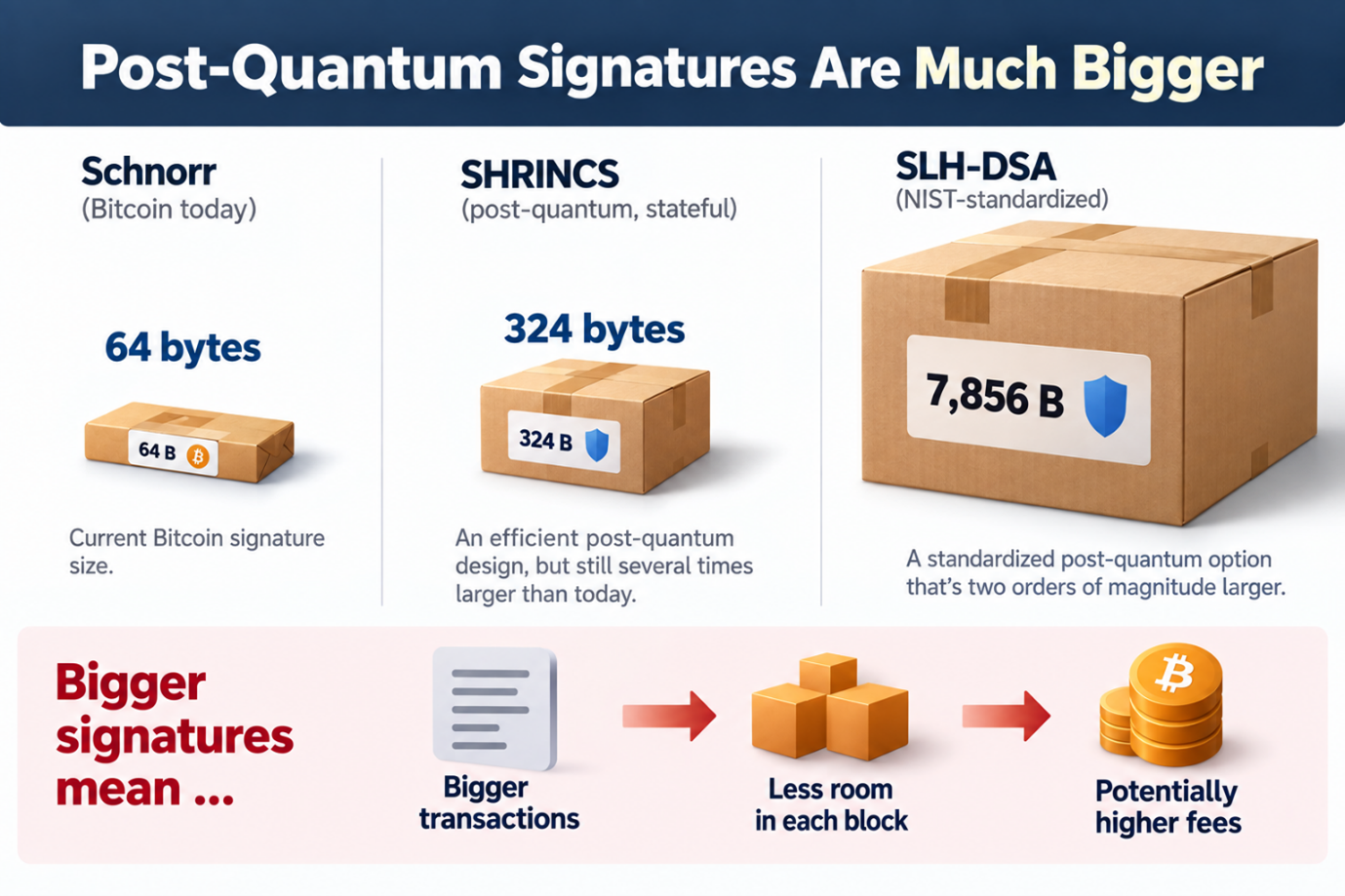
Meanwhile, standardized alternatives can be two orders of magnitude larger.
That means bigger transactions, less room in each block and potentially higher fees.
The challenge, then, is not just finding a quantum-safe alternative.
It’s finding one that does not make Bitcoin significantly more expensive or difficult to use.
SHRINCS is one attempt to find that balance.
It Has Already Been Tested
In March, Blockstream Research deployed SHRINCS on Liquid, a Bitcoin sidechain.
It successfully broadcast post-quantum-signed transactions on the production network.
That does not mean Bitcoin itself is quantum-resistant.
Liquid is a separate network, and upgrading Bitcoin would require much broader agreement.
But it does show that post-quantum signatures can work in a Bitcoin-related transaction environment.
The discussion has moved beyond whether this can be done at all.
Now it is about which design offers the best trade-off between security, transaction size and usability.
The Hardest Problem May Be the Bitcoin That Never Moves
Another issue could become much more controversial.
Let's say Bitcoin eventually introduces quantum-resistant addresses and active users migrate their coins. What happens to wallets that never move?
Some owners may have lost their keys. Some may have died. Others could be wallets that have remained untouched for more than a decade.
And then there are the coins associated with Bitcoin's earliest years. Many believe Satoshi hasn’t sold any Bitcoin, ever.
If a future quantum computer became powerful enough to derive the private keys behind those coins …
Then Bitcoin itself would not know whether the resulting transaction came from the original owner or an attacker.
The network only sees a valid signature.
It cannot distinguish one produced by the original owner from one produced by a quantum attacker.
That is where a wallet-security problem starts becoming a Bitcoin-wide governance problem.
- Do you leave vulnerable old coins spendable … and accept that a quantum attacker could potentially take them?
- Or do you introduce some mechanism that stops them moving after a certain point?
Neither option is straightforward, and that social question may eventually prove harder than the cryptography.
Should Bitcoin Investors Be Worried?
I would not lose sleep over a quantum computer deriving Bitcoin private keys tomorrow. We are not there.
But I would not dismiss the issue, either.
- Google has lowered estimates of what an eventual attack might require.
- Project Eleven has demonstrated the basic attack on very small keys using real quantum hardware.
- Bitcoin developers are already looking at ways to reduce public-key exposure.
- Blockstream has tested post-quantum transactions on Liquid.
- And Fidelity Digital Assets is now openly discussing how Bitcoin could transition toward quantum-resistant signatures.
None of this suggests Bitcoin is about to be “hacked.”
It shows the risk is serious enough for developers to start designing and testing the migration … well before quantum computers can compromise Bitcoin’s signature system.
Bitcoin's quantum problem is real, but it remains a long-term challenge rather than an immediate threat.
The eventual solution will involve trade-offs around transaction size, wallet design and usability.
But Bitcoin is not starting from zero. Developers are already testing ideas.
And right now, Bitcoin still has the one thing it needs most:
That is, time to prepare.
Best,
Mark Gough
P.S. Post-quantum security is far bigger than Bitcoin. The military, defense contractors and every U.S. federal agency will soon be required by law to implement protections against quantum threats.
Chris Graebe has uncovered a small startup with PROVEN technology that’s active on 1 million+ devices now. And with over 600 million threats stopped so far.
The company leadership has decades of experience in cybersecurity, encryption and cyberwarfare, plus the guidance of three NATO generals with deep expertise in the field.
And he’s getting ready to reveal the name of that startup any day now.
But only to Weiss Members who watch this urgent briefing before midnight tonight and follow the instructions at the end.