Bitcoin Bounces as Wall Street Eyes New Highs in 2027

 |
| By Marija Matic Reviewed by: Beth Canova |
After one of the most punishing stretches of the year, Bitcoin (BTC, “B+”) is finally showing signs of life.
And it’s the bit of hope we’ve all been waiting for.
Last week was brutal. It saw U.S. spot ETFs bleed $1.79 billion in Bitcoin outflows and $305.8 million in Ethereum (ETH, “B+”) outflows.
Then, on Saturday, BTC plunged to a two-year intraday low near $55,100.
Fortunately, dip buyers stepped in aggressively.
By Sunday, Bitcoin broke its record 18-day streak of lower daily highs and reclaimed $61,000+. And earlier today, it even touched $63,600 before settling back near $61,200.
If it continues this show of strength, today will be the third consecutive day of gains.
Leverage Flush Meets Macro Relief
Three catalysts helped stop the bleeding over the past 48 hours:
- A $1.8B Leverage Reset: Friday and Saturday’s sell-off wiped out roughly $1.8 billion in over-leveraged positions. Clearing out that excess froth stabilized spot markets and flipped perpetual funding rates back toward mildly bullish territory.
- Policy Breathers from Washington and Asia: Overnight into Monday, U.S. stock index futures jumped roughly 2% after Treasury Secretary Scott Bessent warned that the Federal Reserve risks raising interest rates too far.
The statement eased fears of an aggressive 50-basis-point rate hike in December. Combined with weekend equity market support from governments in South Korea, Taiwan, and China, broader risk appetite caught a much-needed breather after six weeks of tech-led turbulence — highlighted by Nvidia’s (NVDA, “B-”) nearly 50% drawdown.
- Jensen Huang has been reinstated as CEO of Nvidia: Earlier today, the chip maker reversed its decision to part ways with its co-founder. Both the NVDA stock and Bitcoin rose on the news.

Meanwhile, Ethereum is hovering above $1,700. It’s staging a modest bounce despite core developers pushing its next major network upgrade into 2027 to resolve smart-contract compatibility issues for existing dApps.
The Wyckoff "Spring" and Who Is Buying the Dip
If the macro backdrop explains the bounce, market structure suggests something bigger may be unfolding.
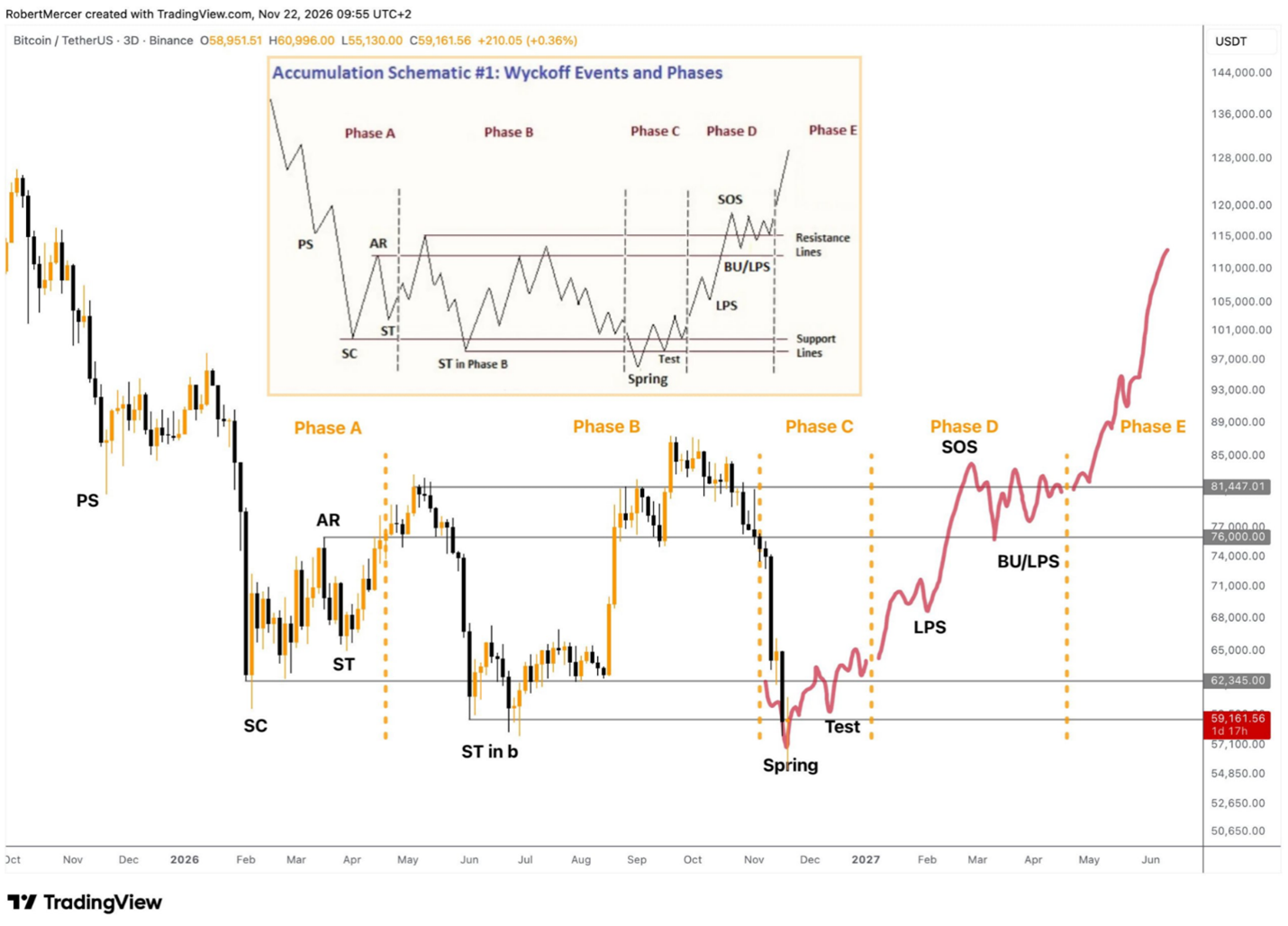
As shown in the Wyckoff Accumulation chart above — made by trader Robert Mercer — Bitcoin has spent most of 2026 grinding through a wide sideways range (Phases A and B).
Saturday’s sharp wick down to $55,100 — briefly undercutting range support before snapping right back — looks like a textbook Phase C "Spring" …
That is, a final shakeout designed to flush weak hands before a sustained markup phase into 2027.
On-chain and corporate filings confirm that deep-pocketed buyers used the sub-$60,000 panic to accumulate:
- Corporate Treasuries Step In: Strategy (MSTR, “D”) acquired another 457 BTC ($29.6M). That brought its total stash to 851,305 BTC. It also repurchased $212M of STRC — Strategy’s perpetual preferred stock — and expanded its Digital Credit Repurchase Program by $1B.
At the same time, Twenty One Capital deployed $20 million into Bitcoin as prices dipped below $60,000. - Retail & Wealth Conviction: According to Charles Schwab’s (SCHW, “B”) 2026 Modern Wealth Survey, 60% of crypto investors plan to increase their holdings over the next 12 months — a higher share than ETF owners (56%) or stock investors (52%).
Wall Street’s Early 2027 Playbooks Are Already Bullish
Most major crypto research desks wait until mid-to-late December to publish their year-ahead theses,
But two institutional heavyweights have already laid out their 2027 roadmaps:
21shares released its report — 10 Predictions for 2027 — late last week.
It forecasts Bitcoin hitting a new all-time high in 2027 after ETFs, corporations, and sovereigns absorbed 180,000 BTC during 2026’s 50% drawdown.
21shares expects formal digital asset rulebooks across 15 of the 21 G20 nations, over 100 million active stablecoin addresses, $25 billion in neobank card spending, and tokenized real-world asset (RWA) volumes nearly tripling to $15 trillion.
Bitwise’s 2027 Capital Market Assumptions raises the company’s 10-year base-case Bitcoin target to $1.6 million by 2036 (34.3% CAGR).
The report argues that broadening 1%–5% institutional portfolio allocations are steadily weakening Bitcoin’s traditional four-year boom-and-bust cycle.
Builders Aren’t Waiting for the Bull Market
Beneath the price volatility, crypto-native infrastructure and policy continue to move forward.
On the infrastructure side, South Korea’s KB Securities unveiled a multi-chain architecture for its upcoming tokenized securities platform. It’s designed to connect with public networks like Ethereum.
Meanwhile Coinbase’s (COIN, “D+”) Base network partnered with HashKey’s HSK Chain to bridge Asian on-chain assets with global DeFi liquidity.
And fresh off its Alpenglow finality upgrade, Solana (SOL, “B-”) outlined its 2027 technical roadmap, which is focused on validator efficiency and network scaling.
And when it comes to policy, we’re seeing a bipartisan effort.
Six U.S. senators — led by Cynthia Lummis (WY-R) and Kirsten Gillibrand (NY-D) — have urged the Treasury Department to grant a regulatory "safe harbor."
This would let state-licensed stablecoin issuers continue to operate smoothly when the GENIUS Act takes effect on Jan. 18, 2027.
Key Levels to Watch This Week
Early Monday brought us hope that the long-term accumulation thesis is finally strengthening.
It’s a welcome shift. But we still have short-term battle lines to watch carefully ...
- Immediate Resistance ($62,000 – $63,000): Watch how Bitcoin reacts here. A clean breakout above $63,000 opens a path toward $67,000 and signals that Bitcoin could be transitioning out of the Wyckoff Spring faster than expected.
- Rejection & Downside Floor ($53,000 – $55,000): If BTC hits a wall at $62,000-63,000, traders will look for tactical short setups or patient dollar-cost average entries lower.
Bitcoin’s estimated electrical production cost — a zone that has historically marked cycle bottoms, even if a brief weekly wick tests below it — currently sits around $53,000-55,000.
Either way, if the institutional desks and Wyckoff structure are right, the closing weeks of 2026 seem to be prime territory for hunting long-term entries.
Savvy investors should have their price targets ready when that happens.
Best,
Marija Matić