Bitcoin’s Productivity Problem Has a New Solution

 |
| By Mark Gough |
Bitcoin (BTC) is the biggest and most secure crypto network in the world.
But most BTC still sits idle.
For plenty of holders, that is exactly the point. They want to own Bitcoin and leave it alone.
That’s the “Bitcoin as a store of value” approach. One that sees holders use their BTC as digital gold, basically.
But that means there’s little option for holders who want to put their BTC to work. Like they can with Ethereum (ETH), Solana (SOL) and numerous other altcoins.
Those token holders can stake, lend and provide liquidity to earn yields on the blockchain. They can also use their crypto as collateral to secure a loan.
Previously, the only option for Bitcoin holders was to use wrapped BTC.
But that normally introduces another layer of risk through a custodian, bridge or signer network.
But now, a new network is building out more utility for the original crypto.
Stacks Aims to Build Another Route
Stacks (STX) is a smart-contract network built around Bitcoin.
The idea is to keep Bitcoin as the base asset and build the financial layer on top of it.
The simple way I look at it is:
Bitcoin is the vault. Stacks is trying to build the financial system around it.
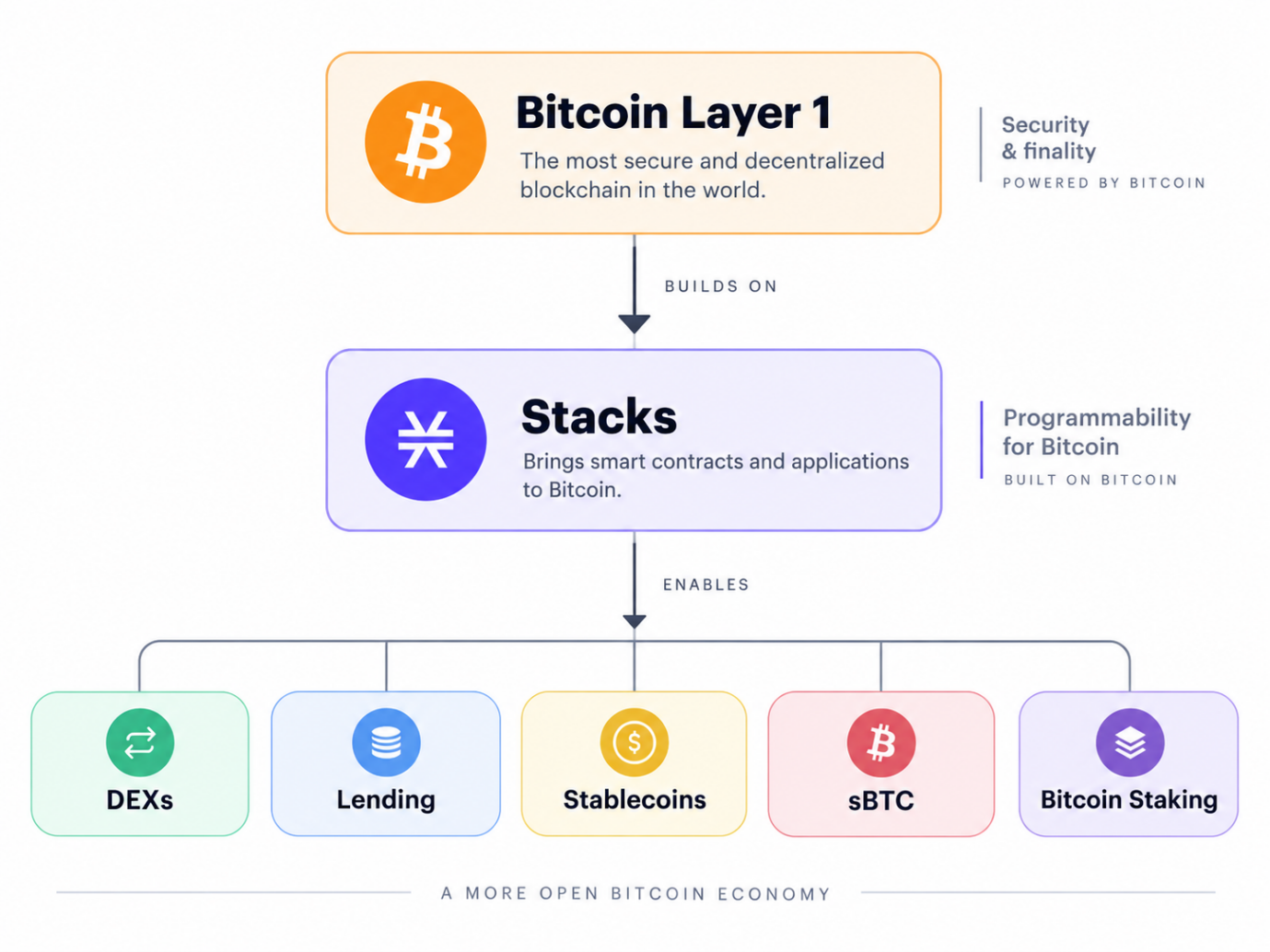
Developers can build exchanges, lending markets, stablecoins, Bitcoin-backed assets and other financial applications.
It works thanks to a system called Proof of Transfer, or PoX.
Stacks miners commit BTC for the right to produce blocks and receive newly issued STX.
The network then distributes that BTC.
Proof of Transfer has been running since January 2021 and has distributed more than 4,200 BTC, which Stacks estimates is worth more than $500 million at current prices.
Bitcoin Staking Is Now Live
On Sept. 10, Stacks launched its first institutional Bitcoin staking program, called the Genesis Bond.
The first participants were:
- 21Shares
- HashKey Cloud
- UTXO Management
- Sypher Capital
Together, they bonded 250 BTC. That’s not a huge amount in the grand scheme of things.
But this is the first live version of the product. So, I wouldn’t expect them to open the floodgates straight away.
What matters more at this stage is who is involved.
21Shares manages more than $6.5 billion across more than 60 crypto ETPs.
HashKey is one of Asia’s better-known regulated crypto groups.
And UTXO Management and Sypher Capital are professional crypto investors.
These aren’t four random wallets experimenting with a new DeFi product.
They’re elite crypto entities that have put actual Bitcoin into the system.
How It Works
The term “Bitcoin Staking” can be confusing because Bitcoin obviously doesn’t use Proof-of-Stake (PoS).
Stacks isn’t changing that.
Instead, the system uses two assets.
The Bitcoin stays locked on the Bitcoin network itself, while STX is locked alongside it on Stacks.
The BTC remains in a time-locked Bitcoin address controlled by the holder’s own keys.
It doesn’t need to be wrapped or handed over to a lender.
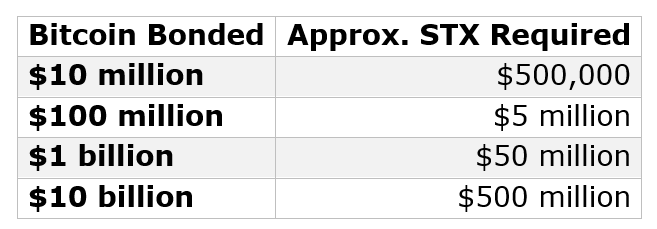
The participant then locks STX worth around 5% of the Bitcoin position.
So, if somebody bonds $1 million worth of BTC, they would need around $50,000 worth ofSTX alongside it.
The bond lasts around six months, and rewards are paid weekly in BTC.
The initial target yield is around 3% annually, which works out to roughly 1.44% over a six-month bond.
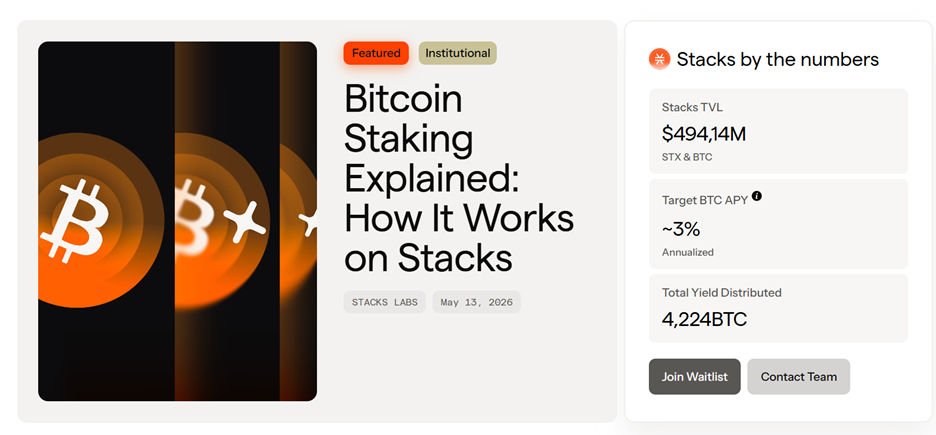
That yield isn’t guaranteed. It depends on how much BTC Stacks miners commit to the system.
What I like about the structure is where the reward comes from.
The Bitcoin isn’t being loaned out.
There isn’t a company taking your BTC, investing it somewhere else and promising to pay you interest.
The rewards come from BTC committed by Stacks miners through Proof-of-Transfer.
That doesn’t remove every risk. But it does create a cleaner structure than many of the yield products I’ve seen in crypto over the years.
The Next Step Is Building Real Usage
Getting Bitcoin into the ecosystem is only half the job.
Stacks also needs places for that Bitcoin to go.
Its new Stack Sats program will distribute one BTC per month for three months across Bitflow and Zest.
Bitflow is a decentralized exchange, and Zest is a lending protocol.
The idea is to build deeper liquidity around markets such as sBTC/USDCx and STX/USDCx.
The program began on Sept. 16 and will run until Dec. 10.
I wouldn’t read too much into a sudden spike in activity while those incentives are running.
We have seen that plenty of times in crypto already:Pay people to use a protocol, and activity goes up.
The test is what happens when the rewards stop.
If liquidity and users stick around, then Stacks may be building something durable.
If activity drops when the incentives leave, most of that growth was rented.
If you’re interested in putting your BTC to work, Stacks should be on your radar. But the cautious approach would be to wait until this testing phase is over before you commit your capital.
You’ll want to see user activity continue after that before you hop in.
Another Way to Play
Every Bitcoin bond requires STX worth around 5% of the BTC being bonded.
So if more Bitcoin enters the system, more STX needs to be bought and locked alongside it.
None of that guarantees STX goes up in price.
But it does create a direct link between product growth and demand for the token.
STX is also used to pay network fees and can be locked through the existing Stacking system to earn BTC rewards.
So, there are now three main demand drivers for this new crypto:
- Network fees
- Traditional Stacking
- Bitcoin bond capacity
Stacks estimates annual STX emissions are currently around 2%.
That means demand still needs to grow faster than new supply.
If usage stays flat, the tokenomics won’t save the price.
But if Bitcoin Staking starts to attract serious capital, that 5% requirement could become increasingly important.
For growth investors willing to take on more risk, a small STX position may be worth considering for your portfolio.
Best,
Mark Gough
P.S. The 3% APY Stacks can offer on your Bitcoin is incredible considering most BTC sits idle. But it’s not a strategy designed to bring a windfall.
For that, you’ll want to check out my colleague Nilus Mattive’s latest briefing, The Friday Income Machine.
In it, he explains his system which helps him target payouts of $1,000 … $2,000 … $4,000 or even more every week.
You can learn more about it for free right here.