Bitcoin Wallet Security: The Big Lesson from the Coldcard Hack

 |
| By Mark Gough |
For years, Bitcoin (BTC, “B+”) investors have been told the same thing: The safest way to store their crypto is get their coins off exchanges, use a hardware wallet and hold their own keys.
Our own team has recommended the same multiple times. Because, in most cases, that remains the gold standard of crypto security.
Leaving meaningful Bitcoin balances on an exchange means trusting someone else with your wealth. If that exchange freezes withdrawals, gets hacked, mismanages customer funds, or collapses, you may quickly find out that the Bitcoin you thought you owned … was never really under your control.
Crypto natives learned that lesson the hard way through FTX, Celsius, and several other failed platforms.
But the recent Coldcard security failure shows the other side of the argument: Self-custody is powerful, but it is not a magic shield.
It gives investors control, but it also places more responsibility on the person holding the coins.
The Coldcard Hack
More than $130 million worth of Bitcoin is now estimated to have been stolen from wallets linked to vulnerable Coldcard firmware. In the first major wave, roughly 1,083 Bitcoin was moved from 1,196 addresses in just 41 minutes.
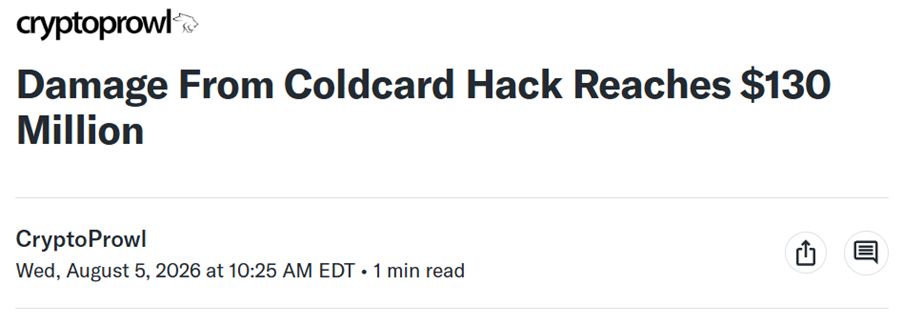
Source: Yahoo! Finance1
This was a serious failure. But here’s the truly uncomfortable part: Many affected users appear to have been doing what Bitcoin investors are usually told to do.
They had taken their coins off exchanges, used a respected Bitcoin-only hardware wallet and kept their recovery phrases offline.
Yet the weakness appears to have been there from the moment some of those wallets were created.
The Weak Point Was the Seed
A Bitcoin wallet is only as strong as the private key behind it.
Most people experience that private key as a 12-word or 24-word recovery phrase. Those words are the master key to the wallet. Lose them, and you may lose access. Let someone else get them, and they can move your coins.
That is why the way those words are created matters so much.
If the seed is weak, the entire wallet is weak.
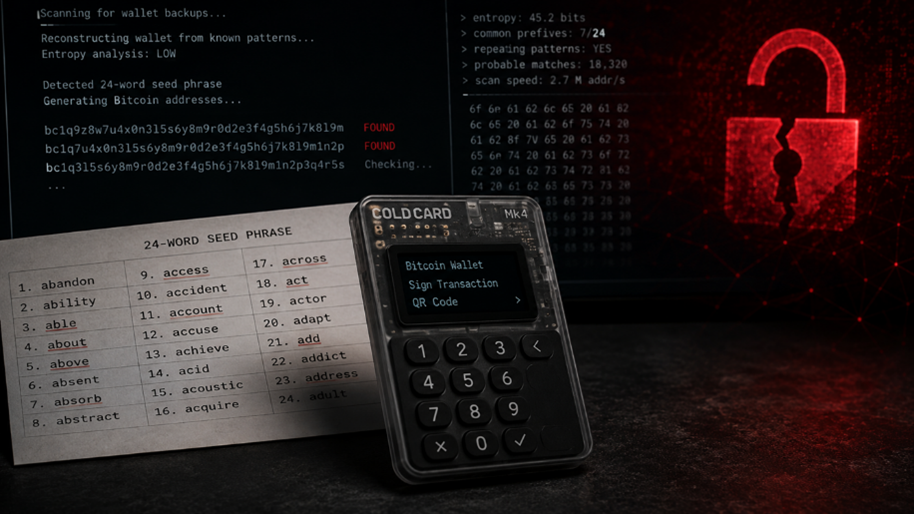
For a wallet to be secure, the recovery phrase must be generated with extremely strong randomness. In plain English, it should be impossible to guess because the number of possible combinations is so large.
The Coldcard issue appears to have come from older firmware versions that, under certain conditions, relied on a weaker random-number generator than users believed they were getting.
So from the owner’s point of view, everything may have looked normal. The device worked, the recovery phrase looked fine, the wallet generated addresses and Bitcoin could be received and held as usual.
But behind the scenes, the seed may not have been as random as it needed to be.
Imagine it like the lock on your a door: No one needed to break in. They already had the keys. All they needed to do was find the door that fit the key then check if there was anything worth stealing inside.
That’s exactly what happened. These attackers searched through possible weak seeds, checked whether any related Bitcoin addresses held funds and moved the coins once a match was found.
From the Bitcoin network’s point of view, those transactions were valid because they were signed with the correct key.
That is the hard truth of the network. Bitcoin does not know whether the person signing a transaction is the rightful owner or an attacker who managed to recreate the key. It only knows whether the key is valid.
That is part of Bitcoin’s strength, but it is also part of the risk.
This Is Bigger Than One Wallet Brand
It would be easy to dismiss this as a Coldcard-only issue and move on.
But I do not think that is the right lesson.
The bigger lesson here is that control, security and simplicity are not the same thing. Self-custody comes responsibility. And each user must be honest about what that involves.
Holding your own keys removes exchange risk, but it does not remove trust completely. You still need to trust the hardware manufacturer, the firmware, the process that created the seed and your own ability to store backups safely.
You are also trusting yourself not to make a mistake when updating, restoring, or moving funds. And to maintain your wallet’s hygiene if it has ever been connected to a DeFi platform.
That does not make self-custody a bad idea, far from it. “Not your keys, not your coins” is still one of the most important rules in Bitcoin. I still believe that.
The problem is that people sometimes treat it as the end of the security conversation. Many investors, in fact, still treat a hardware wallet as a complete security plan in itself.
It is not.
It is just one part of what should be a larger plan.
Updating Firmware Is Not Enough
A firmware update can fix how future keys are created. But it cannot go back in time and repair a recovery phrase that may already have been generated under weak conditions.
That is why updating the device alone may not solve the problem.
If the recovery phrase was created during the vulnerable period, the risk may already be sitting inside that seed. The safer option is to create a completely new wallet using corrected firmware, then move the Bitcoin to fresh addresses.
But this is also where people need to be very careful.
After every major crypto hack, scammers pile in straight away. Fake support accounts appear, fake wallet checkers get shared and fake migration tools start doing the rounds. All pretending to help people protect their coins.
Do not type your recovery phrase into any website. Not to check it. Not to verify it. Not because someone on X claims it is the official tool.
That is usually how the second wave of losses begins.
Steps to Improve Your Own Security
The Coldcard hack is not an argument against self-custody.
Instead, it should be a reminder that buying a device, writing down 24 words and assuming the job is done can be risky without proper security practices.
For smaller balances, a good hardware wallet with updated firmware may be perfectly fine.
For larger balances, relying on a single device, a single seed phrase and a single manufacturer starts to look like a single point of failure …
The very reason centralized exchanges are considered risky places to keep your crypto.
Here’s the key for investors: The bigger the position, the more serious the security setup needs to be. A few hundred dollars' worth of Bitcoin does not require the same protection as a life-changing balance,
For those larger balances, investors may want to consider a multi-signature (multisig) wallet.
These can require two out of three separate keys before Bitcoin can move. Those keys can be created on different devices and stored in different locations.
In short, it means one compromised device or seed phrase does not automatically compromise the entire balance.
There are trade-offs, of course.
Multisig adds complexity. That complexity can become its own risk if not managed properly. Lose access to the wrong backup, misunderstand the setup, or make a mistake during recovery and you may create the very problem you were trying to avoid.
So, this is not a blanket recommendation. Just a warning that Bitcoin security should grow with the size of the position.
The more valuable the holding becomes, the less comfortable investors should be with one point of failure.
That is just common sense.
The Real Lesson
Bitcoin itself was not hacked.
The network did what it always does. A valid key signed a transaction, and the transaction moved. If you control the key, you control the coins. If someone else gets that key, the network will not protect you.
That is the beauty and the brutality of Bitcoin.
And it’s why this Coldcard story matters.
Self-custody remains one of Bitcoin’s biggest strengths. But it’s a responsibility that should not be treated lightly.
A hardware wallet is usually a far better option than leaving serious money on an exchange, but it is not a magic box.
The device matters.
The firmware matters.
The way the seed was created matters.
And the way you back it up matters.
For most Bitcoin investors, this is not a reason to panic. It is a reason to review the setup.
Check your setup. Understand where the weak points are. And if your Bitcoin position has grown into something meaningful, treat security with the same seriousness you treat the investment itself.
Because with crypto, protecting the upside starts with protecting the keys.
Best,
Mark Gough
1 https://finance.yahoo.com/markets/crypto/articles/damage-coldcard-hack-reaches-130-142500652.html