Blockchains Vs. Corpo Chains: How to Spot the Real Crypto Infrastructure Play

 |
| By Beth Canova |
In 2022, Maersk and IBM (IBM) shut down a project they spent five years building.
It was called TradeLens. And it was meant to be a blockchain for global shipping — every container, every port, every handoff would be recorded on a single immutable ledger.
That seems right in line with the trend your Weiss crypto experts have identified recently: Crypto’s Infrastructure Has Expanded onto Wall Street.
More and more, institutions are turning to crypto technology to solve emerging modern financial problems. Juan Villaverde even said last week to Bet on the Plumbing When Crypto & Wall Street Collide.
And yet, Maersk and IBM shut down their own blockchain years ago.
They weren’t alone, either. The same year, the Australian Securities Exchange wrote off more than $250 million AUD on its own blockchain migration.
Six years of development. Gone.
To me, these failures were more than just examples of “right idea, wrong timing.” And they weren't bad implementations of a good idea.
They were predictable failures of the wrong idea.
Which means, as investors, they can teach us a lot about what to avoid going forward.
What’s in a Blockchain?
Before we start, we first have to know what we're actually talking about when we say "blockchain."
There are two kinds.
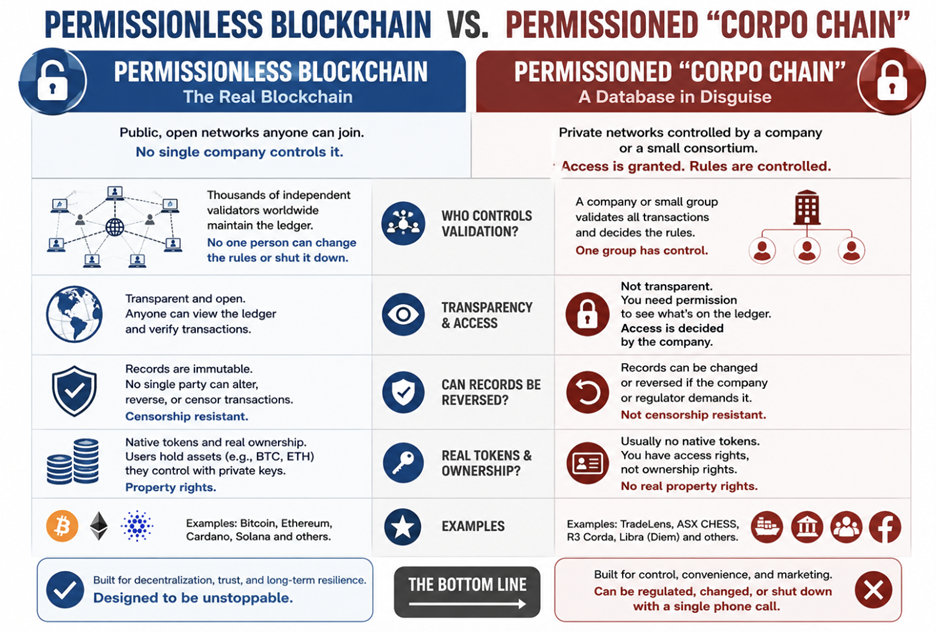
The first is what most people think of when they think of crypto: a public, permissionless ledger that contains verifiable and transparent records of every transaction conducted on the network.
No single company controls it. Thousands of independent validators worldwide maintain the ledger.
That means no one person can change the rules, reverse a transaction or shut the blockchain down. The community has to agree to every action.
Most cryptos you can think of — from Bitcoin (BTC, “B+”) and Ethereum (ETH, “B+”) to newer, more speculative plays — have this type of blockchain as their backbone.
The second kind is what most corporate blockchain announcements describe: a permissioned network.
Called “corporate chains” or “corpo-chains,” these are not transparent. You need to be given access to review what’s on the blockchain. And access is decided by a company or a small consortium. That group also validates all transactions and decides the rules.
The only similarity to real blockchains is that corporate blockchains are digital ledgers.
In short, they’re only similar when it comes to marketing. But not in any way that matters for the stability of the network.
That distinction is everything.
A Corpo-Chain’s Achilles’ Heel
A writer named Omid Malekan put it plainly: a permissioned network creates "a regulatory throat to choke." 1

With corpo-chains, governments don't need to fight the technology or spend months debating legislation. They just call the company that runs the tech … and that phone call ends the experiment.
It’s happened before …
- TradeLens shut down partly because the competitors Maersk needed on the platform didn't trust Maersk running the infrastructure. 3
- ASX's project collapsed under regulatory scrutiny and governance disputes. 4
Everything a blockchain is supposed to provide — records that can't be altered, a system no single party can override, censorship resistance — vanishes the moment one company controls the keys.
It's a database wearing crypto's clothing.
And the smart money has begun to realize it. The graveyard is long.
- TradeLens shut down 2022, after five years.
- The Australian Securities Exchange’s CHESS exchange was shut down with over $250 million AUD written off.
- R3 Corda was once backed by over 200 financial institutions. But in 2023, it cut 90 staff and has since explored a sale or strategic partnership after years of struggle to find real utility.
- Libra, Meta’s (META) attempt at a global digital currency, shut down under regulatory pressure in 2022 before it ever launched.
Each one failed for the same structural reason: The technology wasn't the problem.
The architecture was.
Any network with a company at the center can be regulated out of existence with a single conversation.
Takeaway for Investors
Some TradFi leaders have reviewed the data and learned before they invested too heavily in private digital infrastructure. JPMorgan (JPM) and Morgan Stanley (MS), for example, have both quietly abandoned launching their own private blockchains.
Sadly, not all institutions are learning this lesson at the same time. Some still plan to launch their own private blockchain and benefit from the marketing hype it’ll generate.
And if you as an investor can't tell the difference between the two, you'll overprice the wrong projects and miss the real winners.
The good news is there is a simple test to help you bet on crypto’s big infrastructure trend while avoiding corpo-chains.
The answers to these three questions tell you everything …
1. Who controls validation? Can a single company add, remove, or override validators? If yes, it's a controlled ledger. That's a database, not a blockchain.
2. Can past records be reversed under regulatory pressure? If a government calls and demands a transaction be rolled back, can that happen? On a public chain, the answer is no. On a permissioned chain, the answer is almost always yes.
3. Are there real tokens with actual ownership? Public blockchains have native assets — BTC, ETH, etc. — that users actually hold and can't be confiscated without the private key. Permissioned chains usually don't. Which means there are no real property rights, only access rights.
Fail any of those three, and you're looking at a cumbersome digital database … even if the word “blockchain” is used in the press release.
Bottom Line
Projects built on public, permissionless infrastructure are the ones likely to win the infrastructure race. Think chains like Ethereum, Solana (SOL, “B-”) and others like them.
This isn’t a philosophical preference. It's an architectural one.
The value of those systems comes directly from the fact that no one controls them, and everyone can trust what’s recorded in them.
Those are strengths that a corpo chain just can’t compete with.
I'm not going to tell you any specific crypto investment is a sure thing. Nothing in this space is.
But when you hear "blockchain" attached to a bank, a logistics giant, or a government initiative, I hope you ask the three questions.
Because they’ll reveal if you’re investing in a real infrastructure play, or if that institution is expecting you not to see the database hiding in a crypto costume.
Best,
Beth Canova
1https://x.com/i/article/2034637974239862784
2https://x.com/malekanoms/status/2034643631949152366
3https://wisechainconsult.substack.com/p/8-why-did-tradelens-failed-and-and