China's Chip Industry Gets a Boost from U.S. Trade Limits

 |
| By Jurica Dujmovic |
At the core of our modern tech revolution — which includes ever-advancing AI capabilities — are semiconductor chips.
Whoever controls chip manufacturing has their thumb on quite a few key sectors. Which is why the U.S. has been focused on slowing China’s access to advanced U.S. technology.
For South Korean chip makers who have factories in China, this policy used to be a small concern. Each could apply for special status that allowed them to continue to supply their Chinese factories while still doing business with the U.S.
But a shift last year changed the game. And potentially, the entire semiconductor supply chain.
Now, companies must apply annually for a special license to continue shipping U.S. tech into Chinese factories.1
An annual license is a very different planning horizon than a standing designation. And it means developing geopolitics have put South Korean chipmakers directly in the middle of this tug-of-war.
Companies like Samsung have begun to read the writing on the wall.
No Fire, But Plenty of Smoke
This isn’t your typical free market competition.
The specific fear is that future restrictions — from both Washington and Beijing — could extend past new tool sales to the servicing, repair and replacement of Western equipment,
The kind that Samsung and many other South Korean chip makers already have bolted to their factory floors in China.
Reuters reported Wednesday2 that Samsung Electronics and SK Hynix have been evaluating plasma etching equipment from the Shanghai-based Advanced Micro-Fabrication Equipment (AMEC) for possible use in their Chinese factories.
Put simply, these companies may begin to test whether a Chinese-sourced equipment to make chips is viable in their existing factories.
Samsung told Reuters it has not yet officially tested AMEC equipment for its China plant and had not considered doing so. SK Hynix also denied testing the tools for use in China.
Take both denials at face value, but don’t forget the grain of salt: The incentive they deny is still sitting there, and it is not going away.
Which means your tech and AI investments may have a twist coming soon.
One that every investor should be aware of.
The Threat Isn’t Chinese Hardware. It’s a Potential Supply Chain Shift
Chip-making tech like an etcher isn’t the same as buying hardware in other industries. Because each must go through a process of qualification that is unique to each factory’s own recipes, materials and yield targets.
So, the sale of a single unit isn’t the concern. What is worth noting is the commercial reference.
Once a Chinese etcher has cleared a Samsung or SK Hynix production line, other factories hold a data point they did not have before. And the vendor holds an international validation that no amount of additional research spending can buy.
Reuters notes that AMEC tools are already running at Yangtze Memory Technologies, and that this history is part of why the Koreans considered the systems mature enough to test at all. AMEC says that as of the end of June it had more than 8,800 reaction chambers in production across 220-plus lines.
Traditional export controls do not directly reach that dynamic. They only restrict what American companies may sell.
But they also can’t stop an Asian manufacturer from qualifying a Chinese tool inside its own Chinese factory as supply insurance.
The Scoreboard
China remains the largest single equipment market on earth.
SEMI3 put global semiconductor equipment billings at $135.1 billion in 2025. Of that, China accounted for just over a third of that total at $49.3 billion. But that number is essentially flat year over year. Meanwhile, Taiwan jumped 90% and Korea rose 26%.
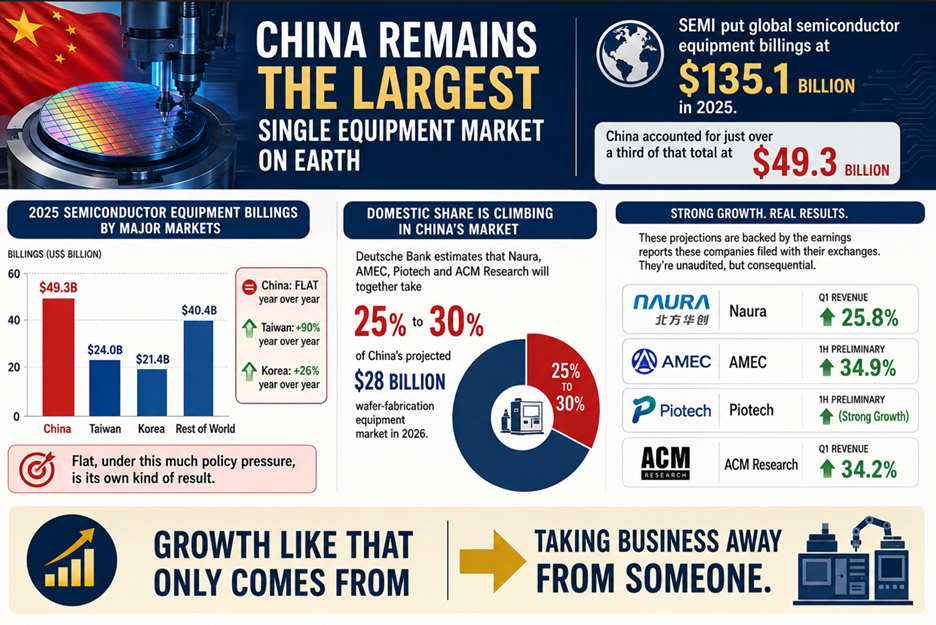
Flat, under this much policy pressure, is its own kind of result.
Inside that market, the domestic share is climbing.
According to Reuters, Deutsche Bank estimates that Naura, AMEC, Piotech and ACM Research will together take 25% to 30% of China's projected $28 billion wafer-fabrication equipment market in 2026.
These projections are backed by the earnings reports these companies filed with their exchanges. They’re unaudited, but consequential …
- Naura's revenue rose 25.8% in the first quarter,
- AMEC's preliminary revenue rose 34.9% in the first half,
- ACM Research (ACMR) reported revenue is up 34.2% in the first quarter.
Growth like that only comes from taking business away from someone.
The Exposure Screen
The useful public-market question is not whether Chinese equipment makers eventually compete. It is which Western vendors carry the most revenue from China … in the categories where Chinese alternatives are closest to qualification.
Those two variables together are the chart below:
|
Company |
Ticker |
Reported China exposure, each company’s own definition |
Core tool categories |
How close Chinese substitutes are |
|
Applied Materials |
AMAT |
26.4% of total revenue, quarter ended April 26, 2026. |
Deposition, epitaxy, CMP, ion implant, thin-film metrology |
Close in deposition and CMP, where Naura and Piotech already ship volume. Implant is the newer front. |
|
Lam Research |
LRCX |
26%, quarter ended June 28, 2026, down from 34% in the March quarter |
Etch, deposition, wet clean, plus the Reliant mature-node line |
Closest of the group. Etch is exactly where AMEC and Naura have spent a decade and where the Korean testing is reported. |
|
KLA |
KLAC |
26%, quarter ended June 30, 2026 |
Process control, defect inspection, metrology, reticle inspection |
Furthest away. Inspection and metrology remain the weakest link in China’s toolkit, alongside lithography. |
|
Tokyo Electron |
8035.T |
30.4%, quarter ended June 30, 2026. 34.1% for the year ended March 2026. |
Coater/developer (about 91% global share), etch, deposition, wafer probers |
Mixed. Coater/developer is contested by Kingsemi, which Naura has controlled since June 2025. Etch and deposition face the same pressure as Lam. |
|
ASML |
ASML |
14% of Q2 net system sales by destination. Management expects about 20% of full-year total net sales, a different base. |
EUV (extreme ultraviolet lithography) and DUV (deep ultraviolet lithography), optical metrology |
Least exposed. There is no commercial domestic alternative to EUV, and China’s domestic lithography effort remains well behind ASML in immersion DUV. The constraint here is policy, not competition. |
Sources: company filings and earnings releases (Lam, KLA, Applied Materials, Tokyo Electron, ASML). Geographic disclosures are not strictly comparable: some measure customer location, others shipment destination, and ASML’s quarterly figure covers net system sales rather than total revenue. The final column is an assessment and not reported company data. Tokyo Electron market-share figures are the company’s own, drawn from Gartner and TechInsights data.
Read the table sideways and the picture sharpens …
Applied Materials (AMAT) carries the largest absolute China dollar exposure of the three American companies listed above at $8.53 billion in fiscal 2025. And sits across both categories where Chinese alternatives are closest.
Lam (LRCX) and KLA (KLAC) both booked 26% of their revenues in China last quarter. But they’re not the same 26%.
Lam sells etch and deposition into the exact categories where Chinese suppliers have closed the most ground.4
KLA sells process control, where foreign competition has closed the least.
The Beneficiaries & the Access Problem
Naura Technology, AMEC and Piotech all benefit. But none are available directly through U.S. markets.
Broad China technology ETFs hold some of these names. But the funds overall were not built on this thesis, and exposure is heavily diluted.
That said, there is one way for a U.S. investor to get direct exposure: ACM Research.
It’s the odd one out as it’s the only beneficiary to this trend that’s listed directly on a U.S. exchange. First-quarter revenue was $231.3 million, up 34.2%,5 with full-year guidance of $1.08 billion to $1.175 billion.
But fair warning: Concentrated is not the same as clean.
Like any other investment riding a trend, the structure deserves a hard look before it can be treated as a simple proxy.
ACM holds roughly 74% of Shanghai-listed ACM Shanghai. That contributes the substantial majority of consolidated revenue and income, and it has approved a plan for a secondary listing in Hong Kong.
If that listing proceeds, it puts three jurisdictions of governance and disclosure around a single supply-chain thesis.
So, more exposure comes with more potential regulatory hurdles.
What to Watch Over the Next Three Weeks
ACM Research reports second-quarter results on Aug. 7.6 Applied Materials reports fiscal third-quarter results on Aug. 13,7 with revenue guided to $8.95 billion.
The number you’ll want to find on that call is not the top line. It is the China percentage. And whatever management says about the mature-node business there, which it has been describing as flat to slightly higher for the calendar year.
Beyond that, tech investors using this thesis should watch whether the 2026 annual licenses get renewed for 2027. And whether any Western vendor starts breaking out service and spares revenue in China as a separate line.
That last disclosure would be the tell you need that management in U.S. firms has started to worry about the same thing the Korean fabs are worrying about.
Bottom Line
Export controls have done their job at the leading edge.
Chinese fabs still cannot legally import EUV systems from ASML. And no commercially comparable domestic alternative has appeared.
But the controls have also converted a commercial question into a supply-security question for every manufacturer operating inside China.
Supply-security questions like this get answered by qualifying second sources. Because Washington has given the contenders a reason to be tested by the most demanding customers in the industry. And given those customers a reason to say yes.
Nothing is happening yet. Both Samsung and SK Hynix say they have not tested AMEC's tools. That may be true.
But somewhere in their management teams, the calculation that produced these evaluations has not changed: the licenses are annual now, the service question is unanswered, and a second source that Washington cannot switch off is worth having even if it is never switched on.
Export controls decided what American companies may sell. They did not decide what Korean manufacturers may keep in reserve.
For an industry so reliant on global supply chains, this is definitely a trend all tech investors should be mindful of.
Best,
Jurica Dujmovic
4https://cset.georgetown.edu/article/inside-beijings-chipmaking-offensive/