 |
| By Sean Brodrick |
The ceasefire deadline is almost upon us. With time quickly racing to April 21, all eyes are on the Mideast to see what will happen next.
But that meant many missed the copper catalyst China just dropped on the market.
And that’s a big deal for the AI narrative.
Let me explain …
China recently announced that, starting next month, it will halt exports of sulfuric acid.
The motivation behind the move ties directly back to the Strait of Hormuz. Sulfur is produced as a byproduct of oil and gas production.
The Persian Gulf states ship sulfur to China, where it is turned into sulfuric acid for all sorts of industrial uses.
Here’s where things get interesting. One of those industrial uses is in copper mining. Miners around the world use Chinese sulfuric acid in the leaching process to extract copper from oxide and lower-grade ore.
And copper is a key ingredient in powering AI datacenters.
Global Stress Zones
Nervous traders are watching three countries: Chile, the Democratic Republic of Congo and Zambia.
Chile is the world's largest copper producer. A fifth of its production relies directly on acid-intensive leaching.
The DRC and Zambia are even more dependent — 60% of their copper output relies on sulfuric acid leaching.
And 90% of the elemental sulfur that the DRC and Zambia use comes from the Middle East.
When combining these regions with other acid-starved hubs such as Indonesia and Morocco, 15% to 20% of the global primary copper supply is currently vulnerable to this chemical bottleneck.
And already, copper prices are heading higher, after bottoming in mid-March.
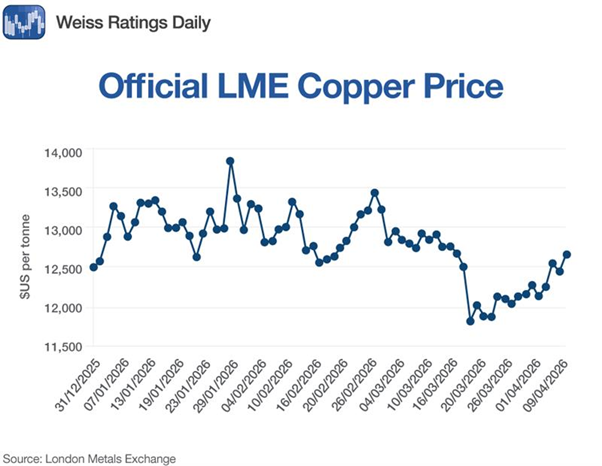
How this affects you: Copper is used in just about every industry. This lights a bonfire under inflation.
And this is only the latest force lining up to push copper prices higher.
Copper supply has been under pressure for years.
Ore grades are declining across major deposits, forcing miners to move more material just to maintain output.
At the same time, the pipeline of new projects is nearly dry.
Large-scale copper projects can take more than a decade to move from discovery to production.
Many of the remaining undeveloped deposits are more complex, more expensive or located in areas miners would prefer to avoid for political reasons.
Disruptions are increasing and demand is rising.
Recent years have brought a series of high‑impact disruptions:
- Geotechnical issues at large open pits,
- Water and power constraints in arid regions,
- Protest‑driven shutdowns in Peru,
- The closure of Cobre Panamá after a political backlash and
- Intermittent problems at big names like Grasberg and key Chilean mines.
That’s a problem as electrification (EVs, charging networks, renewables, grid upgrades) is structurally copper‑intensive and expected to drive a multi‑decade increase in demand.
And new demand is surging from AI datacenters, cloud infrastructure and energy infrastructure buildouts will only exacerbate the problem.
The Perfect Storm for Copper Prices
How far prices will go up depends on who you ask.
Senior analysts at CRU are targeting the $20,000 to $30,000 per tonne range.
As of April 10, copper was ranging from $12,600 and $12,900 a tonne.
Bank of America may be dragging its feet because analysts report that $15,000 per tonne is becoming the new “base case” for the second half of this year.
To be sure, a lot depends on how soon the Strait of Hormuz reopens. But even if it opens tomorrow, there are already huge disruptions working their way through the global supply chain.
And it may stay closed for a while. Within my lifetime, the Suez Crisis closed the Suez Canal for seven long years.
I’m not saying that will happen this time. I’m saying the market is still pricing for a quick resolution to the crisis.
How You Can Play It
I’m a TradFi guy. So, my natural instinct is to look to the Global X Copper Miners ETF (COPX).
It holds a global basket of miners, including Freeport-McMoRan, BHP, Southern Copper and Zijin.
Since miners are leveraged to the metal, this can amplify gains. It has an expense ratio of 0.65%.
Here’s a performance chart showing how COPX and copper have performed since the start of the year.
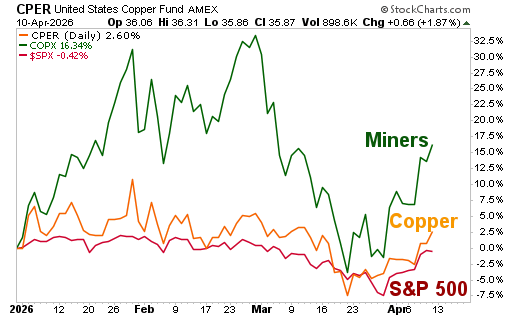
You can see miners are more volatile.
Both are outperforming the S&P 500.
I believe the most bullish days for copper are yet to come. And you’d be wise to hop on board as the metal hits the pedal!
But if you’ve been paying attention to your crypto experts, you know that tokenization is the trend that just won’t stop.
And this ETF has caught the bug. Now, you can gain access to COPX … right on the blockchain!
If you live outside the U.S., you can buy COPXon, an Ondo Finance (ONDO, “D+”) tokenized real-world asset of COPX.
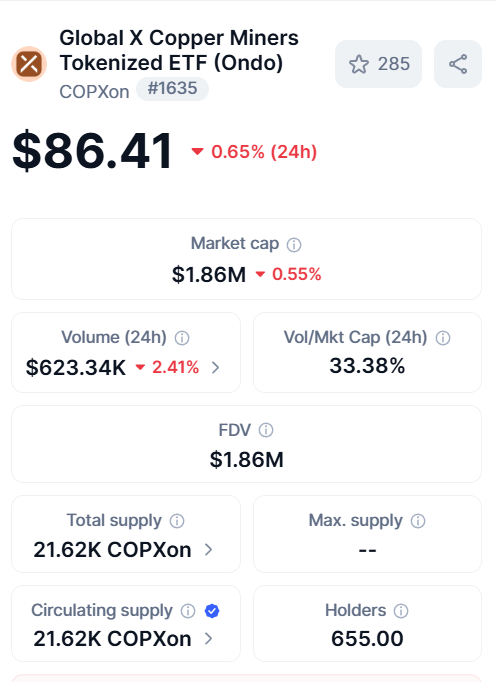
It tracks the price of COPX. But gives you all the benefits of trading on the blockchain.
Including the ability to trade when the TradFi markets are closed.
And, thanks to Ondo’s recent partnership, you can buy it directly through your MetaMask wallet.
For those of us who live in the U.S., though, we still have to wait to access tokenized opportunities like this.
But don’t worry, I have …
One More Thing!
Because a significant portion of the world's silver comes as a byproduct of copper mining, an “acid-starved” copper market will create a secondary supply shock for silver.
Copper isn’t the only metal that will power higher.
In fact, I already have selected seven metal miners in the best position for this bull rally.
You can come hear all about them tomorrow, Tuesday, April 21, at 2 p.m. Eastern. Here’s your ticket.
I can’t say if my picks will have tokenized alternatives. But I can tell you that all of them should be on your radar.
Which is why I hope you’ll join me tomorrow.
All the best,
Sean