 |
| By Bob Czeschin |
In last week’s column on the Iran crisis, I observed the operational expenses of America’s newly assembled Mideast naval armada.
It stands at a hefty $16 million a day.
And because of this, I said Trump would have very little patience with negotiations. Five days later, his patience ran out. And missiles started flying.
Based on the history of petroleum and prior Mideast wars, I also anticipated that oil prices would spike sharply.
And indeed, it has.
So far, no oil and energy infrastructure targets have been targeted, let alone destroyed. Even so, petroleum prices — which hovered in the low $60s per barrel last week — shot up to $72 and change over the weekend.
Gold made a somewhat lesser move, climbing from $5,250 to above $5,400.
Bitcoin (BTC, “B+”), however, blew right past gold. It rose roughly 9.8% from early Saturday morning to sit just under $70,000 at the time of writing.
What Comes Next
It has only been two days since the attack. But a lot has changed.
Supreme Leader Khamenei has become a casualty of war. And the upper echelon of Iran’s Revolutionary Guard Corps (IRGC) has been decapitated.
Iran fired back with hundreds of missiles and up to a thousand drones — against targets in Israel, Kuwait, Jordan, Iraq, Oman, UAE, Saudi Arabia and Qatar.
With the war underway, it’s time to reassess where it might lead. Starting with two key issues that are not yet being priced in by global investment markets.
1. Trump wants regime change in Iran. But Washington has a terrible record getting rid of regimes it doesn’t like.
- President Obama ordered the NATO-led ouster of Muammar Gaddafi, the brutal dictator who ruled Libya with an iron fist for 42 years. What followed was a 15-year civil war that sent thousands of refugees flooding into Europe in an epic humanitarian catastrophe. Meanwhile, Libya is still a failed state today.
- To rid Afghanistan of Taliban rule, President George W. Bush sent in U.S. troops and special forces. They bravely fought a bloody 20-year insurgency — with no visible result. Finally, President Biden pulled them out, leaving behind $2 billion worth of military equipment. And guess who rules Afghanistan today? The Taliban.
- In 1963, President Kennedy’s CIA assassinated South Vietnamese President Ngo Dinh Diem to install a more staunchly anti-communist military junta led by Duong Van Minh. But the war still dragged on another 10 years, with 58,200 American soldiers dead. And the communist North Vietnamese won in the end.
- President Jimmy Carter engineered the fall of the Shah of Iran in the late 1970s, after he became politically unpopular. This opened the door for the Ayatollah Khomeini and his murderous band of mullahs to seize power. And they’ve been in power ever since.
Now Trump wants the mullahs out. And history tells us U.S.-led regime-change efforts almost never work out as expected. Most of the time, they make things worse.
That said, the exiled son of the late Shah of Iran, Reza Pahlavi, wants any transition to be Iranian-led. He’s committed to leading the transition efforts to a new form of government, be that another constitutional monarchy (as was in place pre-1979) or a new democracy.
That’s a change from historical precedent … but also one with no guarantee of working.
Accordingly, the current war is very unlikely to culminate in a quick, clean fix.
2. Trump says Iran can never have a nuclear weapon. But it’s possible that the horse has already left the barn!
Iran didn’t develop nuclear power on its own. The Shah was a charter member of President Eisenhower’s “Atoms for Peace” program. And in 1967, President Johnson gave him a 5-megawatt research reactor and some uranium to run it.
U235 is the uranium isotope that fuels the fission reaction. But it occurs only in low concentrations in raw uranium ore. Which is why U235 content must be enriched to be useful.
Power plants need fuel that’s at least 3.7% U235. Concentrations above 20% are called “highly enriched.” 90% purity (or above) is considered weapons-grade.
Weapons inspectors from the International Atomic Energy Agency (IAEA) have not been allowed inside Iran since last year’s 12-day war. But here is their last snapshot of Iran’s enriched stockpile:
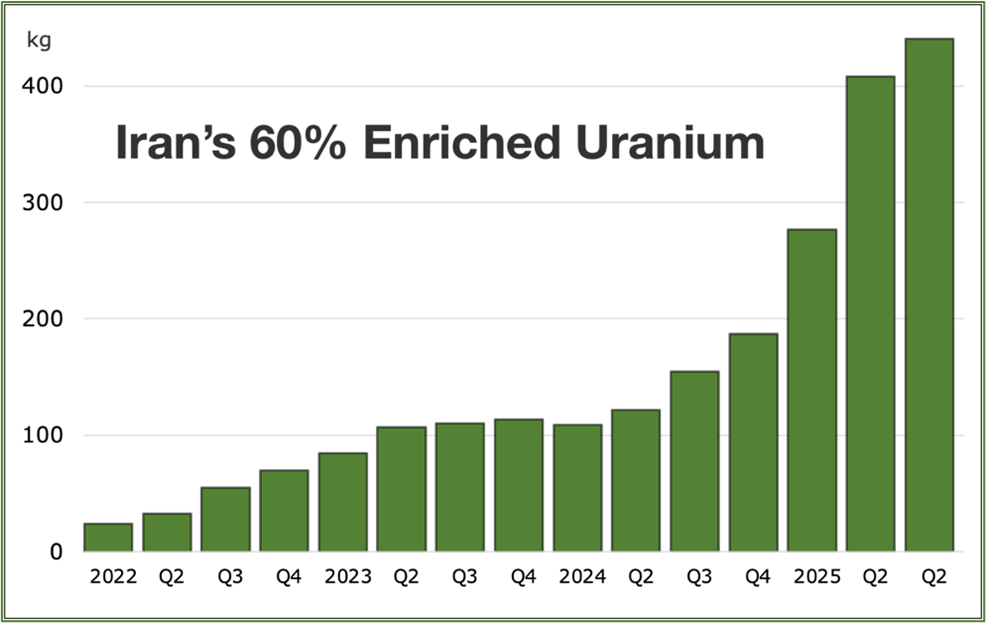
It shows Iran has amassed about 441 kilograms of uranium enriched to 60% — a more than 50% increase from February 2025. If enriched to 90%, that’s enough material to power around a dozen nuclear bombs.
This is what gets reported in the press. And it’s technically true. But it contains a deadly unstated assumption. Which is that 90% enrichment is the minimum required for a nuclear explosive.
The U.S. bomb that destroyed Hiroshima used only 80%-enriched uranium. And changed the course of 20th-century history.
According to the Bulletin of the Atomic Scientists:
The prevailing assertion that Iran needs “weapons-grade” uranium enriched to at least 90% uranium 235 to build a nuclear explosive device — widely repeated by government officials, the media, and commentators alike — is simply wrong.
Its 60%-enriched uranium may not be “weapons-grade.” But it is surely “weapons usable.”
Bombs made directly from 60%-enriched uranium would be bulkier and heavier. They’d also have a smaller explosive yield than 90%-enriched uranium. But they can still be effective and reliable.
Moreover, such a warhead using the same gun-type trigger used at Hiroshima would be inconspicuous to make.
Engineering such a bomb to fit atop an intermediate-range ballistic missile (IRBM), however, would be a technical challenge. But almost anyone could load it on a cargo plane. Hide it inside a shipping container. Or even deliver it by truck or van.
Investment Implications
That neither of these two issues has yet to be priced in by global investment markets creates opportunities for far-sighted investors.
To be clear, I am not celebrating the outbreak of yet another war. Nor the instability it’ll bring to daily life in the region and to the already tense geopolitical framework.
But we don’t get to pick our reality. And the markets will continue to do their thing no matter how we feel about it.
The question is whether you stand idly by … or if you make the most of the situation we’re given.
The longer this war drags on, the greater the temptation on both sides to start blowing up oil and energy infrastructure. And in this respect, the Mideast is truly a target-rich environment.
That’s why the last time Iran fought a major war, oil prices shot up 4x.
So, as an investor, you may want to consider adding some exploration and production (E&P) company stocks to your portfolio, such as the Oil & Gas Exploration & Production SPDR (XOP).
XOP buys U.S. stocks in the S&P Oil & Gas Exploration & Production Select Industry Index. E&P companies give you maximum exposure to higher oil prices.
If you live outside the U.S. and have access to more real-world asset services, you may consider adding tokenized oil exposure to your crypto wallet.
Ondo Finance (ONDO, “C+”), for example, offers its United States Oil Fund (USOON, Not Yet Rated). This is a blockchain-based token representing ownership in the United States Oil Fund (USO) and offers exposure to oil price movements.
But, as I said, this isn’t available to U.S. residents just yet.
One further refinement: If possible, concentrate on quality regional oil and gas producers. In the Americas, Australia or the North Sea.
In other words, far enough away from Mideast turmoil to be effectively immune from collateral damage.
In this respect, Weiss Ratings Plus may have some tools you can use to fine-tune your search.
And what if Iran already has a few crude nukes made with 60%-enriched uranium and equipped with World War II-era triggering technology?
Exploding one or two of them would surely set off a geopolitical tsunami of unimagined magnitude. And the last refuge for a world in existential turmoil … would be gold and Bitcoin.
Both of which you can hold securely in your own self-custody crypto wallet.
And with Juan Villaverde’s Crypto Timing Model suggesting a key, 320-day cycle low is likely in, BTC’s current price could be seen as an excellent entry point.
Best,
Bob Czeschin