Congress Not Needed for Crypto’s Next Regulatory Breakthrough

 |
| By Mark Gough |
I’ve spent most of this year tracking how crypto regulation is shaking out in the U.S. And the CLARITY Act has been the main storyline.
It’s the bill that would finally give the industry a real market structure, set clearer boundaries between the SEC and CFTC and tell everyone where digital assets actually fit under U.S. law.
But getting the bill passed in the Senate is proving to be a problem.
Lawmakers left for the August recess without voting on it. That pushes the next real test to Sept. 15, when the chamber holds a cloture vote that needs 60 votes.
Republicans can’t get there without Democratic help. But with midterms looming, the calendar is working against them.
Which means the window for passing CLARITY this year is getting narrower.
But while everyone is watching Congress, the SEC is quietly doing something on its own: This Friday, Aug. 14, the SEC has an open meeting to consider proposing new rules for crypto companies raising capital in the U.S.
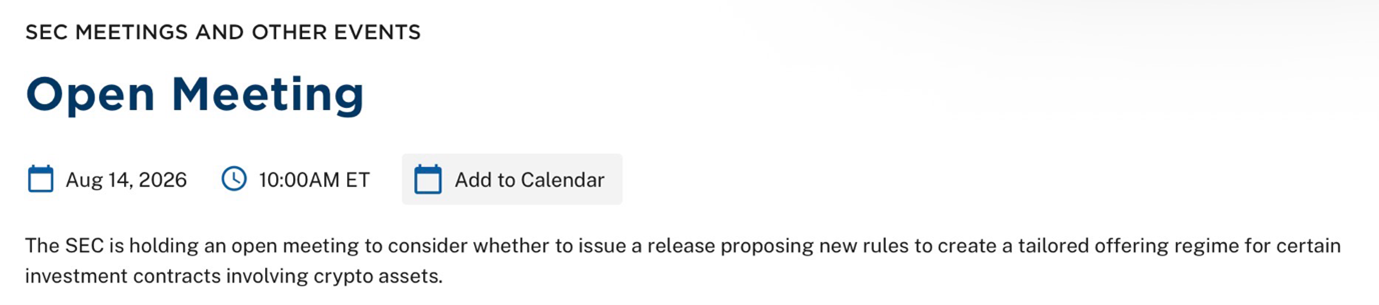
The SEC describes it as a “tailored offering regime” for certain investment contracts involving crypto assets.
We don’t have the full text yet, but it looks like the next step in the framework Atkins laid out in March under the banner “Regulation Crypto Assets.”
And some of the ideas he discussed back then could be a big deal for the industry.
The Safe Harbor Could Be the Most Important Part
SEC Chair Paul Atkins sketched out three potential routes for crypto companies raising capital:
- a startup exemption,
- a larger fundraising exemption,
- and an investment contract safe harbor.
The numbers he floated were notable.
Under the startup exemption, projects could potentially raise up to $5 million over four years with basic disclosures about the project and underlying asset.
A separate exemption could allow projects to raise up to $75 million in a 12-month period, with additional disclosure requirements.
To be fair, these aren’t final numbers. And we won’t know what survives into the actual proposal until we see it.
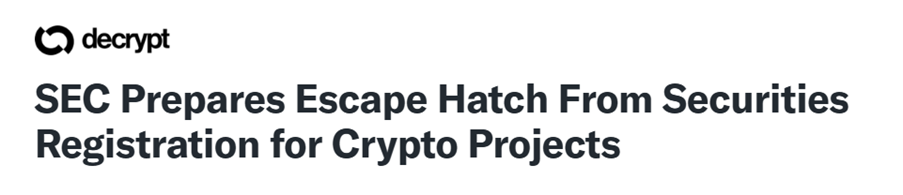
But that’s why I see the safe harbor as potentially the most consequential part. Because it gets at a question that has hung over the industry for years …
What happens to a token after the original investment contract has run its course?
The implications can seem vague, so let’s use a hypothetical: Imagine a team wants to build a new blockchain.
They need money for developers, infrastructure and to get the network off the ground. So, they sell tokens to early investors. Those investors are backing the team to deliver something valuable.
That sale can fall under securities law as an investment contract.
Now, fast forward a few years: The network is live. People are using it. Validators are securing it. Developers are building on top of it.
And the token is being used to pay transaction fees or access services. Once the network is built and the team has delivered what it promised investors, should future sales of that token still be treated as part of the original investment contract?
This is where the lack of a clear regulatory framework became a problem.
Ripple is probably the best-known example. It’s the company behind the token XRP (XRP, “C+”). And institutional XRP sales were found to be investment contracts, while its programmatic sales of XRP through exchanges were not.
The SEC has since acknowledged that a crypto asset that isn’t itself a security can still be sold as part of an investment contract, and that the investment contract can eventually come to an end.3
Atkins wants to put some actual rules around that process.
Why This Matters for Crypto Projects
Regulatory uncertainty has had a predictable effect: Projects avoided America.
And that’s been the reality for a few years now.
Token launches exclude U.S. investors …
Exchanges refused to list certain assets …
Some platforms geoblock American users …
And companies set up overseas foundations because no one could confidently say how regulators would ultimately treat their tokens.
These exemptions are real attempts to remove that uncertainty in ways that can meaningfully change how and where projects develop.
To be clear, however, Atkins isn’t proposing an oversight-free free-for-all. Projects using these exemptions would still have disclosures to make and rules to follow.
The difference is that they would know those rules before raising money.
And if the safe harbor works as Atkins described in March, projects could have a defined route beyond the original investment contract once the issuer has completed, or permanently stopped, the essential work it originally promised investors.4
For projects that have spent years wondering where that regulatory line sits, this is a major change. One that could also make the U.S. a far more attractive place to build and fund crypto projects.
What About CLARITY?
None of this makes CLARITY irrelevant.
There are limits to what Atkins can do with the SEC’s existing authority. Especially regarding the broader market structure … and the point at which SEC jurisdiction ends and the CFTC’s begins.
Atkins has been upfront about that.
In March, he said Congress is ultimately needed to make the framework durable, and that his Regulation Crypto Assets framework would draw heavily from the work already done on the CLARITY Act.5
So, the SEC isn’t trying to replace Congress. Rather, it’s attempting to handle what it can while Congress grinds through the bigger legislation.
What I’m Watching on Friday
We’ve already seen a very different SEC emerge this year.
The Commission has changed its approach across several areas of crypto. Most importantly, it acknowledged that most crypto assets aren’t themselves securities.
Friday could take us another step further.
If the SEC votes to release the proposal for public comment, I’ll be looking closely at what’s actually in it.
Those details will tell us whether this is a relatively narrow fundraising reform … or something much more important for the U.S. crypto industry.
We’ll know a lot more on Friday.
Best,
Mark Gough
P.S. Clearer regulations don’t translate directly into upward price momentum. But they do build a stronger foundation from which crypto prices can rally when the time is right.
When will that be?
Without a crystal ball, we can’t say for sure. But Juan Villaverde’s Crypto Timing Model has accurately called the major lows and peaks for the past three cycles. Along the way, it’s helped his Weiss Crypto Investor members outperform the broad market.
And now, Juan says it’s showing him the next best buy opportunity in 2026.
1https://www.sec.gov/newsroom/meetings-events/open-meeting-081426