Crypto Begins to Welcome the Most Conservative Capital in the World
 |
| By Mark Gough |
For successful assets, there comes a point in their journey where they move from being seen as speculative to being strategically relevant.
When it comes to crypto, though, early signs of this change won’t come from hedge funds or venture capitalists.
It’ll come from pension funds and global policy.
And this week, two developments in different corners of the world — Australia and South Korea — show that retirement capital is moving from early exposure to broader integration with crypto. All while global policy is adapting to keep capital from leaving it.
Australia: A $105 Billion Institutional Signal
In Australia, the change is coming from within the system.
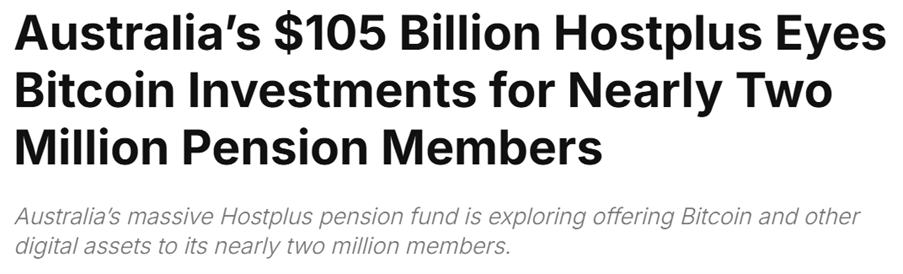
Hostplus is one of the country’s largest superannuation funds. Now, it’s exploring how to offer Bitcoin (BTC, “B+”) and other digital assets to its nearly two million members.
With over $150 billion AUD — around $105 billion USD — under management, it’s a meaningful step from a major institutional player.
And the driver is simple: Demand.
Members — particularly younger ones — are increasingly asking for access to crypto within their retirement accounts.Instead of ignoring that demand, Hostplus is working on a way to provide it in a controlled, structured way.
Of course, that doesn’t mean crypto will be added to default pension allocations. It’s being introduced in a contained, opt-in environment where individuals choose their exposure.
Specifically, through Hostplus’ ChoicePlus platform, a self-directed investment option that currently accounts for about 1% of total assets.
That’s how institutions approach new asset classes.
They don’t jump in all at once. They build access carefully.
There are also early signs that the fund is thinking beyond Bitcoin, with potential exposure to a broader range of digital assets and even tokenized alternatives.
That tells me this isn’t a company jumping on the crypto bandwagon without a plan. Rather, asset managers are working to see how digital assets might fit into future portfolio construction.
Zoom out, and the scale becomes clear …
Australia’s superannuation system manages roughly $4.5 trillion AUD ($3.1 trillion USD), with projections indicating it could reach $5.7 trillion AUD, or $3.9 trillion USD, by 2030.
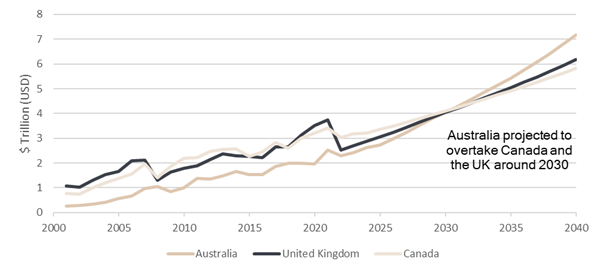
If even a small percentage of that begins to flow into digital assets, the impact won’t go unnoticed.
South Korea: When Capital Forces Policy to Adapt
While Australia is seeing demand build within the system, South Korea is dealing with the consequences of capital moving first.
South Korea remains one of the most active crypto markets globally, with a deeply engaged retail base and a history of driving meaningful trading volume. And if liquidity starts to drain from a market like that, the effects are immediate.
That’s why lawmakers have introduced a bill to scrap the country’s planned 22% crypto capital gains tax. This comes after multiple delays pushed the date this law would go into effect all the way back to 2027.

The reason is straightforward — an estimated $110 billion has already moved offshore. Investors positioned themselves ahead of the tax by shifting funds to foreign exchanges and private wallets.
At that scale, the conversation changes quickly.
This isn’t about encouraging speculation. It’s about stopping capital from walking out the door and bringing back the activity that did leave.
This taught policymakers a tough lesson: If capital doesn’t like the rules, it leaves. And in crypto, it can leave faster than in any other asset class.
The Bigger Picture: A Global Shift Underway
On their own, these stories might seem unrelated. But they aren’t happening in a vacuum.
Together, they point to something much more important: A structural change in how capital is positioning around digital assets.
In the U.S., access to crypto in retirement accounts is gradually expanding through regulatory changes and ETF structures. At the state level, legislation is emerging that allows pension funds to gain controlled exposure.
In Japan, tax reform discussions are moving toward treating crypto more like traditional financial assets. That lowers the barriers to entry that previously discouraged participation.
Across regions, the direction is consistent:
- Access is improving
- Rules are becoming clearer
- Barriers are being reduced
It’s not happening overnight. But it is happening everywhere.
What Most Investors Miss
It’s easy to get caught up in short-term price action. But those are surface-level signals.
What matters more is what’s happening underneath.
Pension funds don’t behave like traders. They move slowly — through committees, frameworks and risk controls. They need clarity before they act.
But once they do, they don’t trade in and out.
They allocate.
And that’s why this phase matters.
These are the rails that allow long-term capital to enter the market. And once that capital comes in, it tends to stick around.
Market Context: Sentiment vs Reality
Right now, the market feels cautious.
Bitcoin is hovering in the low $70,000 range, and sentiment remains firmly in extreme fear territory.
From a short-term perspective, that reflects uncertainty and defensive positioning.
But at the same time, some of the largest pools of capital in the world are quietly figuring out how to gain exposure to the same asset class.
That disconnect is worth paying attention to.
Because markets often reflect emotion in the short term, while structural shifts play out much more slowly in the background.
Final Take: This Is the Shift That Matters
Forget the daily noise.
This is the signal that matters: The most conservative capital in the world is starting to scale into crypto.
In Australia, that shows up as retirement systems expanding access.
In South Korea, it shows up as policymakers adjusting to keep capital from leaving.
Different drivers, same direction.
This is how an asset class matures. Not through hype, but through alignment between capital, infrastructure and regulation.
Pension funds don’t chase trades.
They build allocations.
And once those rails are established, capital tends to become persistent and rarely reverses.
Best,
Mark Gough
P.S. While crypto’s path forward may not always be easy to see, history tells us that increased clarity and access are boons for burgeoning sectors.
And AI is one of those sectors. Like crypto, it is still in its early stages with massive future potential ahead.
In fact, my colleague Michael Robinson has been following the AI advance since its earliest days. He was talking about Nvidia and LLMs long before they became dinner table talk. (He also got into BTC back when it traded near $300, so being early is nothing new to him.)
And, with the help of his Breakout Signal, he’s been able to target 100% gains or more on some of the best AI stocks.
Now, his Signal says the next big opportunity in AI is about to get underway. And it has identified three stocks you should watch.
You can learn their names and what Michael says is ahead for AI in his upcoming briefing on Tuesday, March 31, at 2 p.m.