 |
| By Mark Gough |
If you were around crypto in 2017, you will remember the ICO boom.
Initial coin offerings were everywhere. A project could publish a white paper, launch a website and raise millions of dollars by selling tokens directly to the public.
Sometimes, there wasn’t much more to it than that.
No working product. No revenue. No users. And, in some cases, no clear explanation of why the token needed to exist in the first place.

The idea behind ICOs was powerful.
For the first time, ordinary investors could gain early exposure to emerging crypto networks. You didn’t need to work for a venture capital fund or know the founders. Anyone with a crypto wallet could participate.
Some important projects emerged from that period. Plenty more simply disappeared.
Eventually, the market became flooded with questionable token sales. That’s when regulators stepped in.
What Happened to the ICO Market?
The 2017 ICO boom gave crypto projects a completely new way to raise capital.
Instead of approaching venture capital firms and negotiating privately with professional investors, a project could go directly to its future users.
Investors bought tokens because they expected the network to grow and those tokens to become more valuable. The money raised could then fund development, hire developers and attract users.
In theory, it turned a project’s future community into its earliest financial backers.
Interestingly, TradFi made a similar push back in 2012 with the JOBS Act1 — a piece of legislation that makes it easier for small, private businesses to fundraise … and allow retail investors in under specific requirements.
And that regulated pathway was key.
That’s what allowed the JOBS Act to stand the test of time — and work to the benefit of my colleague Chris Graebe and his Deal Hunters Alliance members.
The 2017 ICO boom, on the other hand? It saw the market grow far faster than the rules around it. Projects raised enormous sums with inconsistent disclosures and few meaningful investor protections.
Some teams were genuine. Others took advantage of the excitement.
The SEC’s July 2017 DAO Report2 marked an important turning point: The agency concluded that tokens sold through certain fundraising arrangements could constitute investment contracts.
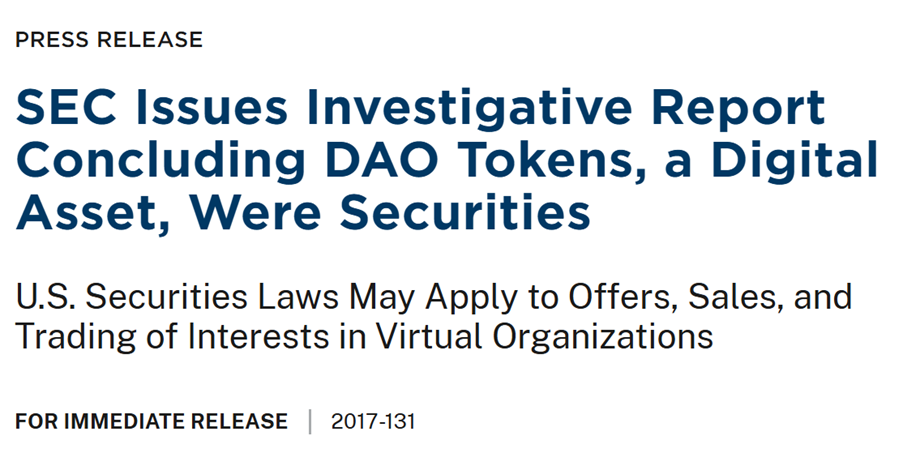
That decision brought ICOs under U.S. securities laws.
That did not mean every crypto token was automatically a security. But it meant you couldn’t get away with simply calling a new coin a “utility token” and hope no one would notice if it didn’t actually do anything.
Investors now had the expectation that the development team would work to make its token more valuable.
The uncertainty that followed changed crypto fundraising.
Many projects moved offshore. The ones that stayed chose to raise privately from venture capital firms. Some even avoided U.S. investors altogether.
The ICO did not disappear.
But early access increasingly shifted away from ordinary investors and toward professional funds and insiders.
By the time many tokens reached public exchanges and became available to the average Joe, prices typically were much higher than what early investors were already sitting on.
The SEC Is Proposing a New Route
Crypto regulation has come a long way since 2017. And while it still has far to go — especially with the CLARITY Act still in limbo — we may not have to wait long for the spotlight to shine on IPOs again.
Mostly because of the SEC’s newest proposal — Regulation Crypto Assets, or Reg-CA.3 It would create new fundraising exemptions specifically for certain investment contracts involving crypto assets.
The first is a startup exemption.
A qualifying project could raise up to $5 million over four years without completing a traditional registered securities offering.
Ordinary retail investors will be able to participate. And projects would need to provide information about what they are building, how the token works and the risks involved.
The proposal would also create a larger fundraising exemption with two tiers.
- A Tier 1 offering could raise up to $20 million over 12 months,
- A Tier 2 offering could raise up to $75 million, with more substantial disclosure and reporting requirements.
For non-accredited investors that participate in ICOs through this larger exemption, investments would generally be limited to 10% of their annual income or net worth, whichever is greater.
If you’re familiar with TradFi private equity investing, these numbers may look familiar.4 A Reg-CF raise already allows qualifying private companies to raise up to $5 million. Meanwhile a Reg-A permits much larger exempt offerings, up to $75 million.
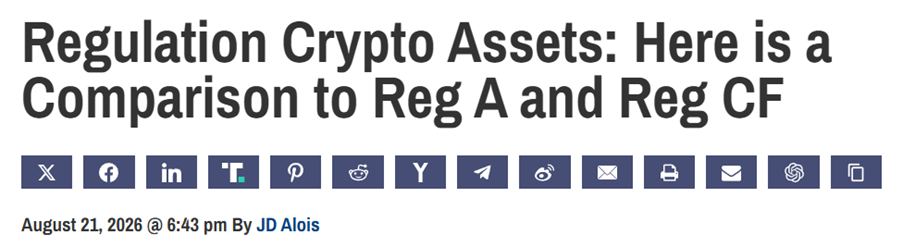
What is different here is that the framework is being adjusted to fit crypto projects.
A conventional company sells shares in a business.
A crypto project may sell a token that will eventually be used to pay network fees, access an application, reward contributors, secure a blockchain or participate in governance.
Crypto fundraising has never fit particularly neatly into securities rules designed primarily for traditional companies.
Now, however, it seems the SEC is now trying to tailor existing rules for a better fit.
The Safe Harbor Could Change Things Further
Another part of the proposal tackles a question the crypto industry has struggled with for years: Can a token begin as part of an investment contract without being treated that way forever?
Imagine a development team that sells tokens to finance a new blockchain.
In the beginning, investors are heavily dependent on that team. The network may not even exist yet, and its success relies on the developers delivering what they promised.
It’s very similar to any startup. Chris will be the first to tell you how important a founder and their team is when analyzing future risk versus reward potential.
That fundraising arrangement may therefore be an investment contract.
Several years later, however, the situation for an on-chain project could look completely different.
- The network may be fully operational.
- Independent developers could be building on it.
- Users may be buying the token because they actually need it to use the network.
These conditions don’t exist in traditional private equity opportunities. And they fundamentally change the situation and the investment.
Which is why the SEC’s proposed regulations have another component: a conditional safe harbor. That is, it will make room for the possibility where the issuer has completed, or permanently stopped, the essential managerial work it originally promised.
In plain English, the investment contract could eventually end even though the token continues to exist and trade.
That could give crypto projects something they have lacked for years: a clearer pathway between early-stage fundraising to functional network operations, even if the token is no longer tied to the original investment contract.
That may seem like nothing more than fine print for us investors.
But it makes a very big difference to a development team when deciding how to raise money and whether access can be given to U.S. residents at all.
Why This Could Restart the ICO Market
The 2017 ICO boom did not happen simply because everyone lost their senses. It happened because people genuinely wanted early access to promising crypto projects.
That demand has never disappeared.
What changed was who got the access. The average U.S. investor has been on the outside looking in ever since.
Much of crypto fundraising moved into private markets after the ICO crackdown. Venture funds could invest early and receive tokens long before the public could buy them.
Retail investors often arrived much later. But by then, projects could already carry valuations running into the hundreds of millions or even billions of dollars.
And this created one of the structures I dislike most in crypto: The public gets access just as some of the earliest investors are approaching their token unlocks.
A properly designed public fundraising exemption could begin to change that. Just as it did in the TradFi markets over a decade ago.
Regulation Won’t Remove the Speculation
We should not kid ourselves here. No amount of regulation will ever make an ICO opportunity risk-free.
If these rules are adopted and public token fundraising returns to the U.S., speculation will return with it.
Legitimate projects will use the framework to finance useful networks. But there will also be rubbish projects in the mix — hiding in plain sight with professional-looking disclosures, fashionable narratives and wildly optimistic projections.
Regulatory compliance is not the same as investment quality. And even promising projects can fail.
Which means our job as investors — and the due diligence we have to take on for any investment — won’t really change under the SEC’s new exemptions. We’ll just have more opportunities to sort through.
Bringing Early Access Back to Retail
None of this is final.
The SEC proposed Regulation Crypto Assets on Aug. 18. It was published in the Federal Register on Aug. 21, 2026, and comments are due by Oct. 20, 2026.
Which means the final details could still change. But we can already see where this could lead …
A chance for ordinary investors to participate earlier in their favorite crypto projects. Rather than arriving only after venture funds and insiders have secured the best entry prices.
The ICO boom showed what can go wrong when early access comes with too little disclosure. The years that followed showed the other side of the problem: retail investors were pushed further away from the earliest stages.
The better answer probably lies somewhere between the two.
Give credible projects a realistic way to raise capital. Give ordinary investors a chance to participate earlier. And require enough transparency to make it harder to raise millions with little more than a token, a white paper and a good story.
If these rules are adopted, the ICO may return under a different name, with clearer disclosures and defined fundraising limits.
It would not recreate the mania of 2017. But it could bring back one of the best parts of that era — where ordinary investors get the same shake as the big money.
If you’re interested in crypto’s future, as I am, you’ll want to watch how this plays out closely.
Best,
Mark Gough
P.S. The value difference between an ICO and when a coin gets listed on major exchanges can completely upend your investment thesis.
So getting in early matters. Which is why I hope these SEC exemptions come through.
But that’s something my colleague Chris Graebe doesn’t have to worry about for his Deal Hunters Alliance members. Thanks to the JOBS Act, they’ve been able to target a number of impressive private investment opportunities. In the past year alone, four of those have gone public.
Members who invested alongside Chris in these early-stage companies could have seen returns of 4x … 6x … even 777% on their initial investment.
That last one? Was 3x more than what an IPO investor could have made on the same trade.
Now, Chris has found another pre-IPO opportunity. One poised at the heart of something every crypto investor should hold dear: cybersecurity.
To learn more about this startup … why Chris is so excited about it … and how you can get first-day access to invest, you’ll want to sign up for Chris’ Fall 2026 Private Investment Summit.
It’ll take place on Tuesday, Sept. 8 at 2 p.m. Eastern. And it’s completely free to join.
Just let Chris know you’re coming via this link, and he’ll save you a seat.
1https://www.sec.gov/rules-regulations/statutes-regulations/jumpstart-our-business-startups-jobs-act
2https://www.sec.gov/newsroom/press-releases/2017-131
3https://www.sec.gov/newsroom/speeches-statements/atkins-remarks-regulation-crypto-assets-031726