Crypto Is the Canary in the Coal Mine for MSCI’s Latest Proposal
 |
| By Jurica Dujmovic |
There's a fight brewing in the financial world. And most crypto investors will never hear about it.
There are no flashy headlines. No congressional hearings. Just a quiet proposal from one of the most powerful companies you've probably never heard of.
MSCI — the index giant that effectively decides which stocks get included in trillions of dollars’ worth of funds — is considering a rule change.
On the surface, it sounds technical.
In reality, it could build a wall between Bitcoin and mainstream investing.
The Gatekeeper Most Investors Don't Know Exists
Here's the thing about MSCI: It doesn't make headlines, but it moves markets.
When MSCI adds a company to one of its indexes, billions of dollars automatically flow into that stock. Pension funds buy it. ETFs buy it. Your retirement account probably buys it without you ever knowing.
And when MSCI removes a company? Those same funds dump the shares, whether the business is thriving or not.
MSCI doesn't just measure markets. It shapes them.
And now, according to a coalition led by Bitcoin for Corporations, MSCI wants to change how it treats companies that hold Bitcoin on their balance sheets.
Put simply, companies with significant Bitcoin holdings could be reclassified, pushed out of mainstream indexes and shoved into narrow specialty categories.

Which means index funds might be forced to sell Bitcoin-aligned stocks. Not because those companies are failing, but because of what's sitting in their treasurys.
Why This Should Make You Uncomfortable
I've covered crypto markets for years, and I've seen plenty of regulatory battles.
But this one feels different.
The coalition's argument is straightforward: Indexes have always classified companies based on what they do — their revenue, operations, business model, etc.
Not what assets they hold in reserve.
Apple sits on mountains of cash. Energy companies hold oil reserves. Real estate firms own property. And none of that triggers reclassification.
But when a company holds Bitcoin? Apparently, that's different.
Which begs the question, “Why?”
The proposal doesn't answer that question in any satisfying way. And when I look at it from an analyst's perspective, the inconsistency is hard to ignore.
Either treasury holdings matter for classification, or they don't. You can't carve out one asset class and pretend the logic holds.
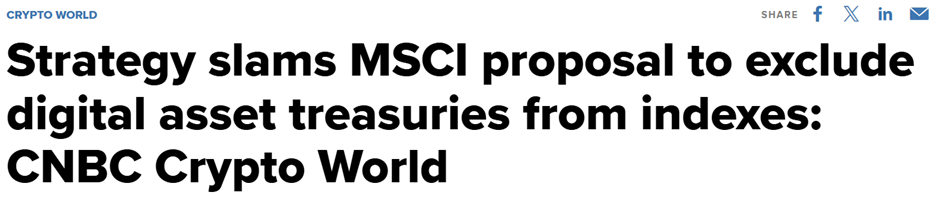
It’s no wonder Strategy — the original “Bitcoin as a treasury play” company — is pushing back hard against this proposal.
The Domino Effect Nobody's Talking About
Let's say MSCI moves forward with this. What happens next?
First, ETFs and index funds tracking MSCI benchmarks would be forced to sell shares of affected companies.
That selling pressure could hammer stock prices despite no fundamental changes or technical failures. Volatility will spike. Liquidity will dry up. And long-term investors who believed in these companies suddenly face losses driven purely by index mechanics.
Second — and this is the part that concerns me most — it sends a message to every public company considering Bitcoin adoption: Do this, and you might get kicked out of the club.
Corporate treasurers pay attention to index inclusion. It affects their cost of capital, their shareholder base, their ability to raise money. If holding Bitcoin means risking exclusion from major indexes, many companies will simply avoid it altogether.
That's not market evolution.
That's market steering.
What's Really at Stake Here
Here's my honest take: This fight isn't really about index methodology.
It's about whether traditional financial infrastructure will accommodate Bitcoin — or resist it.
We're at a strange moment in financial history. Bitcoin is held by corporations, governments and institutions. It trades through regulated ETFs. It's discussed in boardrooms and central banks. And even the SEC has finally softened to crypto, with its Project Crypto entering its next phase, as my colleague Mark Gough told you yesterday.
Yet the plumbing of traditional finance — the indexes, the classification systems, the gatekeepers — still treats it like an anomaly.
And don’t think you’re safe if you personally are not exposed to crypto. Not only will any company with crypto on its books find themselves in a tight spot. But this proposal could also set a concerning precedent.
If MSCI can exclude companies based on their asset holdings, it opens the door to all kinds of arbitrary screening. Gold-heavy firms … commodity-backed businesses … currency-diversified multinationals. Who can say where it will end.
What Happens Next
For now, this is still just a proposal.
MSCI hasn't made a final decision, and the coalition is applying pressure to force a withdrawal before the rule takes effect.
Which means there’s a few developments you should watch to keep up to date with the decision, including …
- Whether MSCI responds publicly to the coalition's concerns.
- Any official guidance on how digital-asset-heavy companies will be treated going forward.
- And most importantly, whether other index providers follow MSCI's lead — or reject this approach entirely.
The Bottom Line
This a battle over access.
If MSCI's proposal moves forward, your retirement fund might quietly lose exposure to an entire category of Bitcoin-aligned companies.
Not because you chose to sell. And not because those businesses failed.
But because an index provider decided their treasury strategy didn't fit the old rules.
That should concern every investor who believes markets should remain open, fair and free from arbitrary gatekeeping.
The fight is just beginning. And what happens next could shape how Bitcoin enters — or gets locked out of — mainstream portfolios for years to come.
I’ll be watching closely to see how this situation unfolds.
No matter what your primary investment strategy is — TradFi, crypto or anything in between — I encourage you to do the same.
The outcome of this proposal will impact us all.
Best,
Jurica Dujmovic