Crypto May Be Wired into Institutions You Already Own
 |
| By Juan Villaverde |
Every time you wire money, somewhere in a back office, someone is waiting for an email.
Thousands of people whose job it is to take a piece of data, check it against another system, touch it slightly and pass it on.
That's the back office of modern finance; a human relay chain. People waiting for data, reconciling records that don't agree with each other, then forwarding the result to the next desk.
It is slow. It is expensive. And it’s a problem we’ve dealt with for a while.
In the 1960s, Wall Street nearly drowned in paper. Trading volume outran the clerks who settled it, and stock certificates piled up in warehouses faster than anyone could process them.
They called it the Paperwork Crisis.
The fix was to move ownership into a central electronic ledger. It didn’t solve the problem. It merely abstracted away the mess.
Naturally, then, the same coordination problem keeps showing up. We just keep patching it.
This relay chain bottleneck is a systemic issue. It's built into the structure of every major financial institution. And reconciliation — entire teams whose only function is to make two databases agree after the fact — is a massive cost center.
Which brings us to the opportunity. And it's not the one most people think.
Crypto’s Breakthrough Tech
Most investors still treat crypto as something you trade. A coin to buy and hope it increases in value.
But the real value in crypto runs deeper. And the market is much larger. Because two core pieces of crypto technology can reimagine this infrastructure and put the middlemen to rest.
The first is the blockchain, which underpins the entire crypto ecosystem. And there are thousands of them.
Think of them as shared public databases. In those databases, new entries can be added. But existing entries can’t be altered.
Entries record the details of every transaction. Once verified, they are published so anyone who reviews the blockchain can see the details for themselves.
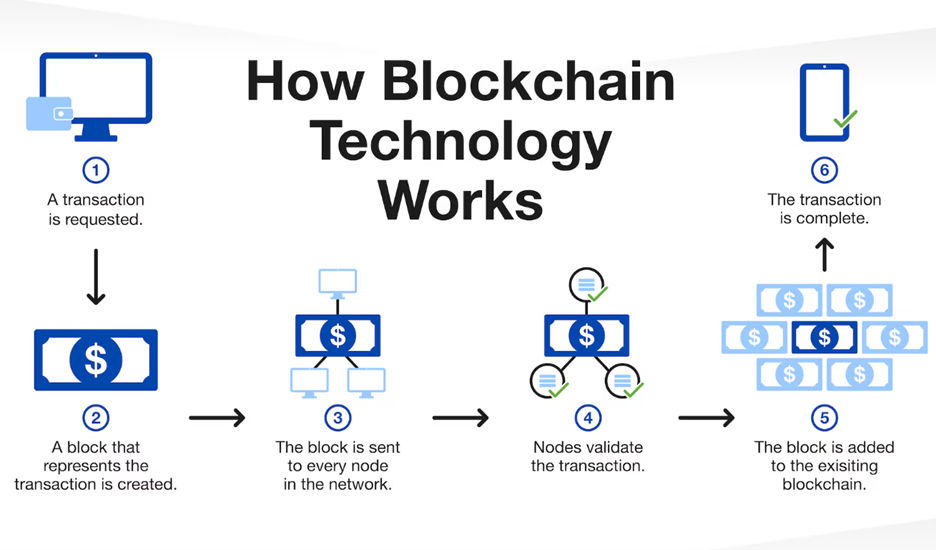
In short, it’s a secure way to transact without needing to trust anyone other than yourself.
The second crypto tech that’ll be a main part of this new plumbing are smart contracts. These are if/then algorithmic codes.
Basically, “if” the conditions written in the contract are met, “then” the agreement will execute.
All without human interference in the moment.
Which is why, as I pointed out on Tuesday, the real story isn’t TradFi’s adoption of crypto. The shift you should watch is quieter, bigger and already underway …
Crypto rails are being wired directly into the plumbing of the institutions you already own and use.
Old Process, New Protocol
This isn’t the first time Wall Street has had its plumbing renovated.
The mutual fund let ordinary people own a basket of stocks without buying each one. Then, exchange-traded funds (ETFs) made that same basket tradable all day, with cheaper fees and better tax treatment.
Each was, in its moment, the disruptive new technology. But the key is the assets didn't change. The wrapper around them got better.
Tokenization is just the next wrapper: Not a new thing to gamble on, but a faster, cheaper way to hold what you already own.
This shift isn’t a grassroots movement, either. It’s coming from some of the biggest players on the field.
JPMorgan (JPM) runs a blockchain platform called Kinexys. It has already processed more than $2 trillion in value, moving over $3 billion on an average day.2
That’s not a pilot. It’s real production.
BlackRock (BLK), the largest asset manager on earth, spent years dismissing crypto. Now its CEO, Larry Fink, calls the tokenization of real-world assets one of the biggest shifts coming to markets.
"Tokenization" sounds like complex jargon. But it isn't. All it means is that a real asset — a Treasury bond, a slice of private credit, a fund, etc. — is now represented on a blockchain, the infrastructure rail of the crypto marketplace.
On the crypto side, we call that a TradFi asset brought on the blockchain a real-world asset, or RWA. And it’s what allows these assets to benefit from crypto’s 24/7 accessibility and instant settlements.
The clearest signal that this revolution is already underway came at the end of 2025.
The DTCC, the institution that sits at the center of U.S. securities settlement, announced it would begin tokenizing U.S. Treasury securities.
Then in March of this year, the SEC approved a Nasdaq plan to let stocks themselves trade in tokenized form: the same ticker, the same price, the same shareholder rights. Just settled on a blockchain.
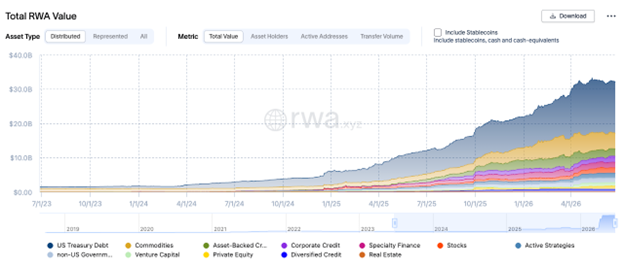
And the money is following. The value of real-world assets moved on-chain jumped roughly fivefold in about sixteen months.
So where does a regular investor look?
There are two tracks. And the best part is you don't have to choose between them.
TradFi & Crypto Both Offer Exposure
The first track takes you the traditional route. That is, the TradFi companies that are investing their own capital into crypto-based infrastructure.
JPMorgan, BlackRock and Mastercard (MA) are all examples of this. And all are companies whose stock you may already hold or have exposure to through funds or ETFs.
The second track is to find the crypto-native firms building the new rails from scratch.
- Ondo Finance (ONDO, “C-”) focuses on tokenized Treasurys.
- Centrifuge (CFG, “D”) works on tokenized private credit.
- Ripple (XRP, “C+”), a payments network with bank partnerships, is also worth watching, though its regulatory history and shady origins make it the noisier name of the group.
You don't need to buy any of them today. Or the TradFi names, for that matter.
Because the move is simpler than that: treat RWA tokenization as a theme to track, not a trade to rush.
Look at where these names sit in your portfolio or your watchlist. Ask whether the assets you own are building the new system, ignoring it or about to be replaced by it.
Best,
Juan Villaverde
1 https://www.tdk.com/en/tech-mag/past-present-future-tech/impact-of-blockchain-technology-on-business
2 https://www.jpmorgan.com/payments/newsroom/kinexys-milestones-2026