 |
| By Jurica Dujmovic |
For most of crypto’s short life, markets moved on belief.
Traders formed views. Narratives spread. Momentum built …
And prices followed.
The entire system revolved around one central question: Are prices going up or down?
Now, that question is losing its importance.
And in the aftermath, everything is changing.
The Impact of Shifting Crypto Strategies
The shift is subtle on the surface.
Prices still fluctuate … Charts still trend … And narratives still emerge.
But under the hood, the motivations driving capital have evolved.
Increasingly, the dominant players in the crypto space are not trying to predict direction at all. They are building strategies designed to extract profit regardless of whether prices rise, fall or drift sideways.
I call this approach “non-directional dominance.”
It’s reshaping how crypto behaves. And it explains a growing number of moves that seem disconnected from news or sentiment.
A useful way to understand this is to look at how money is actually deployed …
In earlier cycles, most capital entered crypto through outright bets: Investors bought Bitcoin expecting appreciation, rotated into altcoins chasing higher returns and exited when sentiment turned.
Today, a large and growing share of capital is deployed in strategies that treat price as a variable to manage. Not as a target to predict.
These strategies are not concerned with whether Bitcoin reaches a new high or retraces sharply. They are engineered to generate yield from the structure of the market itself.
This distinction matters because it changes what drives price formation. When directional traders dominate, markets reflect collective opinion:
- Bullish conviction pushes prices higher,
- Bearish conviction pushes them lower,
- And volatility often builds gradually as views evolve.
But in a market dominated by non-directional strategies, price becomes an output of positioning adjustments. Movements emerge from the mechanics of capital allocation, risk management and automated execution.
The result is a different kind of volatility.
The Impact on Price Action
Instead of smooth trends, markets exhibit bursts of activity. Liquidity can appear deep during calm periods and vanish quickly when conditions shift.
One of the clearest signals of this transition is the growing importance of derivatives.
Data from CoinGlass shows that perpetual futures volumes consistently exceed spot trading volumes, often by several multiples.
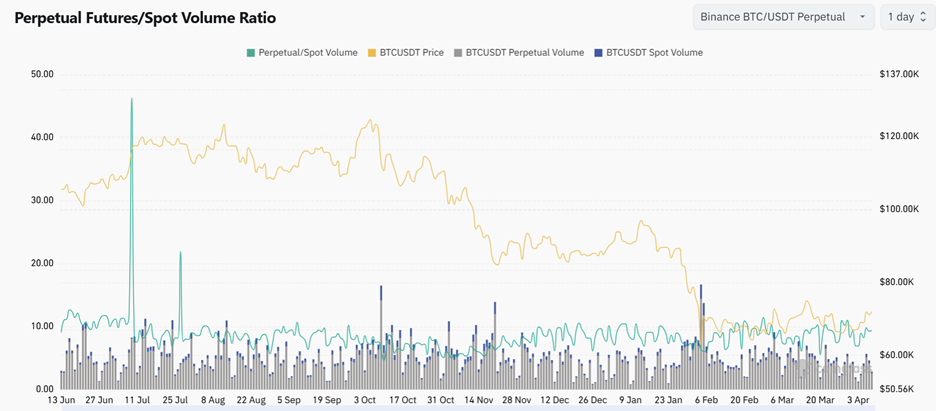
These instruments are designed for leverage and hedging, not long-term ownership. Their mechanics introduce feedback systems — particularly through funding rates and liquidation thresholds — that can accelerate price movements independently of external news.
Consider what happens when a widely used strategy begins to unwind: A basis trade may become less profitable as spreads compress. Participants reduce exposure, selling one leg of the trade while covering another.
Those actions impact prices. Which in turn affect other strategies relying on similar assumptions.
The process feeds on itself. And within hours, what began as a small adjustment can cascade into a sharp move.
From the outside, it often looks like randomness. There is no obvious catalyst, no headline explaining the shift. Market participants search for reasons after the fact, attaching narratives to movements that were driven primarily by internal mechanics.
This is where non-directional dominance becomes relevant for readers and investors.
It reframes how market signals should be interpreted.
- A rally no longer guarantees widespread optimism.
- A decline does not always reflect deteriorating fundamentals.
- Price action increasingly reflects positioning stress, liquidity conditions and the behavior of systematic strategies.
That’s a big shift for longtime crypto users. One that means we need to adjust how we approach this market on every level.
Broad Market Implications
There is also a broader implication for how crypto evolves as an asset class.
As non-directional strategies grow, they bring efficiency: Arbitrage reduces price discrepancies, funding markets balance leverage and spreads tighten.
At the same time, they introduce fragility.
Efficiency depends on continuous participation. When conditions disrupt that participation, the system can transition quickly from stable to unstable.
This duality is not unique to crypto. Financial markets have long balanced efficiency and fragility.
Which is why it’s no coincidence that this new dynamic has parallels in traditional finance, particularly in episodes where liquidity providers withdraw simultaneously. Not when every other headline these days is yet another announcement of a TradFi institution partnering with a crypto project or adding crypto products to their offerings.
But what sets crypto apart is the speed at which these dynamics play out and the relative lack of circuit breakers.
What You Need to Watch Now
In a market shaped by directional conviction, reversals often develop over time. Participants can adjust gradually.
But in a structurally driven market, dislocations can emerge quickly. Liquidity gaps form when multiple strategies react simultaneously, leading to abrupt price changes that leave little room for adjustment.
This helps explain the growing frequency of sudden double-digit moves in major crypto assets. Analysts at Glassnode have highlighted how liquidation cascades contribute to these events, particularly during periods of elevated leverage.
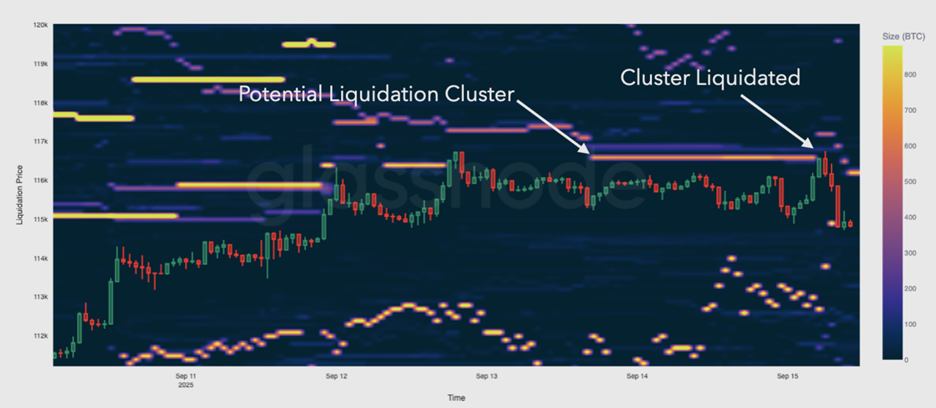
Once certain thresholds are breached, forced selling accelerates the move and creates a feedback loop that resolves only after positions are cleared.
Another layer of complexity comes from the increasing overlap between crypto and traditional finance. They’ve introduced new flows that operate on different time horizons and constraints.
Institutional capital often moves through structured products, hedging exposures and rebalancing portfolios according to predefined rules.
These flows interact with crypto-native strategies in ways that can produce unexpected outcomes.
- Algorithms respond to price changes,
- Risk models trigger adjustments,
- And liquidity providers recalibrate continuously.
Human discretion still plays a role. But it is no longer the dominant force in short-term movements.
For readers trying to make sense of crypto, this shift answers a common frustration.
Many have experienced moments where markets move sharply without clear justification. The instinct is to search for hidden news or assume manipulation.
But in reality, the explanation often lies in how the market is structured.
Understanding this does not eliminate uncertainty. It simply changes the lens through which price action is viewed.
Instead of focusing solely on narratives or macro trends, investors should direct their attention to positioning, leverage and liquidity conditions.
These factors offer clues about when the system is stable and when it is vulnerable to sudden adjustments.
Bottom Line
The shift toward non-directional dominance does not mean that narratives are irrelevant or that long-term trends no longer matter.
They do. And long-term investors need to still take note of them.
But for traders, short-term price behavior will increasingly be shaped by forces that operate independently of those narratives.
Those who recognize this can better interpret volatility and identify moments when structural pressures create opportunities.
And, more importantly, avoid overreacting to noise.
Crypto is still a young market, but it is no longer a simple one.
The transition underway marks a move from opinion-driven trading to system-driven behavior. Prices continue to fluctuate. Stories continue to circulate.
But beneath it all, a different engine is running.
And you’ll need to start moving to that engine if you want to stay in the driver’s seat of your crypto journey.
Best,
Jurica Dujmovic
P.S. With its specific “buy” and “sell” alerts, Juan Villaverde’s Crypto Timing Model acts like a GPS guide, helping you find the best entrance and exit ramps for your long-term crypto investments.
To learn how — and to see how it has mapped out the rest of 2026 — click here.