Crypto’s Giant Funding Deals Tell an Unexpected Story

 |
| By Beth Canova |
Not to sound too much like a millennial, but shopping malls aren’t what they used to be.
As a kid, I’d walk through a mall on a Saturday afternoon and have to carefully navigate the mass of people flooding out of every store.
But when I strolled through my local mall this past weekend, the only crowd I came across was at the Apple (AAPL) store.
It was packed, with a line out the door as people waited for their appointment at the Genius Bar.
But not even three shops down, and the space looked like a ghost town. Nothing there but a row of empty shops with paper on the windows.
If all you saw was the line at Apple, you would think the mall was booming.
But one full store does not tell you much about the economics of the shopping plaza.
Crypto is in that spot right now.
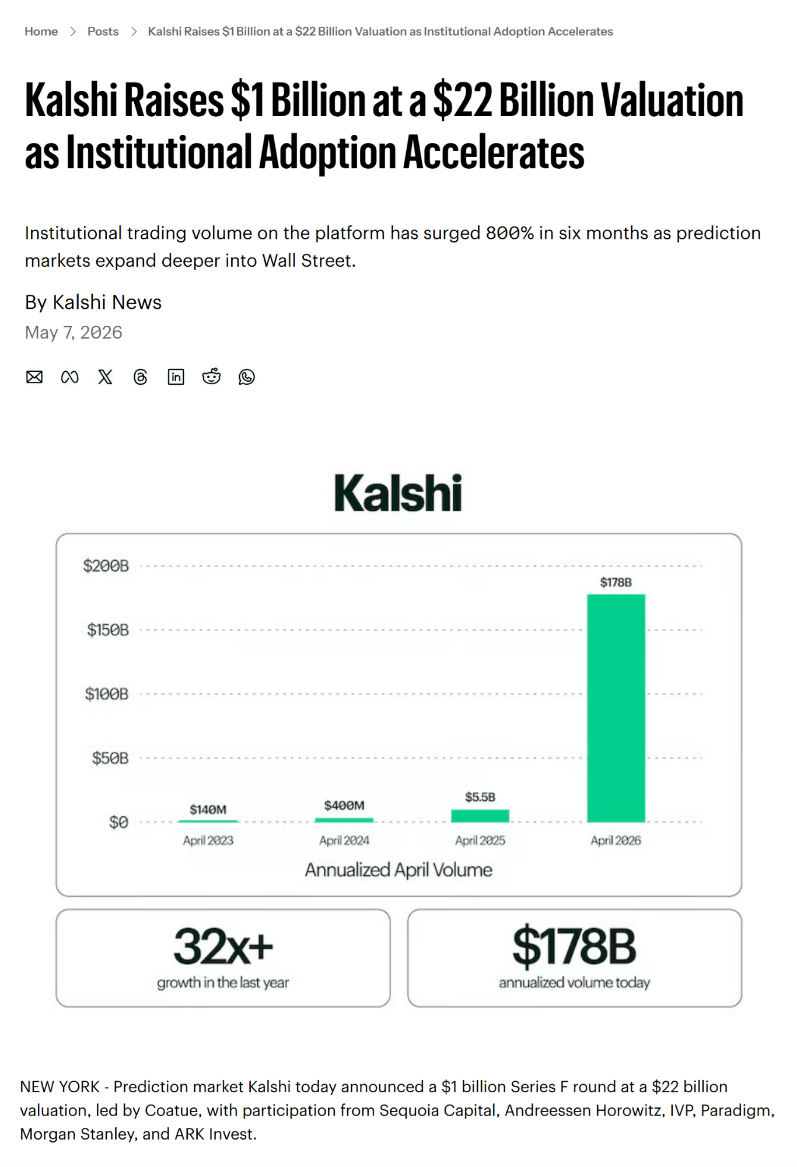
The headlines are huge: A prediction market — a site where people trade on the odds of real events — raised $1 billion at a $22 billion value this spring. It is now in final talks to nearly double that.
Its rival just raised $1 billion of its own.
As an investor, the question that should immediately come to mind is, “is this a trend?”
It is. But the trend is not a boom. Fewer firms are getting money. And the ones that do are getting far more of it.
And that shape tells you where to look, and what to avoid.
What the Numbers Actually Show
Venture capital is money that big funds put into young, private firms in return for a stake.
Data on crypto venture deals is messy. Two of the most cited trackers do not agree on how much was raised last quarter. So for our purposes today, we’ll stick with the data from Galaxy Research, the research arm of Galaxy Digital (GLXY).
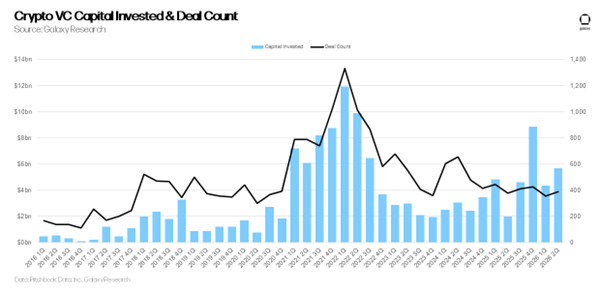
From April to June, funds put $5.7 billion into crypto firms. That is up 31% from the first three months of the year. (For scale, the whole crypto market is worth about $2.8 trillion.)
But the number of deals rose just 10%, to 384.
When the money grows three times faster than the deal count, that tells us the checks are getting bigger and the capital is consolidating.
Galaxy says the typical deal in 2026 hits what would previously be considered a record size.
Now go back to the peak. In early 2022, Galaxy counted almost 1,100 deals in a single quarter. Today's count is about a third of that.
Where the Money Went
About 78% went to late-stage firms. These are older companies with real sales, not two founders, an idea and a token no one understands how to use.
And 62% went to one kind of business: trading, exchanges and lending.
The names tell the story. Kalshi.
The U.S.-regulated prediction market announced that $1 billion round in May. On Sept. 30, Bloomberg reported it was in final talks to raise another $1 billion at roughly $40 billion valuation.
Citing internal figures, it says Kalshi was bringing in revenue at a pace of about $4 billion a year as of August.
Polymarket, its rival, raised $1 billion at $21 billion at the end of August.
Here's the kicker. The funds that back these deals are thinning out, too.
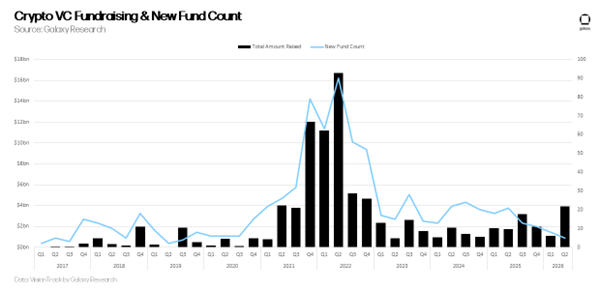
In the spring, just five new crypto venture funds raised money. That is the fewest in a quarter since 2019.
Those five were big, so the dollars held up.
But fewer firms are writing the checks.
Where the Easy Money Dried Up
The stock market: Just one crypto firm has held a U.S. IPO this year: BitGo (BTGO), in January.
Kraken, Ledger, Grayscale and Consensys all put their plans on hold.
Treasury companies: Last year's trend was to trade a public company that raised cash just to buy crypto and hold it.
Today, 16 of the 20 largest crypto treasury companies trade for less than the crypto they own, according to DWF Ventures.
Picture a fund whose shares trade for less than the stocks inside it. Buyers are paying less than a dollar for a dollar of assets.
That tells you they have lost faith in the plan.
We Have Seen This Shape Before
In 1999, 476 firms went public in the U.S., according to University of Florida professor Jay Ritter. Almost anyone with a pitch could raise money.
By 2003, the count was 63.
The same thing happened with SPACs, blank-check shells that list first and shop for a business later. In 2021, 613 of them raised $144.5 billion. In 2022, just 86 came to market.
Crypto's treasury companies were its SPAC moment. And crypto venture in 2026 looks much more like the lean years than like 1999.
Money that is flowing … is going to the few firms that already make money.
That cuts both ways. Firms with real sales are a sounder bet than a pitch deck. But when so much rides on a few names, one bad quarter at the top can drag the whole number down.
Where the Money Could Flow
Here’s the rub for retail investors: Most of the winners are private.
You can't buy Kalshi or Polymarket in a brokerage account.
But some public companies sit right next to them. Here are three names to watch, and potential red flags you’ll want to be aware of …
Intercontinental Exchange (ICE). The owner of the New York Stock Exchange has put about $1.64 billion into Polymarket: $1 billion last October, $600 million more in March, and plans to buy up to $40 million more from other holders. It also sells Polymarket's odds data to big traders.
If Polymarket continues to grow, ICE will get its share.
The catch: ICE's own release says the stake won't move its results much.
You are buying an exchange business with a crypto side bet. Not direct exposure to Polymarket.
Robinhood (HOOD). In the second quarter, Robinhood made $156 million from event contracts, yes-or-no bets that pay $1 if you are right. That is up more than tenfold in a year.
Its customers traded a record 13.6 billion of them.
In June, a joint venture with the trading firm Susquehanna launched Rothera, a licensed exchange for these contracts.
Robinhood does not fully own or control it. But the real risk is in its own filing: State or federal rules could stop it from offering these contracts.
It is already happening: Robinhood agreed to stop some sports contracts in Michigan. And its crypto revenue fell 38% in the same quarter.
Nasdaq (NDAQ). In September, Nasdaq bought into Kraken at a $21 billion value. The stake is small next to Nasdaq's main business. Kraken does not plan to go public before the second quarter of 2027 at the earliest, CoinDesk reports.
Before You Buy the Next Crypto IPO
When a big round ends, the next stop is often the stock market.
Blockchain.com says it hopes to list by year end. Bloomberg reports Kalshi could go public as soon as next year.
But BitGo shows why it pays to be patient.
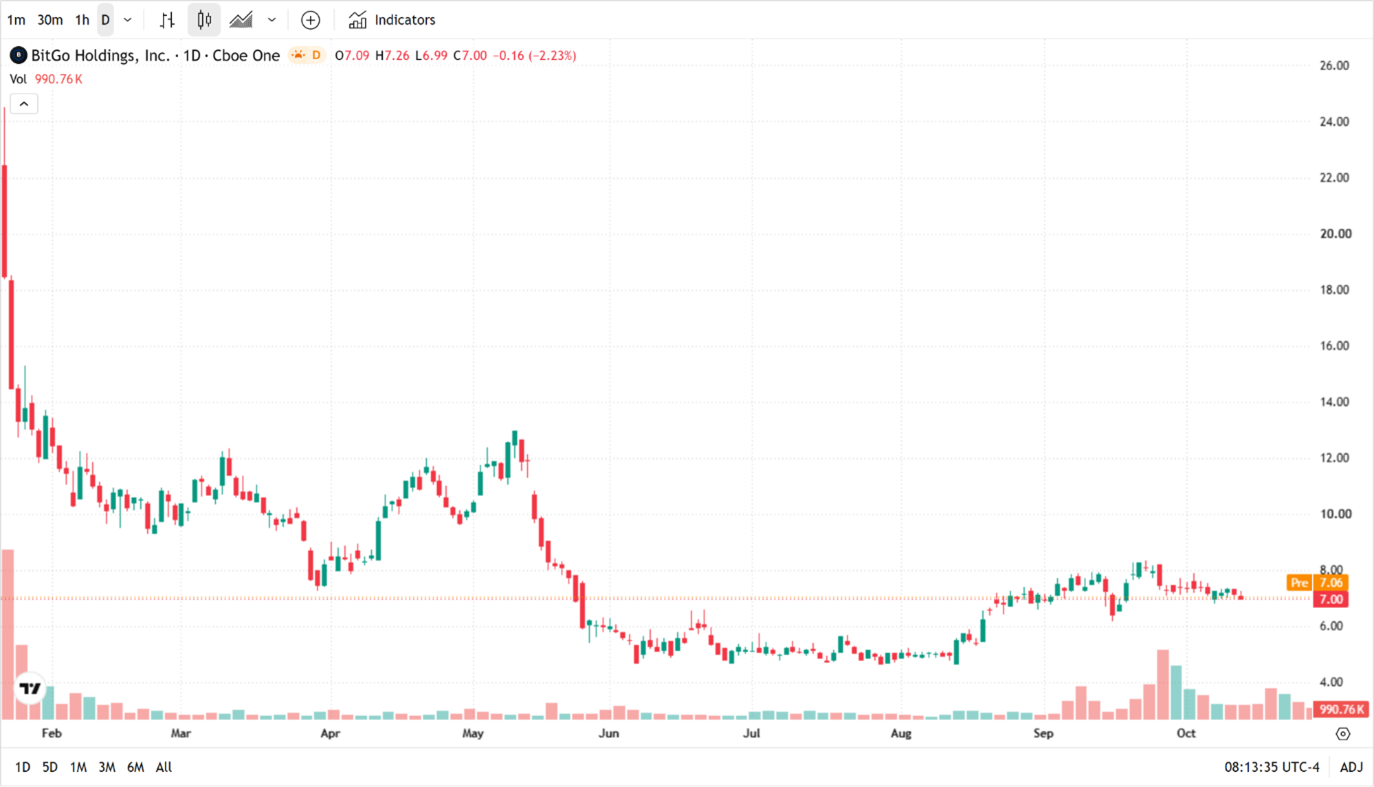
It priced its shares at $18 in January. On day one, the stock opened at $22.43 and touched $24.50.
On Oct. 13, it closed at $7.00. Anyone who bought at that first-day high has lost about 70%.
Here is a big reason why …
At the IPO, BitGo sold about 11.8 million shares. More than 95 million others were locked up, meaning early owners could not sell them yet.
That lock-up ended on July 21. Eight days later, the stock hit its low of $4.69.
This is not just a crypto story, either.
Ritter tracked 1,645 U.S. IPOs from 2012 to 2024. Measured from the first day's close, the average one trailed the broad market by 25.5 points over three years.
Our own Weiss Ratings research team took a look, as well. And over the past 15 years, only 10% of IPOs rewarded first-day investors.
So before you buy a crypto IPO, check three things in the prospectus, the filing every new stock must publish.
- How much is for sale? A small float — that is, the slice of shares that can trade — may push the price up early. Only to leave it fragile later.
- When does the lock-up end? BitGo's came six months after its debut. Mark it on your calendar, because that’s a date where you’ll want to pay close attention to intraday activity.
- Is the company selling, or are insiders? Fresh cash builds the business. Insider sales just change who owns it.
Bottom Line
Big raises are real. But they are a sign of a picky market, not an easy one.
That gives you a two-pronged plan.
First, follow the money to the public firms that hold a stake or run the rails. Size them for what they are: big companies with a small crypto edge.
Then, when the next private crypto winner rings the opening bell, stay disciplined. Let the first rush and the lock-up pass. Then, judge it on its first few quarterly reports.
A long line at one store is good news for that store. It does not mean the mall is full.
Best,
Beth Canova