 |
| By Mark Gough |
For over a decade, crypto operated in a regulatory fog.
If you were building, investing or allocating capital in the U.S. before this year, you were doing so under one assumption: At any moment, your asset could be labelled a security.
That uncertainty wasn’t just frustrating. It was expensive.
It kept institutional capital cautious, pushed innovation offshore and left the market guessing where the real boundaries were.
On March 17, 2026, that changed.
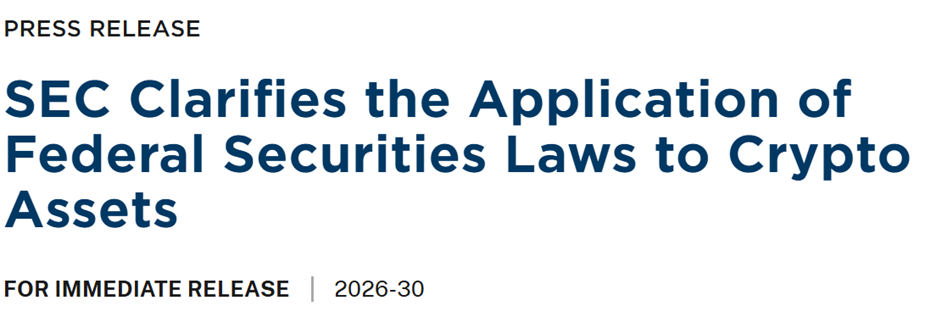
That’s when the SEC — in coordination with the CFTC — released a formal interpretation to finally define how crypto assets are classified under U.S. law.
For the first time, the message is clear. In the words of CFTC Chair Michael Selig …
"For far too long, American builders, innovators and entrepreneurs have awaited clear guidance on the status of crypto assets under the federal securities and commodity laws. With today's interpretation, the wait is over.
Today's joint agency action reflects a shared commitment to developing workable, harmonized regulations for the new frontier of finance."
At the heart of the new framework is a simple but powerful distinction: A crypto asset itself is not inherently a security. But how it is sold can make it one.
That might sound subtle, but it changes everything.
For years, the market treated tokens as if they carried permanent legal risk. If something looked like a security offering at launch, that label could follow the asset forever.
Now that assumption is gone.
The SEC has explicitly acknowledged that a token can begin its life within a securities framework and later transition out of it as the network matures and decentralizes.
This is the long-debated concept of “sufficient decentralization.” And it has now been formalized as policy rather than informal guidance.
Digital Commodities: The New Asset Class
The most consequential section of the document introduces a formal category: the digital commodity.
A digital commodity is a crypto asset that derives its value from the programmatic operation of a functional crypto network and from supply-and-demand dynamics, rather than from the managerial efforts of others.
It does not generate passive yield, convey profit rights or represent an ownership stake in a business enterprise.
In simple terms, digital commodities behave more like gold or oil than equity.
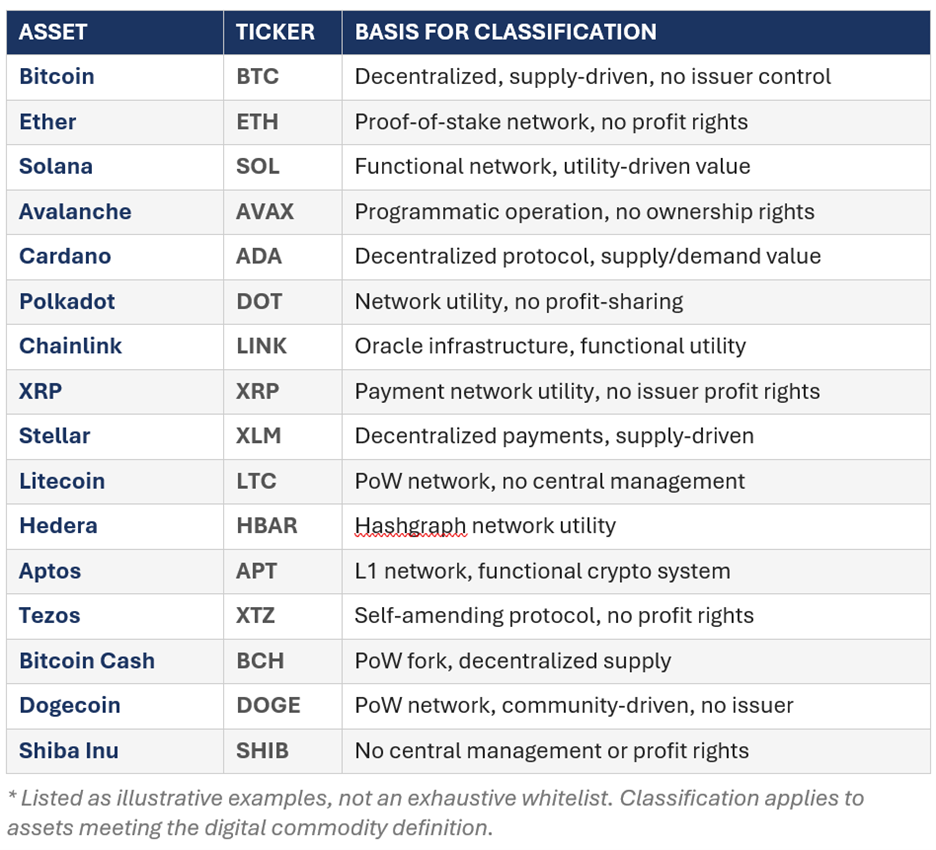
But here’s what makes this historic: The SEC didn’t just define the category. It offered concrete examples by name.
Let that sink in.
This is the first time we’ve seen this level of direct guidance from the SEC. And it is the first definitive move away from regulation through enforcement and vague speeches.
The examples given aren’t a definitive whitelist, but they clearly establish the standard: Classification is based on structure and function, not on prestige or market cap.
As long as a crypto doesn’t derive value from a central team’s ongoing management, it falls into the category of a digital commodity.
That’s the legal test. And any asset with a similar profile now has a credible path to the same classification.
The SEC made clear that this interpretation is not the final word. Congress is still developing comprehensive market structure legislation.
But markets don’t wait for perfect regulation. They move when uncertainty drops below a certain threshold.
We’ve just crossed that threshold.
How This Reprices Risk
These updates aren’t flashy. But their impact will be. Because we’re not just celebrating legal clarity. Over time, this will be a repricing catalyst.
For each asset named above, one of the biggest market overhangs has now materially diminished. That means …
- Lower risk of enforcement actions
- Lower probability of forced delistings
- And clearer treatment across custody, trading and institutional reporting frameworks.
That changes how capital can approach these markets.
Large allocators don’t operate in grey areas. They need clear classifications, defined jurisdiction and predictable compliance frameworks.
This interpretation provides exactly that.
The named digital commodities effectively become the starting universe for serious institutional allocation, a defined, regulatorily coherent asset class for the first time.
Capital doesn’t flow evenly. It flows where uncertainty is lowest.
Top Beneficiaries of This Shift
Not all named assets benefit equally.
The interpretation removes a regulatory ceiling, sure. But the assets best positioned to capture the inflows are those that combine clarity with institutional-grade fundamentals.
Highest Conviction
Ethereum (ETH, “B+”) — The backbone of DeFi, staking and tokenized assets. The staking guidance alone is significant here. ETH’s entire yield infrastructure just got cleaner from a compliance standpoint. Institutions building on-chain need ETH to be unambiguous. Now, it can be.
In fact, this is such a bullish catalyst, my colleague Juan Villaverde recently broke down how bullish he is on ETH. You can watch that video here.
Solana (SOL, “B-”) — The highest-throughput Layer-1 on the list and the most institutionally active outside of BTC and ETH. SOL has been under persistent pressure to delist amid the Coinbase/SEC saga. Now, that overhang is gone.
XRP (XRP, “C+”) — Having already won its court battle in 2023, this is the most legally battle-tested asset on the list. Ripple’s institutional payment rails are the direct beneficiary of SEC-CFTC jurisdictional alignment.
Chainlink (LINK, “B-”) — This is the infrastructure layer that connects real-world data to smart contracts. As institutions build compliant on-chain products, oracle infrastructure becomes critical. And LINK is the clearest pick in that category.
Avalanche (AVAX, “B”) — A high-performance Layer-1 with one of the most active institutional subnet ecosystems. Enterprises building permissioned chains on Avalanche were operating under real legal uncertainty. That’s now removed, and the subnet model becomes significantly more attractive to regulated entities.
The Long Tail
Dogecoin (DOGE, “C”), Shiba Inu (SHIB, “C”), Litecoin (LTC, “C+”) and Bitcoin Cash (BCH, “C”) benefit from classification clarity. But they are less directly tied to the institutional inflow thesis.
Simply put, they’re trading assets, not infrastructure plays.
The clarity matters, but the catalyst is less structural for these names.
Final Takeaway
For the first time in over a decade, the rules are clear.
Not perfect. Not final. But clear enough.
And in markets, clarity changes behaviour.
The regulatory headwind that held this market back is no longer the dominant force. Now we get to see what happens when capital is allowed to flow freely into a defined, legally coherent asset class.
The rules are clear. The opportunity is real.
All that’s left is to decide how your crypto strategy will adapt to this new reality.
Best,
Mark Gough