 |
| By Jurica Dujmovic |
If you’ve followed crypto over the past decade, you’ve likely noticed a pattern …
A new idea emerges. Then, a token gets attached to it and capital flows in.
Simple, right? Well, that loop defined the industry — from ICOs to DeFi to NFTs. Any on-chain project needed a token to capture its value.
Now, however, there’s evidence that pattern might be breaking. Crypto is starting to produce real businesses that don’t need tokens at all.
And that’s a big change for your casual crypto investor.
Revenue Is Replacing Narrative
For years, crypto’s value proposition was largely forward-looking. Tokens represented future utility, future governance or future network effects.
Tokens were an effective bootstrapping mechanism. They enabled rapid capital formation, aligned early participants and accelerated network growth.
But once a product reaches maturity, those same tokens often become a regulatory burden, a source of volatility, and distraction from the core business.
That’s why we’re seeing a move away from tokens as the primary means to capture value.
On-chain data tells the story further.
We’re seeing a meaningful share of crypto’s expansion happening in areas that look more like traditional software or payments infrastructure than token ecosystems. Where monetization is happening through fees, subscriptions and enterprise contracts …
Not in token appreciation.
Take Privy, for example. This project provides embedded wallet infrastructure for applications. It helps apps onboard users, manage wallets and abstract away blockchain complexity.

Which means its value proposition has nothing to do with launching a token.
Similarly, Dfns focuses on institutional wallet infrastructure. It offers transaction controls, security layers and compliance features that resemble banking software more than crypto-native speculation.
At the same time, the primary real-world use case gaining traction is stablecoin-based payments.
According to a16z’s 2025 State of Crypto report, stablecoins have become the backbone of on-chain activity, increasingly used for payments, remittances and operational finance.
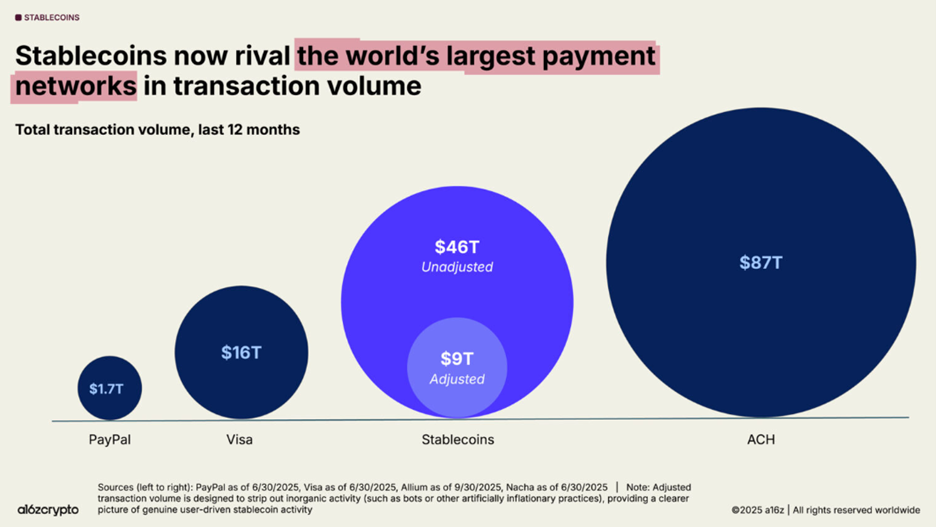
This matters because it changes how businesses are built.
Instead of asking: “How do we design a token?” Founders are increasingly asking: “What problem are we solving, and how do we charge for it?”
In many cases, the answer doesn’t involve a token at all. Because when the core product is moving money efficiently, the monetization layer tends to look like payments. Not tokens.
Which means investors have to change how they view and understand investing in blockchain projects.
Tokens Aren’t Disappearing
None of this means tokens are going away.
Far from it.
Token issuance remains active, particularly in areas tied to capital formation, trading and protocol design.
A recent market outlook report noted tens of millions raised across compliant token launches and hundreds of startups still using token-based funding mechanisms.
But the role of tokens is narrowing. They remain essential in:
- Base-layer protocols (Layer-1s and 2s)
- Staking and security models
- Governance structures
- Speculative trading markets
But they’re no longer required for consumer applications, developer tooling or as payment infrastructure.
In other words, crypto is splitting into two distinct economies: a capital-markets layer, driven by tokens a usage layer, driven by products and revenue.
That distinction didn’t exist clearly in previous cycles.
Why Now?
This shift is thanks to several forces converging at once.
First, regulation has introduced friction.
While the environment is evolving, uncertainty around token classification and compliance has made founders more selective about launching tokens. Even with improving clarity from institutions, the cost-benefit tradeoff of issuing a token is no longer obvious.
And if more regulatory compliant alternatives exist, that’s where projects will focus their time and efforts.
Second, user expectations have matured.
Before widespread adoption, most users were crypto enthusiasts. They were the ones willing to navigate complex user interfaces, bridge assets across networks and manage multiple wallets.
Because the very idea of the blockchain excited them. And the level of control it gave over their financial journey was worth the headache and effort.
Today, however, most casual users don’t want to manage wallets, custody assets or navigate complex token systems. They want straightforward products that work.
This pushes builders toward abstraction and simplicity. A system often incompatible with token-heavy designs.
Third, the industry itself has learned and grown beyond tokens as a universal solution.
Initially, tokens were used for everything from incentives and governance to fundraising and user acquisition. But in practice, many of those use cases created friction rather than value.
The lesson? Projects should take a more selective approach: Tokens where they are necessary …
And traditional business models where they are not.
The Implication for Investors
This shift has direct implications for how crypto is valued.
First, it weakens a widely held belief that crypto protocols capture the majority of value, while apps remain relatively thin (aka, the “fat protocol thesis”).
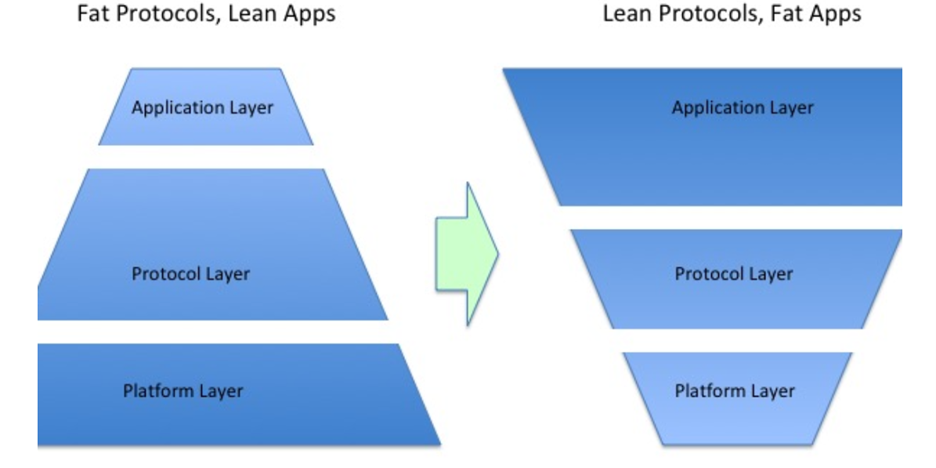
If value accrues at the application and infrastructure layer — through fees, subscriptions, and enterprise adoption — then tokens may capture less of the upside than previously assumed.
Second, it introduces a new class of investable businesses. Wallet infrastructure providers, custody platforms, payment rails and developer tooling companies can generate recurring revenue without relying on token appreciation.
That makes them easier to model. And potentially more durable.
Third, it changes risk profiles. Token-based investments remain highly sensitive to market cycles and liquidity conditions. But product-based businesses are anchored in usage.
While that does not make them immune to market swings, it does impact how deeply a project will feel that move.
It’s a distinction that becomes critical in downturns.
Finally, it creates divergence within the industry. Some sectors will continue to revolve around tokens and trading. Others will increasingly resemble fintech, SaaS or infrastructure plays.
Investors who treat all crypto assets as part of a single category risk missing that split.
What Comes Next
The industry is unlikely to abandon tokens entirely. They probably remain essential in certain contexts and will continue to drive capital formation and speculation.
But their dominance is fading.
The next phase of crypto will likely be defined by something less visible: Products that use blockchains without advertising it.
Businesses that generate revenue without issuing tokens.
And infrastructure that looks more like software than finance.
That shift won’t generate the same hype cycles. It may not produce the same explosive upside. But it is a sign of something more important …
Crypto is starting to function like a real industry.
It’s time we all started to treat it like one in our investment strategy.
Best,
Jurica Dujmovic