 |
| By Jurica Dujmovic |
For more than a decade, crypto markets have followed a familiar script.
Bitcoin (BTC, “B+”) rallies.
Ethereum (ETH, “B+”) follows.
Then the real fireworks begin. When money pours from these leaders into smaller tokens across the market.
That final stage — altseason — has historically produced some of the biggest gains in crypto investing.
But the current cycle is beginning to show signs that something fundamental may be changing.
The data suggests the conditions that once fueled massive altcoin waves may be weakening — and possibly disappearing.
A Market with Weak Breadth
True altseason requires broad participation.
One of the simplest ways to measure that participation is the widely followed Altcoin Season Index, which defines altseason as a period when 75% of the top 100 cryptocurrencies outperform Bitcoin over a 90-day period.
Right now, the market remains far below the sustained altseason threshold.
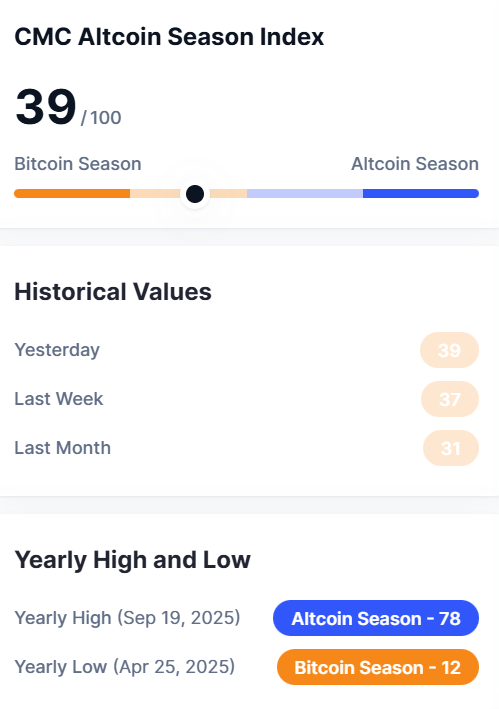
Bitcoin dominance remains elevated, and the index is still far below the level that would indicate a broad altcoin rally.
The deeper market picture looks even worse.
Recent CryptoQuant data shows that roughly 38% of altcoins are trading at or near their all-time lows, a weaker breadth reading than the market saw immediately after the collapse of FTX.
At the same time, the Total3 measure — the crypto market cap excluding Bitcoin and Ethereum — has fallen back toward levels last seen in late 2024.
That is not what a healthy altseason setup typically looks like.
Capital Is Concentrating
Investment flows reveal another shift.
Historically, profits from Bitcoin rallies often rotated into Ethereum before cascading into smaller tokens.
But the latest digital asset fund flows show a very different pattern.
Bitcoin absorbed the overwhelming majority of new institutional inflows, pulling in over $500 million in a single week.
Meanwhile, Ethereum and Solana (SOL, “B-”) received much smaller allocations. XRP (XRP, “C+”) actually saw notable outflows.
Instead of capital spreading outward, money now clusters around the largest, most liquid assets in the market.
That behavior looks less like a speculative crypto boom — and more like traditional portfolio allocation.
Ethereum Isn’t Taking the Baton
Ethereum has historically played a critical role in triggering altseason.
In past cycles, once ETH began to outperform BTC, investors often moved deeper into smaller altcoins.
But that handoff hasn’t happened in this cycle.
Despite record network activity, Ethereum’s price momentum has lagged, as highlighted in recent analysis of Ethereum network usage.
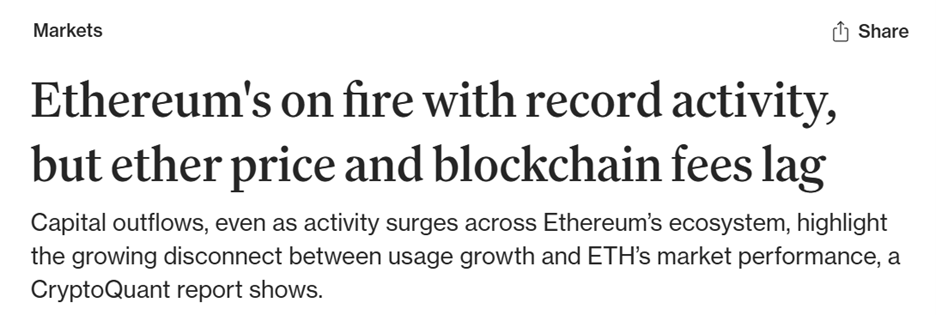
If Ethereum cannot establish leadership after a Bitcoin rally, the classic BTC → ETH → altcoin rotation becomes much harder to sustain.
Without that transition, the entire structure of altseason starts to look fragile.
The ETF Era Is Creating a Shortlist
The biggest structural change in crypto markets may be the rise of regulated investment vehicles.
Spot ETFs opened the door for large institutional investors to access crypto exposure through traditional brokerage accounts.
But ETFs also introduce something the crypto market never had before: gatekeeping.
New filings suggest that institutional access to crypto may expand — but only for a limited group of large assets.
For example, a proposed Solana ETF filing shows how investment vehicles are beginning to broaden beyond Bitcoin and Ethereum.
Another registration statement for a large-cap crypto index ETF reveals an even more interesting detail: The fund initially plans to hold only a handful of assets currently allowed under regulatory frameworks, including BTC, ETH, XRP, SOL, Dogecoin (DOGE, “C”), Cardano (ADA, “B”) and Hedera (HBAR, “B-”).
In other words, institutional capital may be entering crypto — but it is entering through a very narrow funnel.
Instead of money spilling across thousands of tokens, it may increasingly concentrate in a short list of regulator-approved assets.
Macro Conditions Aren’t Helping
The broader economic environment has also become less friendly to speculative assets.
Recent market coverage of crypto volatility described Bitcoin trading near $68,000 and Ethereum near $2,000 amid pressure from ETF outflows, rising oil prices and geopolitical uncertainty.
Those kinds of macro conditions typically push investors toward safety and liquidity.
And in crypto, the safest and most liquid asset remains Bitcoin.
Altcoins tend to thrive when liquidity is abundant, and investors are aggressively chasing risk.
Periods of economic stress usually produce the opposite dynamic.
Crypto Is Changing
Taken together, these trends point to a larger transformation.
Crypto markets once revolved primarily around retail speculation. Back then, enthusiasm could drive capital across thousands of tokens almost simultaneously.
But as institutional capital enters the ecosystem, the structure of the market may be changing.
Liquidity is becoming more selective.
Regulation is shaping which assets institutions can hold.
And investors increasingly favor assets with deep liquidity, large market caps and established infrastructure.
The result may be a crypto market that looks less like the chaotic cycles of the past and more like traditional financial markets.
A few dominant assets could attract the majority of capital.
Thousands of smaller tokens may struggle to compete.
A Different Question for Investors
None of this means altcoins are finished.
Some will still deliver extraordinary gains.
But the classic altseason — when hundreds of tokens surge together after a Bitcoin rally — may no longer be the default outcome of every cycle.
Instead of asking when altseason will begin, investors may need to ask a more important question:
Which altcoins are actually large enough, liquid enough and credible enough to survive the institutional filter now reshaping the crypto market?
Because in the next phase of crypto, staying power may matter far more than hype.
For investors uninterested in this game of crypto roulette, you’ll want to stick to the large-cap cryptos. The ones with institutional access.
Those are the exact opportunities Juan Villaverde looks for in his Weiss Crypto Investor strategy. In it, he uses his Crypto Timing Model to find the best times to buy and sell them for long-term gains.
You can watch this video to learn more.
But if you want to find the outsized growth altseason used to bring, you’ll need to go smaller. And be much more strategic in which projects are worth your investment capital.
Best,
Jurica Dujmovic