 |
| By Mark Gough |
Every crypto cycle seems to follow the same pattern: Prices surge, headlines explode and suddenly everyone is talking about digital assets again. Then, the markets cool off, attention fades and the narrative shifts back to skepticism.
But beneath all the noise — price charts, hype cycles and daily volatility — something much quieter has been happening.
Crypto adoption has continued to expand, largely unnoticed.
According to the Crypto Market Sizing 2025 report from Crypto.com, global cryptocurrency ownership has reached 741 million users. That’s a 12.4% annual increase as tens of millions of new participants entered the market … despite an environment that was far from smooth.
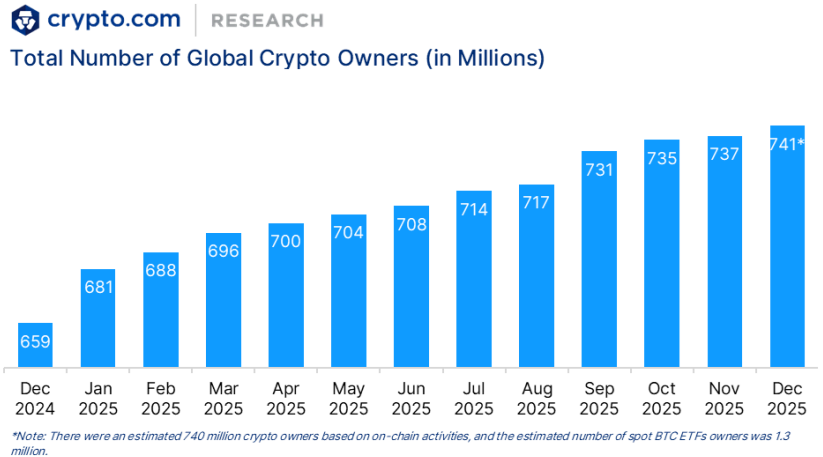
And that number tells us something important: Crypto’s real story is no longer about speculation alone. It’s about expansion.
The Quiet Milestone Most People Missed
To put 741 million users into perspective, that means nearly one in every 11 people on Earth holds some form of cryptocurrency.
Think about that for a moment.
Crypto began as a niche experiment discussed on forums by technologists and early adopters. Today, ownership levels rival the early adoption phase of major internet platforms.
Growth is no longer driven purely by enthusiasts. It’s increasingly fueled by mainstream financial access, institutional participation and improved infrastructure.
What makes this milestone particularly interesting is when it happened.
We didn’t see this acceleration of adoption during the euphoric bull-market peak. Rather, it continued to climb during periods of uncertainty and consolidation.
This is more than just a few people jumping on a popular bandwagon. This is what real technological adoption looks like.
Prices move in cycles, but user growth trends upward over time. Viewed through a long-term lens, adoption trends often reveal more about an emerging technology’s trajectory than price movements ever can.
Bitcoin Remains the Gateway … But Altcoins Are Not to Be Ignored
Beyond the broad look, the report dives into adoption trends within the crypto market. And to no surprise, Bitcoin (BTC, “B+”) remains the entry point for most new users.
It now boasts approximately 364 million holders around the world.
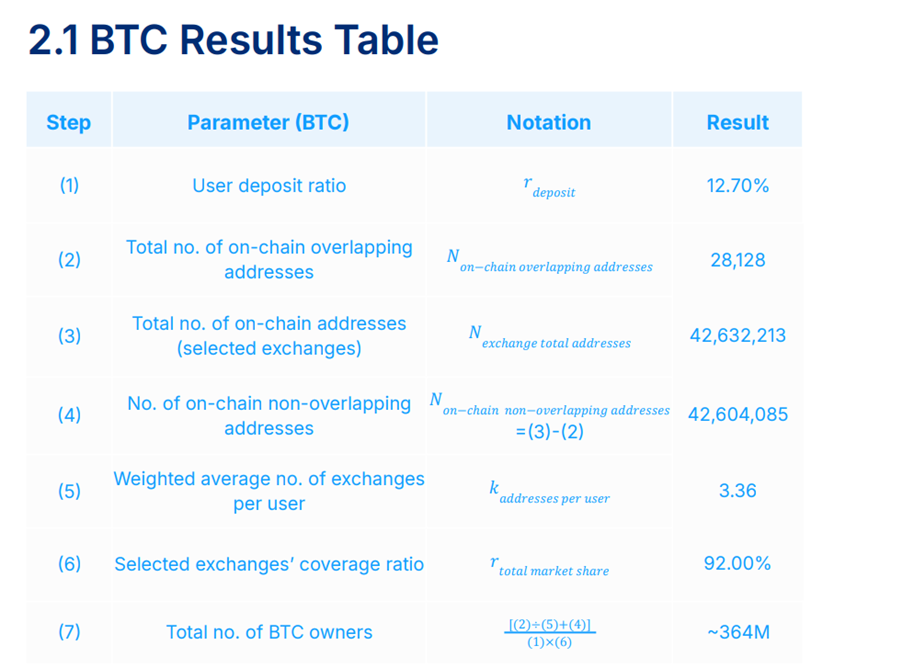
Why? Well, for many beginners, Bitcoin has the simplest narrative to understand: digital scarcity and an alternative store of value. And with institutions soundly invested at this point, it’s a familiar bridge between TradFi and crypto.
And there have been several structural changes that have reinforced Bitcoin’s role, such as …
- Greater institutional participation
- Easier access through regulated investment products
- Increased recognition among traditional financial firms
- Growing acceptance within treasury and reserve discussions
And historically, that gateway effect matters. Many users who begin with Bitcoin eventually explore broader parts of the ecosystem.
Typically, their next stop is Ethereum (ETH, “B+”). And that’s where we find one of the report’s most important insights …
Ethereum ownership grew significantly faster than Bitcoin. It hit roughly 175 million users. While a much lower number than BTC, it represents extraordinary growth.
Bitcoin’s adoption only rose about 8% year over year. But Ethereum’s adoption is up a remarkable 22% in that same time.
That doesn’t just beat Bitcoin. It’s nearly double the overall market expansion rate of 12%.
This divergence hints at a deeper transition underway in crypto.
Bitcoin introduced digital money. But Ethereum introduced programmable finance. That distinction may explain why growth is increasingly shifting toward platforms that enable activity rather than simple ownership.
Instead of simply holding value on Bitcoin, users can now interact with financial systems directly on-chain with altcoins, led by Ethereum. They can lend, trade, tokenize assets and engage with decentralized applications.
As infrastructure improves, Ethereum increasingly functions less like a speculative asset and more like a financial operating system.
In simple terms, adoption is moving from ownership toward utility.
Why Adoption Surged … And Why It’s Not Done Yet
Early crypto growth was largely retail-driven. But today’s expansion looks very different as a combination of structural factors has lowered the barriers to entry.
With user interfaces, custodial solutions and regulated platforms now common, onboarding has been simplified dramatically. Buying crypto no longer requires technical expertise.
That’s helpful, but not enough on its own. For adoption to hit its current milestone, investors needed reasons to choose to expand into crypto. And a big one is that the market is no longer limited to trading.
Several trends have stood out, likely promoting further growth:
- Tokenization of real-world assets
- Stablecoin expansion
- On-chain financial services
- Corporate experimentation with blockchain infrastructure
All give users practical reasons to participate beyond speculation. And just as important, they give institutions a way to benefit from the blockchain’s “always-on” nature and instant settlements.
In addition, the listing of several spot ETFs — first in Bitcoin, then Ethereum and now select large-cap altcoins — has given institutions even more regulated access to put crypto on their books.
And even more pathways for the regulation-conscious are likely to emerge.
Clearer frameworks in several regions have already passed and increased confidence among both investors and companies building in the space. And recent policy developments may reinforce that trend.
In an interview on Fox News, Ripple CEO Brad Garlinghouse recently suggested he believes there is roughly an 80% chance the proposed CLARITY Act could pass by the end of April.

Greater regulatory certainty has historically acted as a confidence catalyst for digital asset markets. And even the anticipation of clearer rules may encourage investors to position early potentially holding current market lows as sentiment begins to shift.
Adoption Matters More Than Price
One of the easiest mistakes investors make is focusing entirely on price action. But historically, long-term valuations tend to follow user growth.
Technologies don’t become valuable because prices rise. Prices rise once adoption reaches critical mass.
Crypto appears to be following a similar path.
Even during periods where markets move sideways or downward, the number of users continues to expand. This suggests underlying demand is strengthening regardless of short-term sentiment.
In other words, volatility may dominate headlines, but adoption drives long-term fundamentals.
And crypto still has a way to go before we hit critical mass.
While 741 million users is a notable milestone, perspective matters. Global internet usage exceeds 5 billion people.
Meaning we’re still near the starting line.
But that’s not to say we won’t get there. Financial technologies historically follow long adoption curves as trust builds slowly. Consider the smartphone. Now ubiquitous in society, adoption took over a decade to move from early users to a necessity for most adults.
If crypto ultimately becomes integrated into global financial infrastructure — whether through payments, tokenized assets or digital settlement systems — current adoption levels may represent only the middle stages of growth, rather than the end.
That perspective changes how investors interpret market cycles. Instead of viewing each boom and bust as a final verdict, cycles now represent pauses within a longer expansion trend.
Historically, technologies that reach hundreds of millions of users rarely reverse course. Instead, they evolve, integrate and eventually become invisible infrastructure.
The Bigger Picture
The most important takeaway from the market sizing report isn’t a specific asset or short-term forecast.
It’s the confirmation that crypto continues to spread geographically, demographically and functionally … even in the current corrective phase.
More people are entering the ecosystem. More institutions are participating. More real-world applications are emerging.
And perhaps most importantly, adoption is advancing quietly. Without the need for constant price euphoria to sustain momentum.
If user growth continues on its current trajectory, the long-term story may already be unfolding in plain sight: Crypto gradually transitioning from a speculative experiment into a foundational layer of modern finance.
And if past technological adoption cycles are any guide, reaching this scale is rarely the end of the story.
It’s usually when transformation begins to accelerate.
Which makes current prices — near a long-term cycle bottom — a steal for crypto’s strongest projects.
Best,
Mark Gough
P.S. To see which crypto projects Juan Villaverde considers among the strongest for his long-term strategy, click here.