How AI Companies Borrow Billions at 0% Interest

 |
| By Jurica Dujmovic |
On Aug. 31, Taiwanese chip designer MediaTek priced a $3.9 billion bond offering.1
It did so with a feature that looks almost impossible in the present bond market.
The company will pay no regular interest for five years.
The bonds:
- Were issued at face value.
- Carry a 0% coupon.
- And promise a 0% yield if MediaTek repays them at maturity.
Sounds resistible, right? Well, there were two notable takers.
Nvidia (NVDA) bought $3.5 billion of the issue, while Alphabet (GOOGL) participated for an undisclosed amount.
This happened while global borrowing costs hover near multidecade highs.2

MediaTek is not an isolated case.
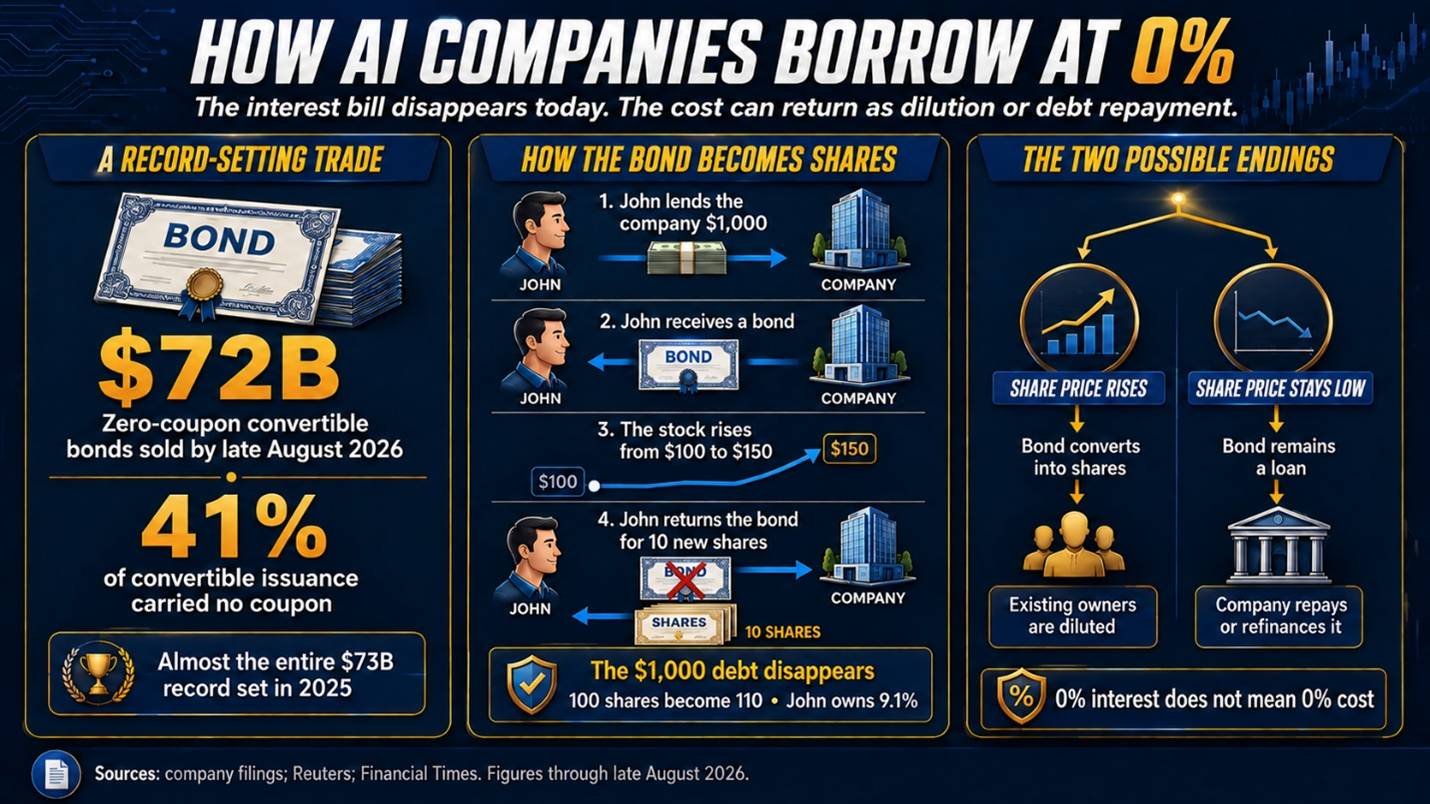
Companies had sold $72 billion of zero-coupon convertible bonds3 by late August.
That’s just $1 billion short of the record for all of 2025.
AI-linked companies such as Cloudflare (NET), Ciena (CIEN), ON Semi (ON) and Amkor Technology (AMKR) have helped drive the boom.
Around 41% of convertible issuance this year carried no coupon.
So, why would major companies jump at offers like these?
Because a closer look reveals the financing is not free. And there is upside potential.
That’s because equity volatility is something AI companies can monetize.
Investors give up interest because these bonds contain a valuable option on the issuer's shares.
That option transfers part of the cost from today's income statement … to tomorrow's shareholders and balance sheet.
Why Volatility Can Replace Interest
A convertible begins as debt.
The investor lends money. If the issuer remains solvent, they can receive the principal back at maturity.
But the bond also grants the right to convert that claim into shares at a predetermined price.
When the share price rises far enough, the equity option can become more valuable than the interest the investor surrendered.
Volatility makes that option more valuable: A stock with larger price swings has a greater chance of crossing the conversion threshold.
And the investor doesn’t even need to believe the stock will rise steadily for this strategy to work in their favor.
Many professional buyers use convertible-arbitrage strategies.4 That means they …
- Buy the bond,
- Short some of the underlying shares,
- And trade the changing relationship between the option, the stock and the issuer's credit risk.
That distinction matters.
It means heavy demand for an AI company's convertible bond does not automatically represent a bullish vote on its business.
Some buyers primarily want its volatility.
Research has also linked convertible issuance to short-term pressure5 on the issuer's shares. That’s because arbitrage funds often establish short positions while buying the bonds.
For the issuer, however, the trade is undoubtedly attractive. Instead of paying a cash coupon, it sells part of the possible future appreciation in its stock.
The higher the market values that possibility, the less interest the company must offer today.
With this approach, the AI enthusiasm does more than raise valuations. It also directly lowers the cash cost of financing expansion.
MediaTek’s Terms Illustrate This Exchange Perfectly
Its Taiwan market filing6 sets the conversion price at NT$4,513.75 — only 15% above the share price used when the deal was priced.
If every bond converted, MediaTek estimated maximum dilution at approximately 1.67%.
The proceeds are intended for foreign-currency purchases of materials. And the low conversion premium makes the equity option easier to reach than in many U.S. deals.
It also reflects the strategic character of the buyers.
Alongside the financing, Nvidia and MediaTek expanded their collaboration7 across custom data-center chips, local AI computers and automotive systems.
MediaTek will adopt Nvidia's NVLink Fusion platform so customers can connect custom accelerators to Nvidia's rack-scale infrastructure.
Nvidia is consequently receiving more than a bond.
It gains a senior claim on MediaTek, an option to participate in its equity upside and a deeper commercial relationship with a company. One that can extend Nvidia's architecture into additional markets.
For its part, MediaTek receives $3.9 billion without a recurring interest bill.
The arrangement may prove inexpensive, but its true cost cannot be read from the coupon alone.
The Cost Does Not Disappear; It Just Moves
Cloudflare gives us a useful comparison.
In August, it priced $2.175 billion of 0% notes9 due in 2031. The bonds initially convert at a share price about 60% above Cloudflare's price when the deal was struck.
Cloudflare then hedged its position. It committed approximately $225.8 million to capped-call transactions designed to offset dilution or excess cash payments if the notes convert, up to a cap set 175% above the original share price.
That hedge cost equals roughly 10% of the initial bond principal.
It buys shareholders substantial protection, so it should not be treated like a wasted fee.
It nevertheless demonstrates why a 0% coupon does not mean 0% economic cost:
Some of the financing proceeds are spent upfront to purchase back part of the equity exposure the company just sold.
Ciena used the same market to close $2.875 billion of 0% notes.10
It used part of the proceeds for hedging and share repurchases, repaid approximately $1.14 billion of a term loan and retained additional money for supply-chain investment and general purposes.
The company explicitly said the transaction lowered its interest expense.
ON Semi’s $1.3 billion 0% issue11 carried a 52.5% conversion premium. Its hedge and warrant structure pushed the point at which dilution could reappear to approximately twice the share price at issuance.
These deals allow shareholders to keep more upside, but the protection itself consumes capital and ends at an agreed cap.
The Risk Appears in Two Different Futures
If the stock rises sharply, the bondholder can convert.
The issuer may deliver shares — cash or a combination — depending on the agreement.
Existing investors can be diluted, or the company can face a cash payment above principal.
Capped calls postpone that cost, but only until the share price exceeds the cap.
If the stock never reaches the conversion price, dilution may disappear, but the debt does not. The company must repay or refinance the principal at maturity.
That outcome is manageable when the borrowed money has created durable cash flow.
It becomes dangerous when the proceeds financed capacity that is underused, obsolete or unable to earn an adequate return.
This is the central investor question …
A zero-coupon convertible can look exceptionally cheap during its first several years because it creates no regular interest payment.
Its eventual cost depends on what the issuer builds with the money and which of those two futures arrives.
The coupon is now one of the least informative figures in the announcement.
So here’s …
What Shareholders Should Examine
I would begin with the conversion premium.
A low premium makes conversion and dilution more likely. Meanwhile, a high premium generally makes the option less valuable and may require concessions elsewhere.
Next comes the dilution hedge.
Investors should identify its upfront cost, its cap and whether the company can settle conversions in cash.
They should then follow the use of proceeds.
Refinancing expensive debt, expanding a constrained supply chain and funding speculative capacity carry very different risks. Even when all three transactions advertise the same 0% coupon.
Finally, shareholders should compare the maturity value with the cash flow the investment is expected to produce.
The absence of interest improves near-term earnings. But it can also make leverage look quieter than it is. A principal payment due in 2031 remains a principal payment due in 2031.
A Financing Window That Depends on Uncertainty
The present market allows AI-linked companies to turn uncertainty about their shares into usable cash.
That is a genuine competitive advantage.
Businesses that raise long-dated capital now can continue to invest while conventional borrowers face higher coupons and more restrictive terms.
The window will remain open only while investors place a high value on the embedded equity options.
If single-stock volatility falls, convertible buyers will demand more interest, a lower conversion threshold or both.
Issuers that waited may discover that the financing subsidy vanished even if enthusiasm for AI itself did not.
For now, the AI boom is funding itself through more than revenue and conventional debt. It is also selling the possibility of future share-price gains.
The companies that convert that possibility into productive assets will have borrowed remarkably well.
The rest will eventually learn why 0% and free were never the same number.
Best,
Jurica Dujmovic
P.S. The idea of putting aside short term returns for a bigger prize on a longer horizon isn’t unique to zero-coupon convertible bonds.
It’s also the thesis behind every startup investment.
As a startup investing specialist, Chris Graebe put his money in 35+ private companies. These were startups valued at just a few million dollars in total when he first invested.
Today, they’re worth a combined $1 BILLION and counting — including the few that didn’t work out.
Now, he’s found a new opportunity on the cutting edge of the next tech revolution. One that could usher in $2.7 TRILLION of economic growth, according to McKinsey & Company.
To learn how you can get first-day access, click here.
3 https://www.ft.com/content/8e93c159-2c02-444a-9f22-dcda14bc451f
4 https://onlinelibrary.wiley.com/doi/10.1002/9781119205074.ch7
5 https://www.sciencedirect.com/science/article/pii/S0378426612000817
6 https://m.moneydj.com/f1a.aspx?a=72AFC1FB-50F4-426E-B91A-4F2E21E5C6F2
9 https://www.sec.gov/Archives/edgar/data/1477333/000095010326012340/dp251721_ex9902.htm