How the Prediction Markets Offer an Investment Edge the Pollsters Often Don’t
 |
| By Dawn Pennington |
Weeks before the 2024 election, every major poll showed a toss-up. The models, the forecasters, the talking heads, all saying the same thing — too close to call.
Polymarket, a crypto-based prediction market where real people bet real money on outcomes, had then-candidate Donald Trump above a 60% win probability for weeks.
The signal wasn't entirely without noise.
A Fortune investigation, drawing on analysis from blockchain research firms Chaos Labs and Inca Digital, found that wash trading (a form of market manipulation that inflates apparent volume) accounted for as much as a third of trading on Polymarket's presidential market.
Yet the broader directional signal held firm.1
The polls were wrong. The prediction market was right.
Related story: Polymarket Just Earned a $2B Wall Street Investment
That’s the thing with polls. Market research companies like Pew view it as a sort of civic duty and don’t provide compensation. Meanwhile, outfits like YouGov, Google or Microsoft may provide some sort of nominal digital reward.
Either way, the persons being polled can change their minds or simply give the answer they want to give at the moment.
But when people make predictions on sites like Polymarket, Kalshi, FanDuel or even at the Roulette table, they have something to lose if they're wrong.
In other words, they are paying to be heard.
The Problem with Expert Forecasts
Think about who you're actually listening to before a major market event. And what they might have to gain or lose.
Analysts keep their jobs by generating engagement, not by being right. Uncertainty keeps viewers watching.
An analyst who says, "I genuinely don't know what the Fed will do!" doesn't survive the next ratings cycle.
None of us know what new Fed Chair Kevin Warsh will do at his first-ever Federal Open Market Committee meeting, which starts today. We’ll find out when it concludes tomorrow afternoon.
Now, we think we know the Fed will hold interest rates steady this month because of the CME FedWatch Tool 2.
FedWatch has long functioned as a prediction tool for the Fed Funds benchmark interest rate.
It uses 30-day Fed Funds futures contracts data, aggregated in real time based on institutional cash flow.
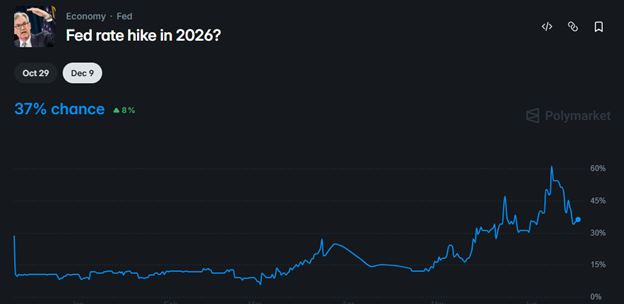
The FedWatch tool suggests a 60% chance of a rate hike through December. Meanwhile, Polymarket currently shows a 37% chance of a rate hike in 2026.3
That’s quite a gap!
Wall Street may have more money to lose. But Main Street is likelier to feel those losses if they make the wrong call.
So when it comes to sentiment, skin in the game may deserve some serious consideration.
The same logic applies to political pundits, economic forecasters and most of the voices filling airtime before a big macro event.
They profit from the conversation, not from the resolution.
For most prognosticators, there's no financial penalty for being wrong. A brief hit to their credibility, maybe.
But most reappear next quarter with a new forecast.
And, if they’ve gotten better at their job, a new chance at redemption.
What Prediction Markets Actually Do
A prediction market is a betting exchange tied to real-world outcomes.
"Will the Fed cut rates in September?" trades as a contract.
At 73 cents, the market is saying there's roughly a 73% chance the answer is yes. If it happens, the contract pays $1. If not, it goes to zero.
That structure changes the incentives entirely. Every participant is putting money behind what they actually believe.
Overconfidence gets punished. Accuracy gets rewarded. There's no audience to impress, no narrative to maintain.
The result is a probability built from thousands of real bets. The more confident someone is, the more capital they risk.
They win or lose in private.
This Isn't Just Theory. It's Quantified
For decades, university researchers have tracked a single question: Do prediction markets beat traditional polls?
The answer, consistently, is yes.
A market run by the University of Iowa has called presidential elections more accurately than traditional polling since 1988.4
But we no longer have to rely solely on political data. We now have proof from the highest levels of economic policy.
A Federal Reserve Board research paper evaluated the structural accuracy of macro prediction markets.5
Looking back at the historical data since the start of the Fed’s aggressive 2022 rate-hiking cycle, researchers compared prediction market data directly against established institutional benchmarks.
The findings were stark.
When looking 150 days out from a Federal Reserve meeting (roughly three FOMC cycles), regulated prediction markets were nearly as accurate to the New York Fed's own Survey of Market Expectations.
Even more impressive?
When it comes to forecasting headline Consumer Price Index (CPI) inflation, the Fed paper revealed that prediction markets provide a statistically significant improvement over the professional Bloomberg consensus forecasts.
The Fed’s Take: According to the Federal Reserve's analysis, these markets function because they act as a "high-frequency, continuously updated, distributionally rich benchmark." Traditional surveys quickly become stale. Financial derivatives are often thinly traded or restricted.
Prediction markets seamlessly aggregate real-time data because information velocity moves at the speed of capital.
The signal isn't perfect. Nothing is. But it is arguably a window into the future before a major event.
How to Use It Without Losing to the House
You don't have to bet a single dollar to utilize this.
Both Kalshi and Polymarket publish their odds publicly, in real time, for free. No account required.
Think of it like checking a futures curve before an FOMC meeting: a direct look at the crowdsourced expectations of people who have a financial stake in the outcome.
A quick word of caution if you do decide to gamble yourself: Market structures matter.
- Kalshi is regulated in the U.S. by the CFTC, the agency that oversees commodities trading. It operates under strict compliance laws.
- Polymarket operates entirely offshore and utilizes crypto rails.
Know the difference before you ever deposit capital.
Before the next Fed decision (after tomorrow, that’s July 29) …
Before the next major legislative or electoral event …
You may want to see the action on Polymarket and Kalshi. The best part? You can check it out for free.
If the market is pricing something dramatically different from what the mainstream headlines are screaming, that gap is where the value lives.
The point is to add one more tool to your framework. One that updates in real time.
As for your own hard-earned money, use it to bet on solid cryptos with a long-term use case, a solid management team and an active user community that wants to see it succeed.
Again, those with real skin in the game, with the potential for a payout that could change their fortunes, could give you real clues where to find the next winning idea.
To your health and wealth,
Dawn Pennington
Editorial Director
1 https://fortune.com/crypto/2024/10/30/polymarket-trump-election-crypto-wash-trading-researchers/
2 https://www.cmegroup.com/markets/interest-rates/cme-fedwatch-tool.html
3 https://polymarket.com/event/fed-rate-hike-in-2026
4 https://iemweb.biz.uiowa.edu
5 https://www.federalreserve.gov/econres/feds/kalshi-and-the-rise-of-macro-markets.htm