Polymarket Earned a $2 Billion Wall Street Investment
 |
| By Beth Canova |
Wall Street has a simple word for what Polymarket does: gambling.
So, when the company that owns the New York Stock Exchange agreed to invest up to $2 billion in the platform in October 2025, you might expect its shareholders to balk.
They didn't. Intercontinental Exchange's (ICE) stock rose on the news.
That’s because ICE did not invest in a casino.
See, Polymarket is a prediction market. Investors trade contracts tied to real-world events: an election, a rate decision, a championship game. Each contract's price is the crowd's estimate of the odds.
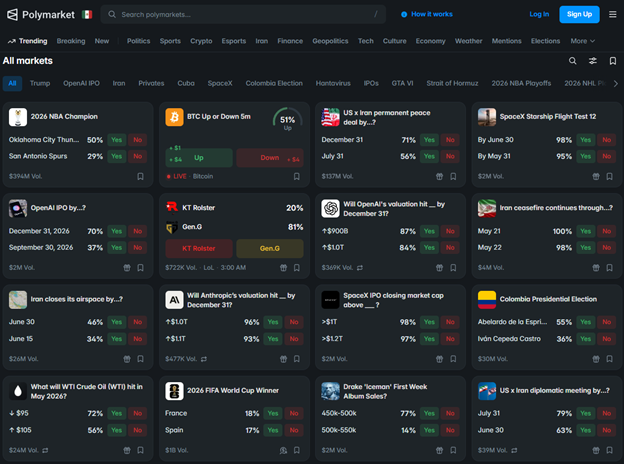
In plain terms, it is a futures market. The only difference is that you trade the future probability of an event instead of the future price of oil.
To be completely transparent, putting money on a Polymarket pool is still gambling. Which is why using the platform isn’t the best play for investors.
After all, ICE did not commit $2 billion to guess the outcome of football scores.
It committed it to the data.
What ICE Actually Bought
Intercontinental Exchange does more than run the NYSE. A large share of its business revolves around selling market data — price feeds, indexes, analytics — to banks and professional traders.
In Polymarket, it saw another data product.
Under the deal, ICE became the exclusive global distributor of Polymarket's event data to institutions. And by February 2026, it launched a feed called Polymarket Signals — crowd-sourced probabilities, sold to the same professionals who already buy ICE's data.

The combined wager of millions of traders on whether a central bank cuts rates or a conflict escalates now sits on screens beside bond yields and stock quotes.
From Free Product to Real Business
For most of its life, Polymarket was free. It collected no trading fees through all of 2025.
That changed this year. Fees arrived in January, and industry trackers reported the shift drove a 10x jump in revenue.
Private investors have valued Polymarket near $15 billion, up from $1 billion a year earlier.
The infrastructure grew up, too. On April 28, Polymarket completed a full rebuild of its exchange, complete with a new dollar-backed settlement token, a $5 million bug bounty and audits from two outside firms.
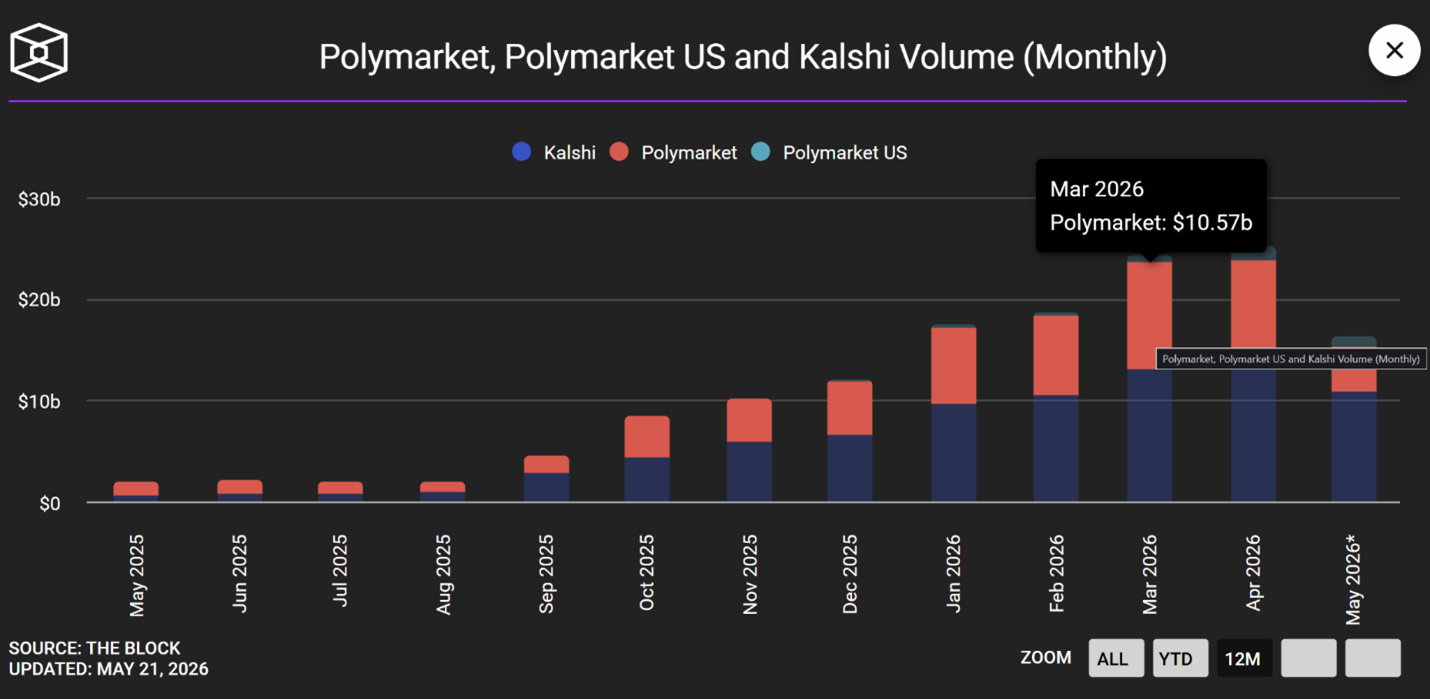
Polymarket handled $73 million in trades in 2023. In March 2026 alone, it cleared $10.57 billion, with more than 1.3 million people now trading on the platform.
The Last Piece
Polymarket is preparing for a big future. The parent company of TradFi’s most prominent exchanges has already invested.
Soon, retail players will be able to get their piece of the pie, too. And users could get theirs for free.
Polymarket has confirmed it will launch a token, called POLY, and hand a portion of it to users through an airdrop. (An airdrop is a one-time distribution, like a company handing stock to its earliest customers.)
No official launch date or airdrop date has been given yet.
But the signals are stacking up: Polymarket recently filed trademark applications for the POLY name. And when asked when token staking would arrive to lower trading fees, a team member replied: "Very soon."
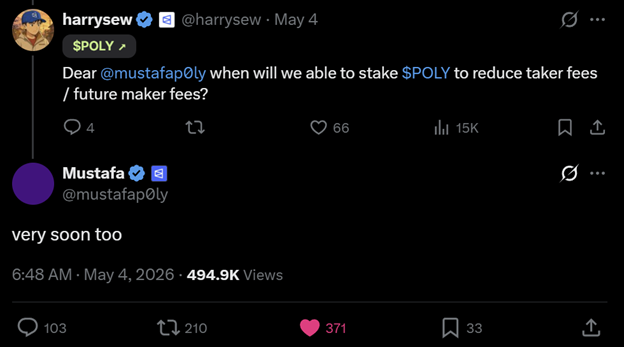
That detail matters.
It means POLY will revive an old idea in new clothing: hold the token, pay less to trade. For more than a century, that was the whole point of owning a seat on an exchange.
Risks Worth Watching
Several risks still deserve attention when it comes to Polymarket …
An imposter problem. POLY does not exist yet. But synthetic "Polymarket" tokens already trade on some crypto venues. They carry no ownership or legal rights.
Which means you should treat anything using the name with caution.
No fine print. There is no confirmed date, no published supply and no airdrop rules. A prediction market, fittingly, puts the odds of a 2026 launch at barely better than even.
A real rival. Kalshi, a U.S.-regulated competitor, out-traded Polymarket this March. This is a two-horse race. And that regulatory approval gives Kalshi a notable edge.
Unsettled rules. Polymarket regained U.S. users in late 2025, after they spent years locked out. The regulations governing prediction markets are still being written.
Bottom Line
For most of Wall Street's history, an exchange was a private club. To trade on the floor of the NYSE, you had to buy your seat … often for the price of a house.
Then the exchanges opened up. When the NYSE went public in 2006, the members who had traded there for years received shares in the business they had built.
Polymarket appears to be walking that path, at the speed of crypto.
It has the revenue, the infrastructure and Wall Street's data giant as a backer. The launch of its token — and the airdrop to the users who carried it here — would complete the picture.
The date is unknown. But the machine is built, and ICE has already placed its bet.
The only question left is, will you?
Best,
Beth Canova
P.S. Polymarket’s token is far from the only highly anticipated investment opportunity on the horizon. Nearly the entire financial world is watching SpaceX’s upcoming IPO with eagle eyes. In fact, many retail investors have tried to get early access through tokenized shares.
But Weiss’ own startup investing specialist Chris Graebe says that’s the wrong play. The real early-stage opportunities he sees lie elsewhere.
That’s not just a talking head blowing smoke. Chris now has four successful startup exits under his belt. One of them, Starfighters (FJET) is a direct SpaceX competitor. On that deal, Chris and his Deal Hunters Alliance Members had the chance to grab 777% gains by just the third day of public trading!
Now, he’s found a different early-stage space company that offers significantly higher upside potential than the IPO opportunity with SpaceX.
He’ll drop all the details in his Pre-IPO Space Summit tomorrow afternoon at 2 p.m. To hear his pick for yourself, click here.