 |
| By Jurica Dujmovic |
It’s not just the Swifties anymore. Even crypto has entered its own new era.
And this change is more than just skin deep. It’s been growing stronger and more powerful over the past two years.
Ever since Jan. 10, 2024.
That’s the day the U.S. Securities and Exchange Commission (SEC) approved the first spot Bitcoin (BTC, “B+”) ETFs in the United States.
That decision opened the door for traditional brokerage accounts to hold spot Bitcoin exposure — all without the need to touch a crypto exchange or open a wallet.
It was expected to open the door to greater crypto adoption. But what followed exceeded most forecasts.
Within months, these products accumulated assets at a pace that rivaled the fastest ETF launches in financial history. Cumulative net inflows into spot Bitcoin ETFs climbed past $50 billion and at their peak approached roughly $60 billion before a wave of 2026 outflows trimmed totals somewhat.

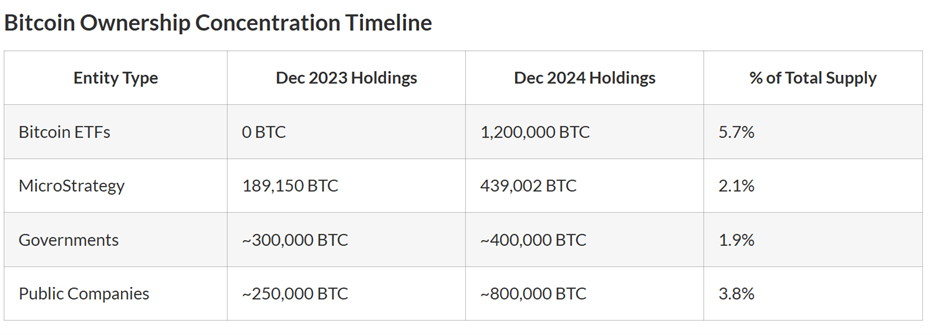
Collectively, these funds now hold around one million Bitcoin, representing roughly 5%–6% of Bitcoin’s total supply.
That may not sound like a lot on its own. But remember that BTC has a hard cap of 21 million tokens, with most of them already mined and owned.
So, in fact, the small percentage owned by ETFs … is actually far larger than the share of coins available to trade!
That’s incredibly significant in terms of market structure.
It means the marginal buyer of Bitcoin is no longer primarily a retail enthusiast or a crypto-native fund. Increasingly, it is a portfolio manager running a model allocation.
And this new kind of buyer is reshaping the market in ways that deserve careful analysis.
ETF Flows Now Drive Price
The relationship between ETF activity and Bitcoin price has become incredibly direct. Enough that market analysts now track daily fund flows as a leading indicator.
- A push toward $68,000 in early 2024 was propelled by cash rushing into newly launched exchange-traded funds.
- The same pattern has continued in later market cycles. A $225 million inflow in a single session helped drive a Bitcoin rally above $71,000 in early 2026.
This price sensitivity to flow data reflects a mechanical reality. When authorized participants purchase Bitcoin for ETF creation, they buy in the spot market. When redemptions occur, they sell.
With daily flows regularly reaching hundreds of millions of dollars in either direction, the ETF channel now functions as one of the most direct and observable demand levers in the market.
The Catch: Institutional Money Moves Fast
Here is where the picture becomes more complicated. The same institutional capital that lifted Bitcoin into a new price range … has also proven capable of leaving quickly.
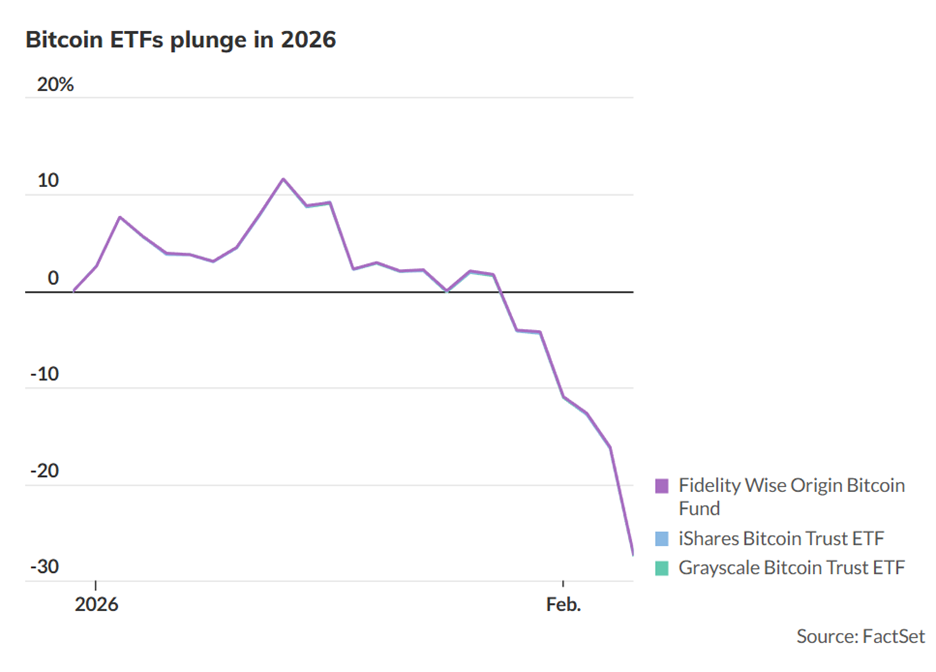
In early 2026, spot Bitcoin ETFs saw several billion dollars in net outflows year to date. One particularly sharp stretch saw billions drained from funds across multiple consecutive weeks of withdrawals.
On a single day during that period, BlackRock's iShares Bitcoin Trust ETF (IBIT) recorded more than $160 million in outflows. Major Bitcoin ETFs fell sharply in price during periods when Bitcoin slipped below key levels, with large outflows and double-digit losses.
Retail crypto investors used to boast about “diamond hands.” And crypto cycles were sacrosanct when it came to forecasting price action.
But bigfoot institutions don’t care about any of that.
Portfolio managers rely on risk models, not sentiment. They don’t hold through drawdowns the way long-term cryptocurrency believers do. When market conditions turn adverse, they reduce exposure.
Even if the weakness isn’t in crypto, they’ll sell to cover losses elsewhere on their books.
And they move systematically, quickly and in size. Which sends ripples through the market … regardless of what the cycles or underlying fundamentals suggest should be happening.
This dynamic is well understood in traditional finance.
Research from the International Monetary Fund has documented how ETF structures in markets like corporate bonds can amplify volatility during stress events as institutional sellers exit simultaneously and force underlying asset liquidations.
The same mechanism is now present in Bitcoin.
And since altcoins follow the OG crypto’s lead, we’re seeing this new phenomenon across the market.
High Concentration Compounds the Impact
The impact of spot ETFs on price action goes even deeper. That’s thanks to the concentration of coins in just a few hands.
The majority of the Bitcoin held by U.S. spot ETFs sits with a single custodian: Coinbase Custody. That means the operational resilience of most institutional Bitcoin exposure … depends heavily on one institution's infrastructure and regulatory standing.
Think about that. One firm's risk management decisions, redemption activity and operational status … can each independently generate meaningful market-wide consequences.
Bitcoin was, at its origin, designed to be resistant to exactly this kind of concentration of influence.
But that design is being tested. And a market that was once distributed across thousands of independent actors … now has choke points.
Your New Market Regime
Academic research confirms what market observers have been watching in real time.
A peer-reviewed study found that Bitcoin's correlation with the S&P 500 increased meaningfully after institutional adoption expanded.
Bitcoin, once uncorrelated with traditional assets and frequently cited as a portfolio diversifier for that reason, is becoming far less uncorrelated.
The mechanism is straightforward: When portfolio managers treat Bitcoin as a risk-on asset within a diversified portfolio, Bitcoin behaves more like other risk-on assets. Stock market rallies bring Bitcoin inflows. Stock market sell-offs trigger Bitcoin outflows.
Don’t get me wrong. I am not saying that spot ETFs were a mistake. Or that institutional adoption has been bad for Bitcoin investors.
Cumulative inflows of more than $50 billion represent genuine demand, genuine price support and a legitimacy that a decade of crypto advocacy could not fully deliver.
The point is simply that the trade-offs are real.
Bitcoin's new regime offers more liquidity, more visibility and more legitimacy. But it also comes with Wall Street's reflexes, Wall Street's correlation and Wall Street's speed.
How Retail Investors Can Keep Their Edge
For investors navigating this environment, the practical implications are specific.
Weekly ETF flow data — particularly from IBIT and the major competing funds — has become a meaningful leading indicator of short-term price direction.
- Days with large inflows have repeatedly preceded rallies.
- Multiweek streaks of outflows have corresponded to sustained price weakness.
- Flow trackers such as Farside and institutional flow reports from CoinGlass are now watched by market participants almost as closely as price charts themselves.
The correlation between Bitcoin and equity markets is also worth monitoring.
During periods of macro stress, that correlation can tighten further, which may surprise investors who originally viewed Bitcoin as an uncorrelated hedge.
The ETF Era
Bitcoin has not simply attracted Wall Street capital. It has become part of the Wall Street system.
And that system moves fast.
Which is why, to stay a step ahead of the crypto crowd, you’ll now need to keep an eye on TradFi.
To help keep track of the top spot ETFs, you may want to add Weiss Ratings Plus to your tool kit. Its customizable scanners can help you monitor crypto spot ETFs with ease.
And keep your focus on finding the best on-chain opportunities to stay a step ahead of TradFi’s traders.
Best,
Jurica Dujmovic
P.S. Cryptos and equities alike are subject to market volatility.
But private equity is not.
My colleague Chris Graebe specializes in those kinds of pre-IPO opportunities. In fact, he’s invested in over 30 of them. And he even got to ring the Opening Bell of the New York Stock Exchange last month to celebrate the IPO of one such company.
He shared that deal with his Deal Hunters Alliance Members. They then had the chance to grab 777% gains on their initial early investment.
Now, he’s just about ready to share the name of the next pre-IPO company to catch his attention — a resource play that has pioneered a new method for extracting 30+ metals in high demand, including gold, silver, rare earths and more …
All without owning or operating a single mine.