McDonald’s AI Pricing Engine: Who Really Pays for Your Big Mac?

 |
| By Jurica Dujmovic |
I have three great loves. My beautiful wife tops that list, of course. And she might tell you that bleeding-edge technology and McDonald’s (MCD) tie for second place.
It was only a matter of time before the latter two crossed paths. This week’s note combines my love for both.
McDonald’s now uses an AI pricing engine to decide what your next “Big Mac attack” will cost you.
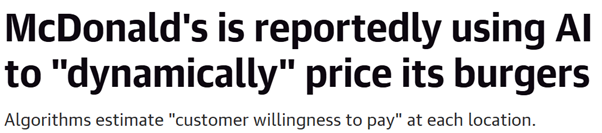
The new system is designed to analyze transactions and local conditions.
That includes competitors’ prices and estimates of how much you’re willing to pay for your Quarter Pounder and medium fries.
Despite the use of this new dynamic pricing model, McDonald’s says franchisees keep control over pricing.
Leaders call the recommendations optional.

However, some franchise owners told Reuters the price recommendations don’t always feel optional.
Dynamic Prices Don’t Always Work in the Company’s Favor
The recommendations are made restaurant by restaurant. But they don’t only point up.
Recently, the system has also suggested cutting some prices.
A lower price can be the more profitable choice if it brings customers back often enough.
McDonald’s is applying better information to that familiar calculation. But it needs to look beyond the immediate sale.
After all, a customer can accept today’s price and still leave thinking the meal wasn’t worth it.
The cost of that disappointment shows up later … when they take their lunch money elsewhere.
Once customers start comparing the bill with other options, McDonald’s has lost some of the convenience that made it the easy choice.
The Long-Term Outlook for In-the-Moment Pricing
A well-designed pricing system should account for repeat purchases and longer-term demand.
Investors should ask whether management actually evaluates it that way.
A sharper forecast of what people will pay is useful only if the business is asking the right question over the right period.
Consider a deliberately simple example.
A restaurant sells 100 meals at $10 each, taking in $1,000.
It raises the price to $11 and sells 95 meals.
Revenue rises 4.5%, even though it serves 5% fewer meals.
Depending on costs, profit could improve, too.
The open question is whether those five lost customers are a sensible trade-off … or the start of a lasting decline.
McDonald’s Has Reason to Care About That Distinction
In its second-quarter results, global comparable sales rose 1.3%, and U.S. comparable sales rose 0.8%.
Comparable sales measure performance at established restaurants. Those can rise because customers visit more often, spend more per visit or both.
With U.S. growth that modest, I would want to know how much came from each.
The Franchise Structure Adds a Wrinkle
About 95% of McDonald’s restaurants worldwide were franchised at the end of June.
The company’s financial disclosures explain that conventional franchisees pay rent and royalties based on sales, subject to minimum rent provisions.
Headquarters gets paid largely on sales. Franchisees get paid on whatever is left after food and labor. The same pricing decision can look quite different from each side.
A discount might bring in enough extra orders to lift sales and the royalties that come with them. At the same time, it could leave the operator with more work and little additional profit.
A price increase could have the opposite effect.
Results May Vary Within the Same Town
The outcome depends on local costs and demand. Which is why a recommendation should be judged against the restaurant’s cash flow as well as the corporation’s revenue.
The two sides still need each other.
Operators need enough profit to maintain their restaurants and invest in improvements.
Shareholders need operators willing and able to do that work.
A pricing tool that keeps disappointing franchisees would become a problem for the whole business — however good its short-term sales numbers look.
There is also a limit to treating each location in isolation.
Customers see the same golden arches above restaurants with very different cost structures.
If a meal at one location feels overpriced, that experience colors what the customer thinks about the whole chain … and what shareholders think about the stock.
What’s Next … Is NEXT
Local pricing decisions have consequences beyond the local spreadsheet.
MCD’s broader technology plans offer a more encouraging route to better economics.
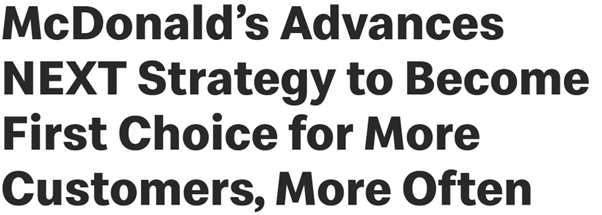
On Sept. 23, the company outlined its NEXT strategy, which includes restaurant modernization, an AI-enabled operating platform and support for franchisees.
The plans include some $8.5 billion in rent relief and capital support through 2036, including about $5 billion through 2030.
The company estimates its targeted efficiency improvements would be worth roughly $100,000 a year in cash flow for the average U.S. restaurant.
McDonald’s expects most of that to eventually reach the restaurant’s bottom line.
Still, those are projections for a broader modernization program that requires investment.
They are not demonstrated savings from the pricing algorithm.
The Economic Logic Is Appealing
If technology helps a restaurant cut waste, organize work better or handle orders faster …
That creates room to improve profits without asking customers to fund the entire gain through higher prices.
Management can then decide how much of the benefit to keep. And how much to spend on making the restaurant more competitive.
That second decision matters.
A business that passes some savings to customers may earn a better return through additional visits.
Efficiency can also pay for better service.
What’s on the Value Menu for Shareholders?
For investors, I would start by watching the number of guests who visit, along with their spend per visit.
Sustained growth in transactions would strengthen the case that McDonald’s is becoming more appealing.
Higher average bills — paired with persistent traffic declines — would suggest the company is squeezing demand rather than preserving it.

I would also watch restaurant cash flow after the cost of new equipment and technology.
Promised savings need to survive installation, training and ongoing expenses.
Franchisees’ willingness to keep investing would show whether the benefits are reaching the people who run the restaurants.
Finally, I would look for evidence that discounts create repeat business.
A promotion can produce a busy afternoon. A customer who comes back without another subsidy is worth a lot more.
For McDonald’s shareholders, AI offers a credible way to improve restaurant profitability while preserving the value customers expect.
Getting there would require management to use better pricing data and operating efficiencies to support demand over time.
I would be more confident in the company’s long-term earnings if those improvements made affordable meals more profitable to serve and left franchisees with more capacity to invest in their restaurants.
Best,
Jurica
P.S. McDonald’s is a 90-year-old company with a Weiss stock rating of “C,” or “Hold.” It’s also down 25% this year.
Meanwhile, a group of new investments we call Apex IPOs ran up as high as 1,924% ... 4,178% ... even 7,245%.
That’s impressive, right? My colleague Chris Graebe says there are more profit opportunities like these coming down the pipe as soon as next week.
Click here before the next one starts to take off!