Micron Stock and the Memory Shortage: What Apple’s Margin Warning Means for Investors

|
Key Takeaways
|
 |
| By Jurica Dujmovic Reviewed by: Dawn Pennington |
Apple (AAPL, “B”) just gave investors another reason to pay attention to Micron (MU, “B-”).
The company behind the iPhone expects rising memory costs to squeeze its holiday-quarter profit margins.
For Micron, major memory producer, those same costs can translate into stronger pricing and bigger profits.
That creates an opportunity for investors. But it hinges on one question: How long will the imbalance between supply and demand last?
Let me explain …
Apple’s Extraordinary Last Quarter
Micron benefits when customers compete for scarce supply. But investors need those favorable conditions to last long enough to justify the price they pay for its shares.
Apple offers a useful look from the customer's side.
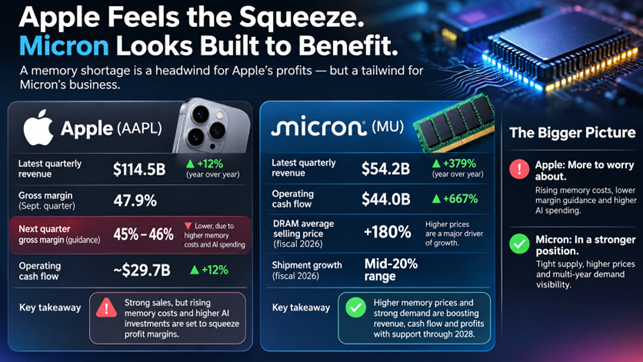
Its Nov. 2 earnings release showed September-quarter revenue of $114.5 billion, up 12% from a year earlier.
Demand was strong enough to produce a record September quarter. Yet, rising component costs complicated the outlook.
On the earnings call, management forecast a December-quarter gross margin of 45% to 46%.
Gross margin measures the share of revenue left after the direct costs of delivering products and services, before operating expenses and taxes.
Apple's September-quarter gross margin was 47.9%, although tariff refunds added roughly one percentage point. Excluding that benefit puts the figure near 46.9% — still above the holiday-quarter forecast.
Apple also cited costs associated with expanding Siri AI.
Memory is a major source of pressure. But blaming the entire margin decline on memory would overstate the case.
Apple has tried to cushion the impact by using components purchased earlier at lower prices.
Related story: Why AI Data Centers Are Ditching the Grid
Management nevertheless expects memory purchases to become more expensive beyond December.
That warning matters because it suggests the pressure extends beyond a single product launch or holiday season.
Apple's strong sales also illustrate an important point: Demand alone cannot protect profit margins when component costs rise.
Why Micron Isn’t Sweating These Supply Issues
For Micron, which makes the components Apple and other manufacturers need, higher memory prices can increase the profit earned on each sale.
The AI buildout is driving demand for several types of memory. High-bandwidth memory (HBM) feeds data to powerful AI processors, while servers also need conventional working memory and storage.
That means the demand extends well beyond the specialized chips attached to AI accelerators.
Micron's prepared earnings remarks describe the manufacturing constraint behind this squeeze …
Expanding HBM production consumes capacity. Limited factory space and long construction lead times also restrict how quickly overall supply can grow.
Improvements to existing production processes help, but they cannot deliver all the additional memory customers want overnight.
The memory inside an iPhone isn't interchangeable with an HBM stack. The connection is the industry's limited ability to expand production across competing uses.
As suppliers decide where to invest and which customers to serve, shortages can spread through the broader market.
Micron's financial results show the benefits.
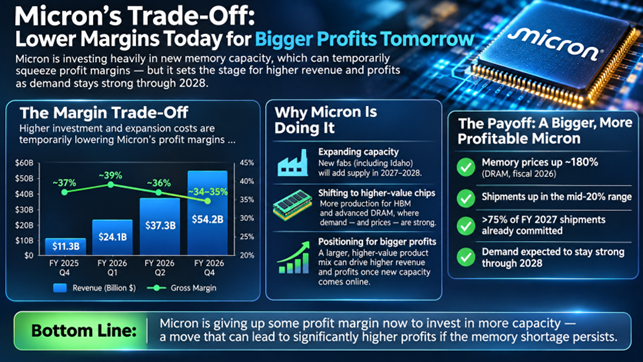
In its fiscal fourth quarter ended Sept. 3, revenue reached $54.23 billion, compared with $11.32 billion a year earlier. Operating cash flow rose to $43.97 billion from $5.73 billion.
Those are extraordinary gains. But the growth wasn't simply the result of shipping more chips.
Pricing played a major role.
- Micron's annual report says average DRAM selling prices increased approximately 180% in fiscal 2026.
- Meanwhile, the amount of memory shipped rose in the mid-20% range.
Higher prices played an outsized role in the company's growth. That makes the duration of the shortage especially important.
If pricing stops improving, investors will need more help from shipment growth, manufacturing efficiency and a favorable product mix.
Management sees demand extending well into the future.
On Micron's latest quarterly call, executives said more than 75% of fiscal 2027 shipments were committed. They also described supply conditions as supportive of a strong outlook through 2028.
Commitments like these provide visibility. They don’t guarantee future sales or profits.
New factories also take time to come online.
Micron's annual report projects initial wafer output from its first new Idaho factory in mid-2027, with a second Idaho factory expected to begin production in late 2028.
And initial production is only the beginning. It takes additional time to bring a factory up to full capacity.
Too Good to Last
Those delays support the investment case today.
But they also point to the eventual risk …
Micron and its competitors are working to relieve the very shortage that gives them pricing power.
Micron expects capital spending, after government incentives, of approximately $25 billion in the first half of fiscal 2027, with additional spending in the second half.
That expansion absorbs cash today while increasing the supply customers can buy tomorrow.
The other risk comes from customers themselves.
If higher component costs make phones and computers too expensive, buyers can postpone replacements.
Apple has already raised prices on some products, and Reuters reports that soaring memory costs have weighed on the broader electronics market.
Simply put, suppliers can’t just trust customers to absorb unlimited increases.
Which means — for both Micron and its investors — there is a fine balance to target.
What to Watch
Investors should keep a close eye on three things:I suggest you keep a close eye on the relationship between three things …
- Pricing: Are memory prices still rising, or have they started to level off?
- Shipments: Is demand strong enough to support healthy shipment growth?
- Cash flow: Can Micron fund its expansion without putting too much pressure on its finances?
Rising prices alongside healthy shipment growth would support the case.
But weakening orders, growing inventories or expansion spending that eats more and more operating cash are signs caution is called for.
Valuation needs the same discipline.
Dividing a stock price by unusually strong earnings can make a cyclical business look cheaper than it really is.
Here’s an example …
Consider a hypothetical stock trading at 10x annual earnings. If those earnings were cut in half while the share price stayed unchanged, its P/E would double to 20x.
That's why the durability of earnings matters as much as the multiple attached to them.
Before treating Micron's valuation as a bargain, ask what it would look like with lower memory prices and more ordinary profit margins.
Bottom Line
Apple's warning strengthens the case for studying Micron because it shows how customers are feeling the shortage firsthand.
But it doesn't establish an attractive entry price by itself.
The opportunity lies in Micron's ability to sustain strong profits — not in assuming today's shortage will last forever.
Investors should focus on a valuation that leaves room for the cycle to turn.
Best,
Jurica Dujmovic