NYSE Picks Avalanche (AVAX) for Tokenized Stocks as Wall Street Goes All In on Crypto

|
Key Takeaways
|
 |
| By Marija Matic Reviewed by: Beth Canova |
There’s something strange happening this week.
Bitcoin (BTC, “B+”) just closed its fifth straight red week. That alone is worth paying attention to. Since 2016, it has gone this long without a green week only twice before.
Bitcoin ETFs bled $1.28 billion. And over the weekend, about a billion dollars in leveraged bets were wiped out in a single day.
That was enough to push BTC down to about $73,800 earlier today, though it has since bounced to sit above $74,000 as I write.
Yet in the very same week, we saw massive developments in terms of broad crypto adoption …
- The New York Stock Exchange picked a blockchain to settle tokenized stocks,
- Charles Schwab opened its doors to more altcoins,
- And Coinbase (COIN, “D+”) became a federally chartered trust bank.
Price is telling one story.
Adoption is telling a completely different one.
Let's unpack both.
How a Stock Sell-Off Became a $1 Billion Crypto Flush
Bitcoin fell from last week’s $80,000 as AI bubble fears spread from stocks into crypto.
But the real damage was done by leverage.
In the two weeks before the drop, traders kept piling into leveraged bets on higher prices. That pushed Bitcoin futures open interest to its highest level since Sept. 22.
In other words, a lot of traders were leaning the same way.
Then the floor moved.
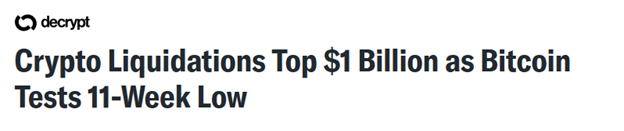
In the 24 hours leading into today, CoinGlass counted about $1 billion in positions liquidated. And most of them were long.
When traders can't cover their losses, exchanges close their positions automatically.
Every forced sale pushed Bitcoin, Ethereum (ETH, “B+”) and the rest of the market lower, triggering the next round of liquidations.
The forced selling has now stopped or slowed for some coins. Others are already rebuilding leverage, with juicy liquidity sitting on both sides of the market.
Translation: Buckle up, more volatility is likely.
ETFs added to the pressure, losing $1.28 billion last week, the biggest weekly outflow since late June.
But a closer look gives important context: About 94% of it came from BlackRock's iShares Bitcoin Trust (IBIT, Not Yet Rated) alone.
Meaning this wasn't a broad exodus, but one giant fund doing most of the selling.
The Treasuries Aren't Selling
While ETF holders headed for the exits, the biggest corporate buyers kept stacking.
Strategy (MSTR, “D”) bought another 1,036 BTC for $81.9 million for an average of roughly $79,000 per coin. It also repurchased $188 million of its STRC preferred stock.
BitMine (BMNR, “D-”) added 9,587 ETH last week. That brings its holdings to 6,070,092 ETH.
To put that into perspective, that’s about roughly 4.97% of all ETH in existence, or nearly one in every twenty ETH.
The company plans to continue its purchases until it hits 5%. That would leave room for only about 40,000 more ETH, unless it raises the cap.
It has 5.23 million ETH staked and says staking all of it could earn about $359 million a year at its current 2.65% yield.
And that bet is backed by real usage.
Ethereum is busier than ever: Its mainnet is averaging a record 2.16 million transactions a day in 2026, up 51% from 2025, with a record 899,000 active addresses a day.
Five Red Weeks & the Technical Set Up Underneath
Five red weeks in a row is a rare sight.
Since 2016, Bitcoin has reached that mark only twice before, and neither streak stopped at five:
- The first, in 2022, continued for nine weeks.
- Then, this past February, we saw a red run last for six weeks.
But today’s set up is different.
Both of those streaks came in the first half of a bear market, when Bitcoin’s price was already trading below the bull market support band.
Both were brutal capitulation sweeps that led straight into a major low.
This time, the losses so far are much shallower. And more important, the price is still holding above its key supports.
Bitcoin almost tested its yearly volume-weighted average price (VWAP) support around $73,400. And the last key support — the 200-day moving average — sits just below there at $73,200.
Many traders will place bids near $73,000, while others wait for a strong breakout above $76,000, the level needed to confirm a bullish bias.
In short, the bulls need a pump this week. Otherwise, they lose short-term momentum.
There's a silver lining, though: The recent drop delivered exactly the rapid cool-off the stochastic relative strength index (RSI) was calling for.
So, to recap …
- Funding is neutral,
- The Fear & Greed Index is still in Fear,
- Overheated indicators have reset,
- And leverage has been flushed.
None of that guarantees a rally. But the technical groundwork for one is already in place.
Wall Street Builds Through the Dip
There’s one group of investors who noticed that groundwork: Institutions.
Which is why if you only watched the charts, you'd miss the bigger story. That is that, through the correction, TradFi continued its move on-chain.
Three developments in particular deserve the spotlight.
The first is all about Avalanche (AVAX, “B”). Itjumped today on the news that it has been chosen to serve as the core ledger for clearing and settlement on an upcoming tokenized securities platform run by an NYSE affiliate.
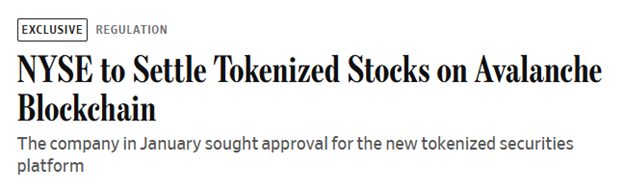
The platform will support stocks issued on multiple chains. But everything will settle on Avalanche, around the clock and instantly. Pending regulatory approvals, of course.
This isn't a pilot: The setup was tested for a full year.
In the announcement, NYSE's Dennis Lee said Avalanche delivers the fast, reliable performance and the developer ecosystem the platform needs.
The second features the largest retail brokerage in the U.S., Charles Schwab.
Today, it announced it’ll expand its crypto offerings to include Solana (SOL, “B-”), Chainlink (LINK, “C”) and AVAX. The move brings its lineup to five assets, alongside BTC and ETH.
The service opened to all eligible retail clients in October — except for those in New York and Louisiana — with a 0.75% trading fee.
This puts AVAX on both sides of Wall Street in a single day: settling NYSE-linked trades and sitting in Schwab clients' accounts.
The third development is all about Coinbase.
The leading centralized exchange in the U.S. also received final approval from the Office of the Comptroller of the Currency for a national trust bank charter.
With it, Coinbase can now run crypto custody, payments and potentially stablecoin issuance under federal oversight. However, it still can't take ordinary deposits or make loans like a commercial bank.
Why Markets Bounced Today
Wall Street opened this week in a much better mood, thanks to a potential peace deal in the Gulf. President Trump is expected to meet Qatar's prime minister today to discuss it.
Oil, though, didn't wait for the meeting.
It fell 4% in six hours, slipping below $90 a barrel. Buyers took that dip as their cue. They rotated back into tech, adding more than $1.5 trillion to U.S. stocks.
That's quite a turnaround from Thursday, which saw the AI-driven sell-off — the fastest pace of retail selling since the Covid pandemic, according to Vanda Research.
The trigger was political. After the Democrats' strong midterm results, investors started pricing in permitting delays, large-load electricity tariffs on data centers and fewer tax breaks for the AI build-out.
The market's shorthand was simple: Democrats = bad for AI.
Not everyone buys the doom, though.
Vitalik Buterin — the co-founder ofEthereum — argued that slowing the data center boom may do more good than harm.
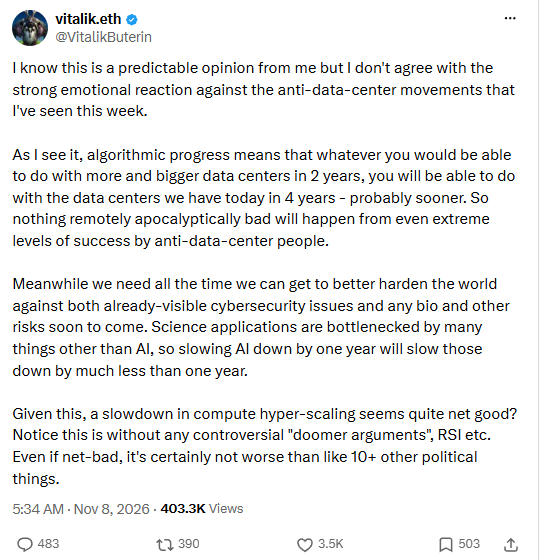
In a recent X post, he said that it could give society time to tackle the cyber and bio risks AI brings. At the same time, the efficiency gains will keep AI progressing on existing hardware.
Follow the Revenue
Crypto prices are down about 30% from a year ago. Blockchain revenue fell 28%, roughly in step.
So far, no surprise.
But a new report from 1kx Capital shows that where the money comes from is changing fast:
- Crypto card spending tripled year over year, hitting $3.4 billion in Q3 2026.
- Real-world use like cards, tokenized assets and prediction markets now generates 33% of all fees. In Q3, it overtook blockchain infrastructure for the first time ever.
- Public companies now earn 16% of crypto revenue, up from 7% in 2022.
- Tokens that pay holders win. 1kx's dividend-token index is up 82% this year.
Even after the price drop, total crypto revenue is on track for about $100 billion in 2026.
According to 1kx, adoption is growing where legacy systems can't deliver yet. For example, in 24/7 tokenized stock trading and middlemen fees.
The ultimate example is Tether.
At the Plan ₿ Forum in Lugano, CEO Paolo Ardoino said the USDT stablecoin now serves more than 730 million users and adds 30 million wallets every quarter, faster than any fintech company on the planet.
A few hundred lines of smart contract code now let people in countries with inflation as high as 100% hold U.S. dollars.
The One Cloud on the Horizon
The biggest macro risk right now comes from central banks.
They’re hiking rates again, with about 45% having raised rates over the past three months.
Just this spring, more of them were cutting rather than hiking.
The U.S. isn't in the clear either. The New York Federal Reserve's latest survey shows one-year inflation expectations at 3.91%, above forecasts. Meanwhile, fears of rising unemployment have hit their highest level since April 2020.
Today's oil drop may not change that on its own.
The deal isn't done yet, and if it falls apart, oil and inflation worries could come right back.
The Bottom Line
The charts and the headlines are pulling in opposite directions.
On the bear side, we see …
- Five red weeks,
- A billion dollars in liquidations,
- And the biggest ETF outflow since June.
On the bull side, we see a line of positive news and developments.
And the people who own most of the Bitcoin seem to know which side they're on. More than half — 64.98% — of all BTC hasn't moved in over a year, up from 61.27% a year ago.
That share tends to shrink as price climbs toward a cycle high, because seasoned holders sell into strength, which is exactly why it was lower a year ago.
Now it's rising again.
Historically, these holders have been good at knowing when to sell and when to sit tight. Some of today's year-old coins were bought near last year's highs.
But whether investors are holding out of conviction or patience, the message is the same: They're not selling at these prices. Even as leveraged traders got shaken out.
Whether price starts to catch up with adoption could come down to how things play out this week …
Whether the US-Iran deal gets done.
How AI earnings land.
What the U.S. inflation data shows.
And, of course, whether Bitcoin can break back above $76,300.
All should be on your radar as we move through this week.
Best,
Marija Matić
P.S. You can monitor these critical developments yourself. Or, you can click here to save your seat for my colleague and cycles expert Juan Villaverde’s urgent crypto briefing tomorrow at 2 p.m. Eastern.
That’s when he’ll explain how his Crypto Timing Model blocks out the noise to see what the market is really doing right now … and what it’ll likely do in the medium-term.
And, he’ll let you know how you can benefit from his model’s specific “buy” and “sell” alerts.