OpenAI Fires New Shots Against Google, Meta in the Digital Ad War

 |
| By Jurica Dujmovic |
OpenAI has entered its ad era.
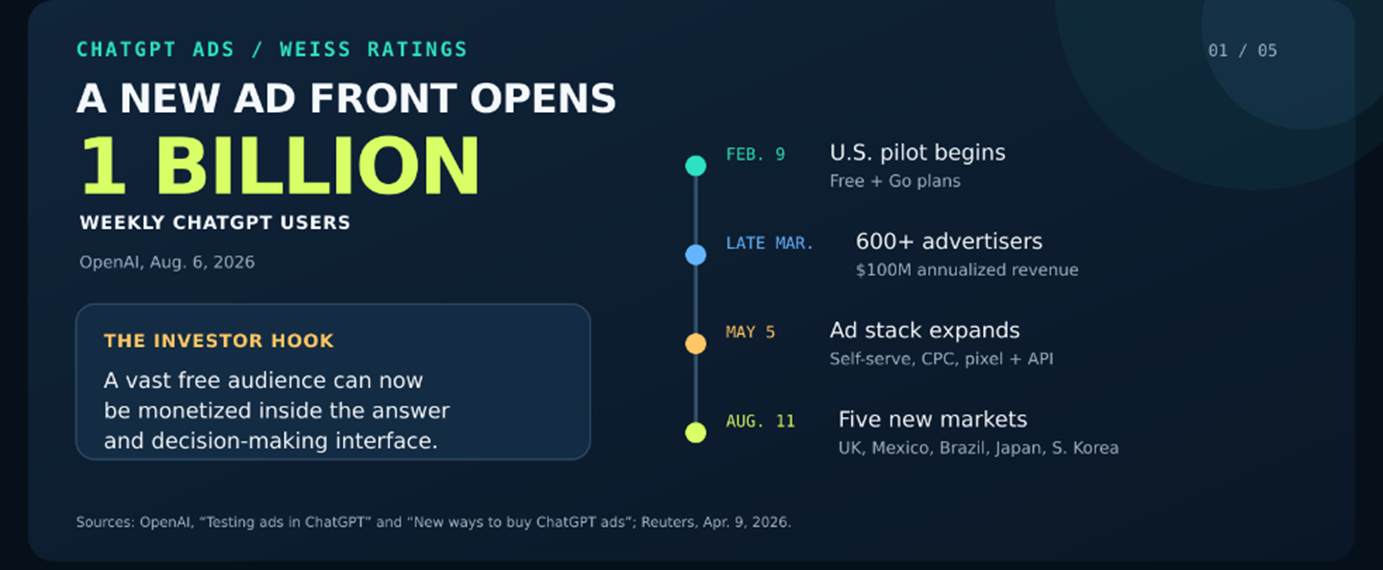
Back in February 2026, the company rolled out a pilot program to test ads on ChatGPT in the U.S. and, after a few weeks, Canada, Australia, and New Zealand.
Two days ago, this rollout hit a new phase — expansion to the United Kingdom, Mexico, Brazil, Japan and South Korea.1
This is big: A service used by 1 billion people each week2 now has a way to turn free conversations into revenue.
And already, Wall Street has started to ask which advertising platforms will lose share.
The rushed investment conclusion3 is to treat that threat as a verdict: Alphabet Inc. (GOOGL) and Meta Platforms Inc. (META) are about to lose their core advertising businesses to a new interface.
I think that leap is quite premature. But plenty of talking heads are buying in. And it’s not hard to see why.
The Threat Is Already Real
OpenAI moved faster than I expected.
Its U.S. pilot crossed $100 million in annualized revenue within six weeks. In that time,4 it attracted more than 600 advertisers, according to an OpenAI spokesperson cited by Reuters.
Investor presentations reported by Axios projected $2.5 billion of ad revenue in 2026 and $100 billion by 2030. OpenAI did not confirm those forecasts, however. And the 2030 figure assumes its products reach 2.75 billion weekly users.
Still, the launch has already advanced beyond an experiment that investors can dismiss.
ChatGPT also owns something advertisers value: a conversation that can reveal intent before a conventional search query does.
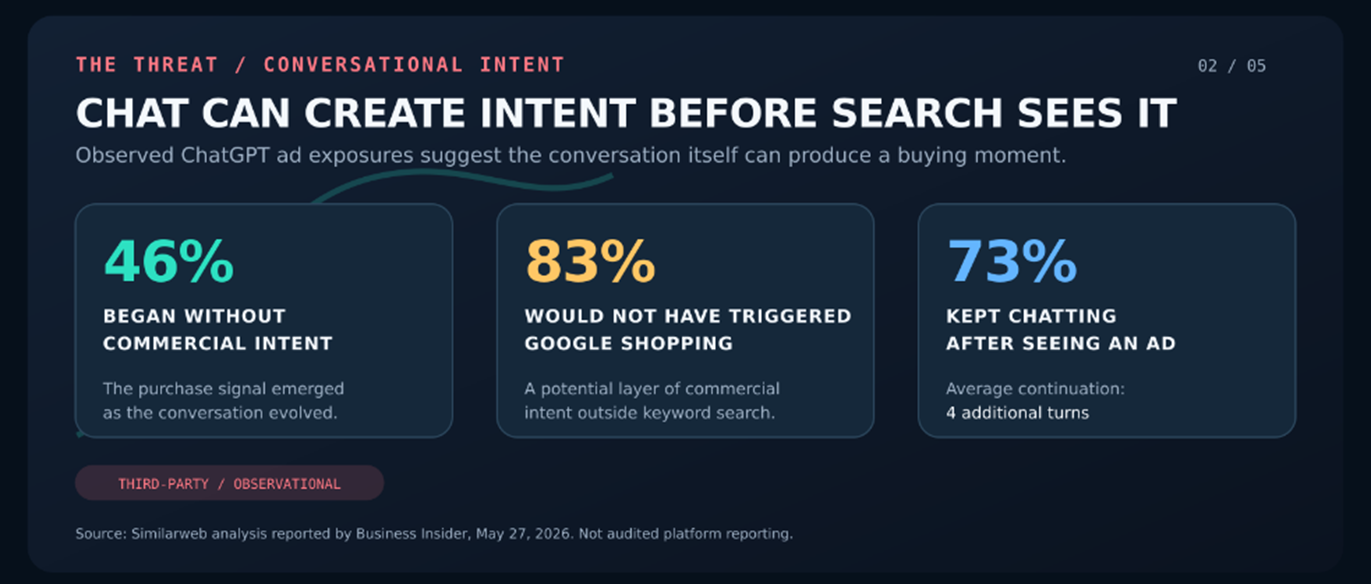
Similarweb analysis reported by Business Insider5 found that 46% of users who eventually saw an ad began without commercial intent. Meanwhile, 83% of the ad-triggering queries would not have activated a traditional Google Shopping ad.
In one example, a conversation about preparing for an interview eventually produced an Indeed ad after 30 turns.
That third-party study is merely observational, so its estimates deserve caution. Even so, the concept is important.
Google monetizes an expressed request such as “best noise-canceling headphones.” ChatGPT can watch a broader problem evolve until headphones become the answer.
In short, OpenAI may create commercial intent inside a conversation. Instead of waiting for the shopper to announce it.
Trust Creates New Value
Another potential feather in OpenAI’s ad cap is its restraint. Which could, in turn, support premium pricing.
ChatGPT currently places sponsored units separately from the answer. Advertisers cannot see conversations or personal details, and ads are excluded around health, mental-health and political topics.
Not only that, but the type of account you have could remove ads entirely. Accounts identified as belonging to minors are ineligible — Plus, Pro, Business, Enterprise and Education customers remain ad-free. And even Free users can opt -out of ads in exchange for fewer daily messages.
These choices protect the trust that makes a recommendation inside ChatGPT valuable. It also means the company must find a balance where an ad remains scarce … but also helpful enough to avoid contaminating the answer.
OpenAI’s reported $100 billion target for 2030 would make it one of the world’s largest advertising businesses. The projection assumes nearly tripling the company’s weekly audience from today’s 1 billion to 2.75 billion, while lifting revenue far beyond its current annualized starting point. Investors should treat that figure as an ambition based on aggressive assumptions, not a forecast that has already been earned.
This is the strongest part of the legacy platforms’ bear case.
But it’s not the only argument worth hearing out.
OpenAI Has Built Something That Already Existed
The bear case for OpenAI assumed it would struggle for years to reproduce basic buying and measurement tools.
That assumption is now stale. But it may not materially change the set up.
In May, OpenAI introduced a self-serve Ads Manager.6 Complete with campaign budgets, bidding, pacing and performance reporting. It added cost-per-click bidding alongside impression-based purchasing, plus a Conversions API and pixel measurement for purchases, leads and sign-ups. It has also connected its pilot to Criteo’s ad-buying interface.7
These products give advertisers the minimum loop they need:
- Buy an ad,
- Measure a click,
- Observe a conversion,
- And adjust spending.
OpenAI says advertisers receive aggregate results without being able to read individual chats. The company also says early tests showed low ad-dismissal rates and no impact on its consumer-trust metrics.
Here’s the thing, though: Google and Meta already offer these features.
The gap between OpenAI and established ad platforms is therefore a matter of depth, distribution and accumulated optimization. Not just the mere presence of an ads dashboard.
Both incumbents already connect huge pools of advertisers, creative assets, merchant catalogs, conversion histories and automated bidding systems. Every new campaign gives those systems more opportunities to learn which impression produces a sale.
OpenAI can build the same loop, sure. But it begins with less history and a deliberately limited supply of ads.
Put simply, Google and Meta have first mover advantage. And a broader ecosystem to run more ads.
Google’s Latest Search Upgrade
Unsurprisingly, Google’s latest numbers do not show an advertising franchise in retreat.
In the second quarter, Google Search & other revenue rose 17%8 to $63.27 billion. Total Google advertising revenue reached $81.63 billion, up from $71.34 billion a year earlier.
The revenue figure itself undermines the claim that conversational answers have already broken Search economics.
Google is also pursuing the same format that makes ChatGPT interesting. In May it announced conversational ads and highlighted sponsored answers in AI Mode.9
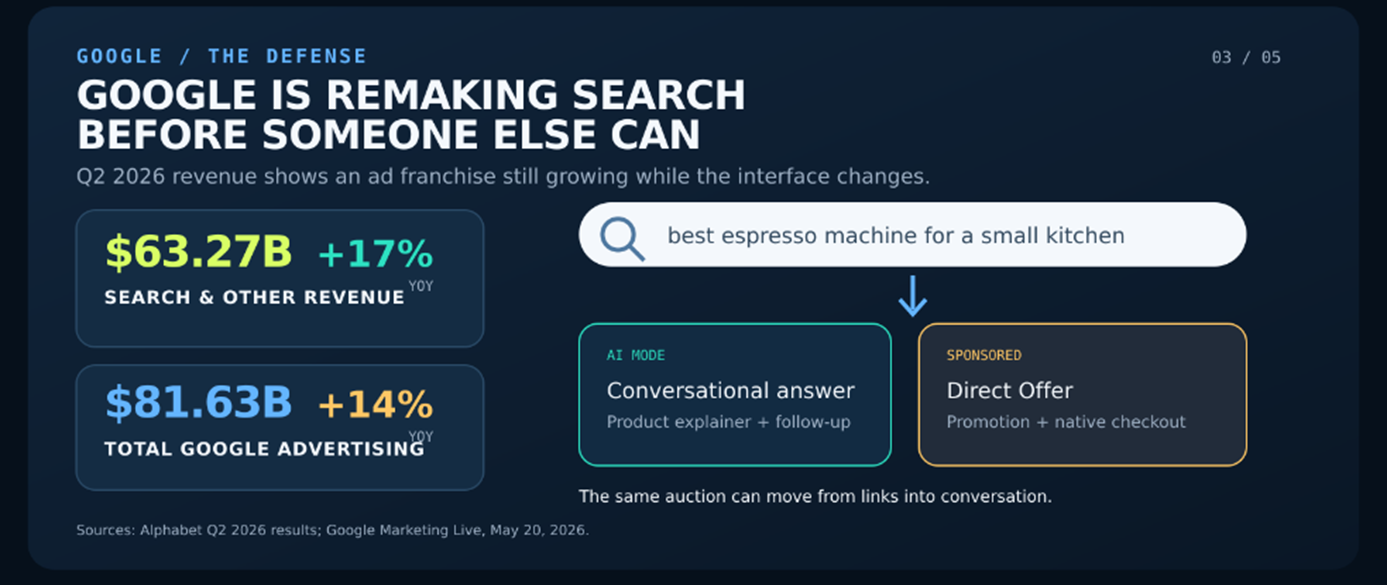
This would let Gemini generate product explanations tailored to a question.
Google’s Direct Offers pilot can surface promotions during product research, while its Universal Commerce Protocol integration supports native checkout. Travel partners including Booking and Expedia are due to place offers inside AI-assisted trip planning.
This gives Alphabet an unusual defensive advantage: If users move from ten blue links to an AI conversation inside Google, the company can move the advertising unit with them.
It still risks losing queries that migrate entirely to ChatGPT. And AI answers cost more to serve than a conventional results page.
But the Q2 evidence shows that Google can change the interface while continuing to grow the business.
Meta’s Battle Is Slightly Different
Meta belongs in the same advertising conversation, no doubt. But its exposure is less direct, which means this isn’t an apples-to-apples comparison.
Google and ChatGPT often meet a user who is researching a decision. Facebook and Instagram are designed to create discovery while a user scrolls.
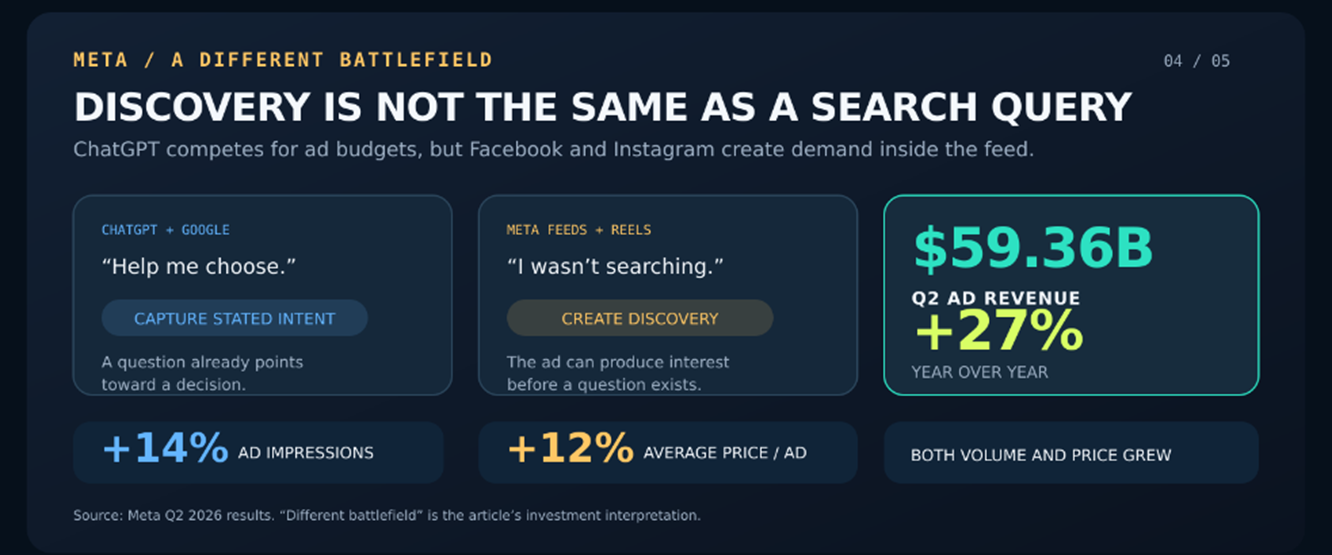
In the latter context, an ad for running shoes can work even when the customer did not ask about running shoes. ChatGPT will compete for the same marketing budget, but it doesn’t automatically replace that discovery function.
Meta’s second-quarter performance supports that distinction. Its advertising revenue rose 27%10 to $59.36 billion. Ad impressions increased 14%, and the average price per ad rose 12%.
Meta is getting more inventory in front of users. And charging more for it at the same time.
Again, revenue growth shows that its ad system remains commercially healthy.
What Investors Should Watch
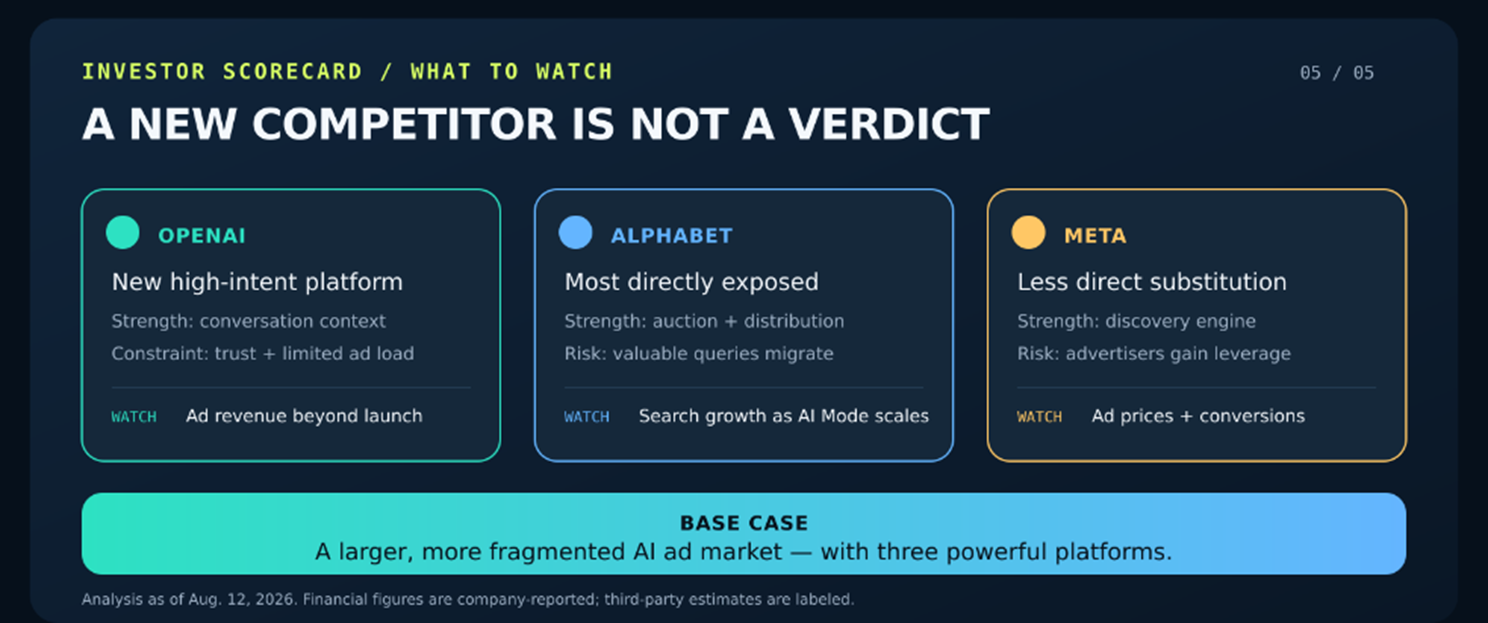
Ads ChatGPT ads are a credible threat to the existing marketplace. Particularly to Google’s high-intent search inventory.
But this disruption likely isn’t strong enough to displace the market dominators. All OpenAI has done is build out the ad machinery those giants already operate at a much larger scale.
At the same time, Google is inserting conversational advertising into Search. And Meta continues to improve the recommendations that drive its own ad returns.
Here’s my take: Instead of overtaking, OpenAI simply becomes a major third advertising platform. That outcome can be extremely valuable for OpenAI without threatening Alphabet or Meta.
For public-market investors, the early rollout looks more like validation of AI-powered advertising than proof that the existing leaders have lost their moat.
That’s the thesis forward-looking investors will want exposure to.
And it means I don’t suggest anyone sell their existing Alphabet or Meta positions simply because ChatGPT now carries ads.
With OpenAI still a private company, Alphabet and Meta are the cleanest listed exposures to the broader shift toward AI-mediated advertising.
For Alphabet, you’ll want to watch Search revenue growth as AI Mode expands.
- If query activity rises but Search revenue stalls, that could be a sign that conversational answers are cannibalizing valuable clicks faster than Google can monetize them.
- On the other hand, continued double-digit Search growth would show that Google is carrying its auction into the new interface.
For Meta, watch the combination of ad impressions, price per ad and reported conversion improvements.
- Weakening prices while impressions rise would suggest that new channels — like ChatGPT — give advertisers more bargaining power.
- Rising prices and conversions, however, would indicate that Meta’s discovery engine retains its value even as conversational inventory grows.
Bottom Line
ChatGPT’s early success demonstrates how valuable high-intent AI advertising can become.
But that doesn’t mean this disruption will shoot OpenAI to the top of the leaderboard.
Alphabet already owns the largest machine built to monetize that behavior. While Meta remains strongest at creating demand before a question is asked.
The available evidence points toward a larger and more fragmented AI advertising market, with three powerful platforms serving different moments in the customer journey.
OpenAI’s arrival changes the contest. It has not yet decided the winner.
Best,
Jurica Dujmovic
P.S. Market shifts like what OpenAI kickstarted aren’t rare. The trick for investors is to understand whether the headlines change your investment thesis or not.
To do that, you’ll need the right data. Over the past 22 years, every stock rated “Buy” by Weiss Ratings has delivered an extraordinary average return of 303% — including losers — in bear and bull markets.
Now, our Weiss Ratings Plus features make it easier than ever to use our trusted ratings and research so you can make smarter, faster and more confident investment decisions.
Learn how this data-powered investing tool can help you here.
1 https://openai.com/index/testing-ads-in-chatgpt/
2 https://openai.com/index/improving-gpt-5-6-sol-in-chatgpt/
3 https://www.businessinsider.com/openai-ads-chatgpt-25b-business-2030-advertising-google-meta-2026-1
6 https://openai.com/index/new-ways-to-buy-chatgpt-ads/
8 https://s206.q4cdn.com/479360582/files/doc_financials/2026/q2/2026q2-alphabet-earnings-release.pdf
9 https://blog.google/products/ads-commerce/google-marketing-live-search-ads/