OpenAI’s Revolving Door Leadership Leaves Big Questions Ahead of Its IPO

 |
| By Jurica Dujmovic |
OpenAI has proved that investors will give it almost unlimited capital.
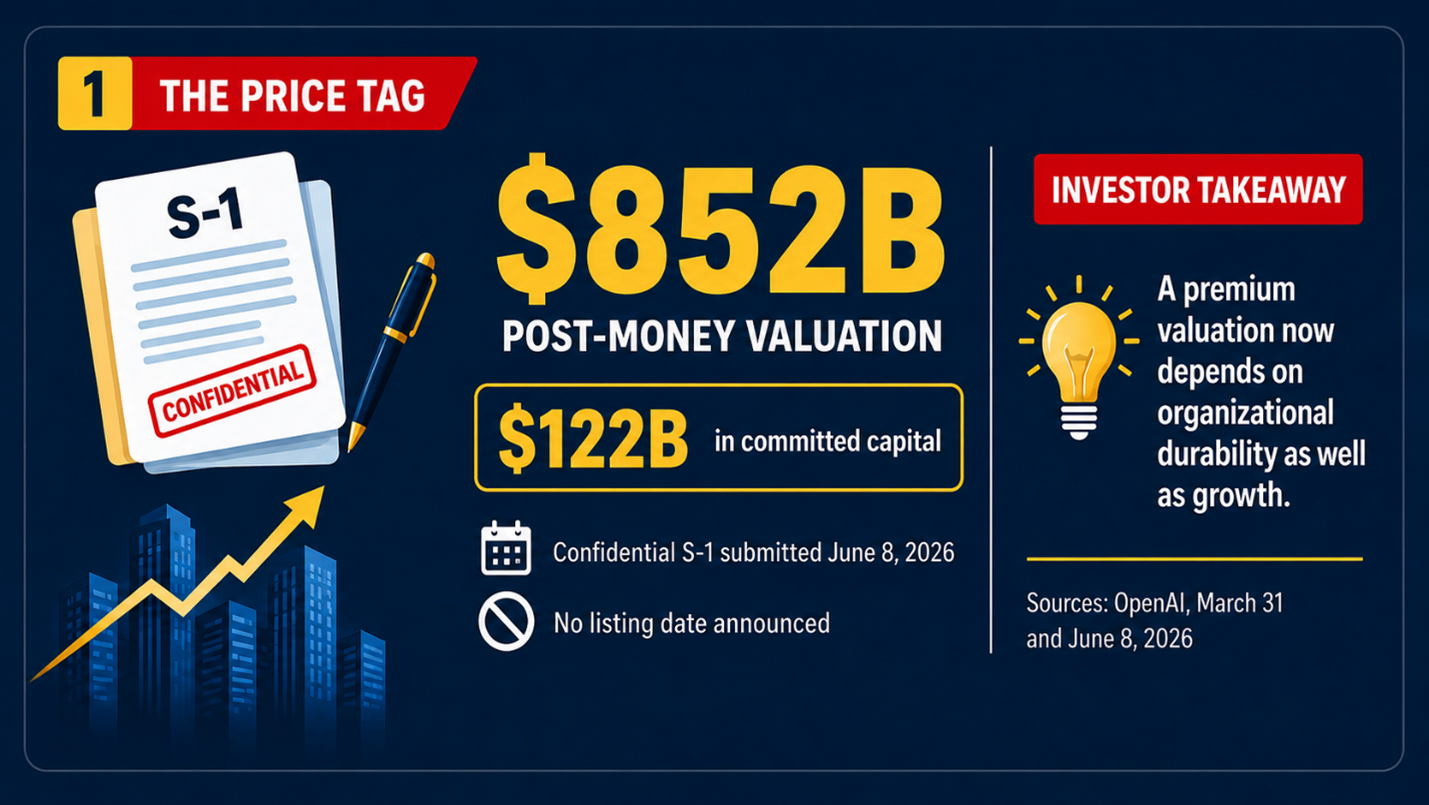
The ChatGPT maker raised $122 billion1 in March at an $852 billion post-money valuation. In June, it confidentially submitted a draft S-12 to the Securities and Exchange Commission, giving itself the option to go public without committing to a date.
Since then, the questions surrounding the offering have expanded beyond revenue, losses and computing costs.
Because what OpenAI has yet to prove is that it can turn its revolving leadership team into a durable public company.
The Revolving Door: Who’s Leaving & Why
Business Insider now counts 13 prominent leaders3 who have left or stepped back during 2026. The latest is Chris Malone,4 the executive who had overseen one of the company’s most capital-intensive functions: data centers.
The raw number makes for a dramatic headline.
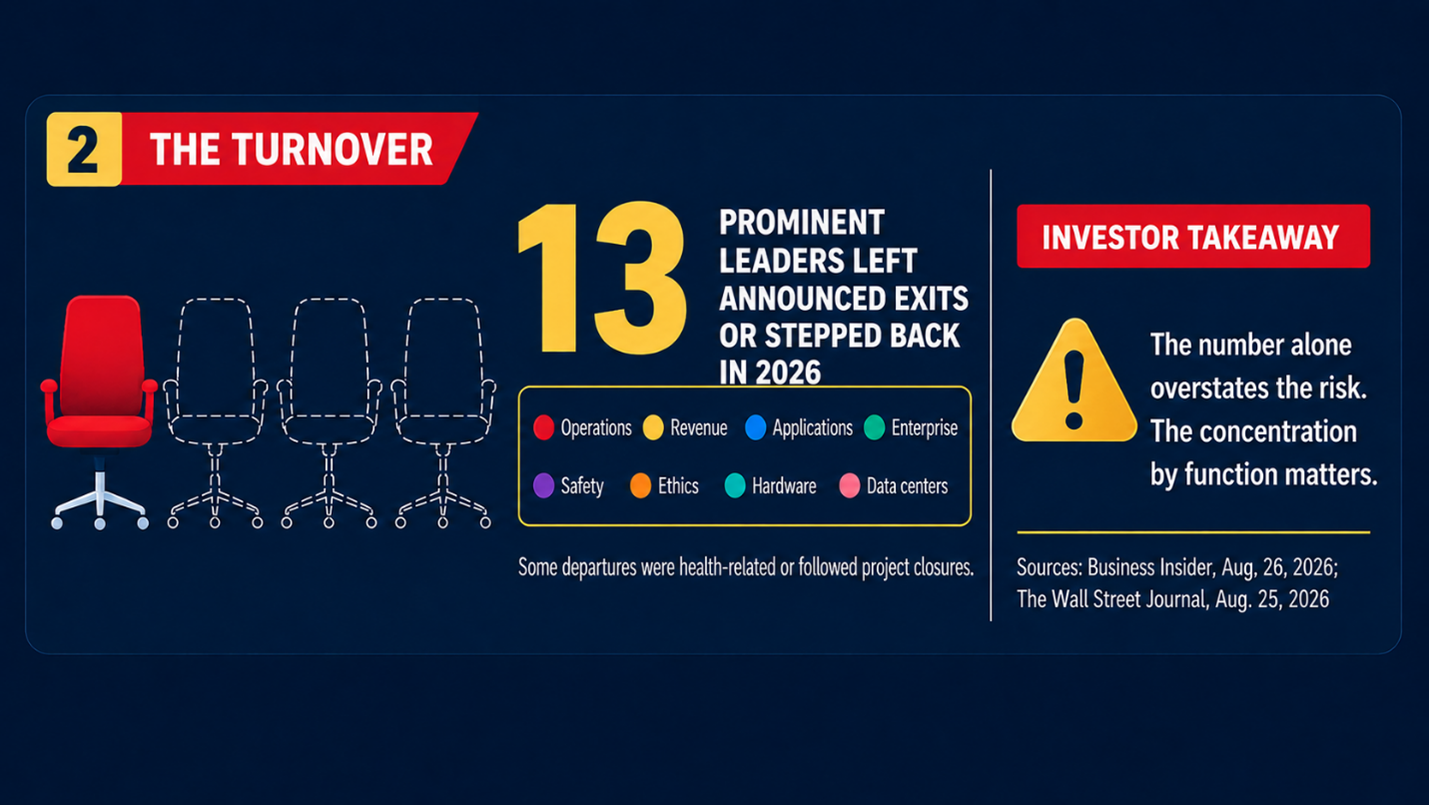
However, anyone truly interested in this IPO should really focus on the composition of the list. That makes for a stronger investment question.
Namely because not all departures are the same.
Fidji Simo, for instance, previously OpenAI’s applications chief and was effectively Sam Altman’s second-in-command. However, he stepped away for personal health reasons. Marketing chief Kate Rouch left because of the same reason.
Treating those exits as evidence of corporate dysfunction would be unfair. But the other departures that look very different.
Brad Lightcap, for example, had been at OpenAI since 2018, where he served as both CFO and COO. But he had already moved away from managing large organizations before announcing that he would start something new. OpenAI said his exit should not affect its teams.5
Denise Dresser left her role as CRO6 after roughly eight months, even though she had recently absorbed many of Lightcap’s commercial responsibilities. OpenAI appointed former Wiz president Dali Rajic7 to replace her, limiting the immediate vacancy.
Yet Kaylin Voss, vice president of sales for the Americas, resigned shortly afterward.
And the pattern extends beyond sales. OpenAI has also lost its …
- CTO for business applications,
- Head of ethics,
- Leader of its safety-systems team,
- Former chief futurist,
- Leader of its robotics and consumer-hardware group
This sequence matters.
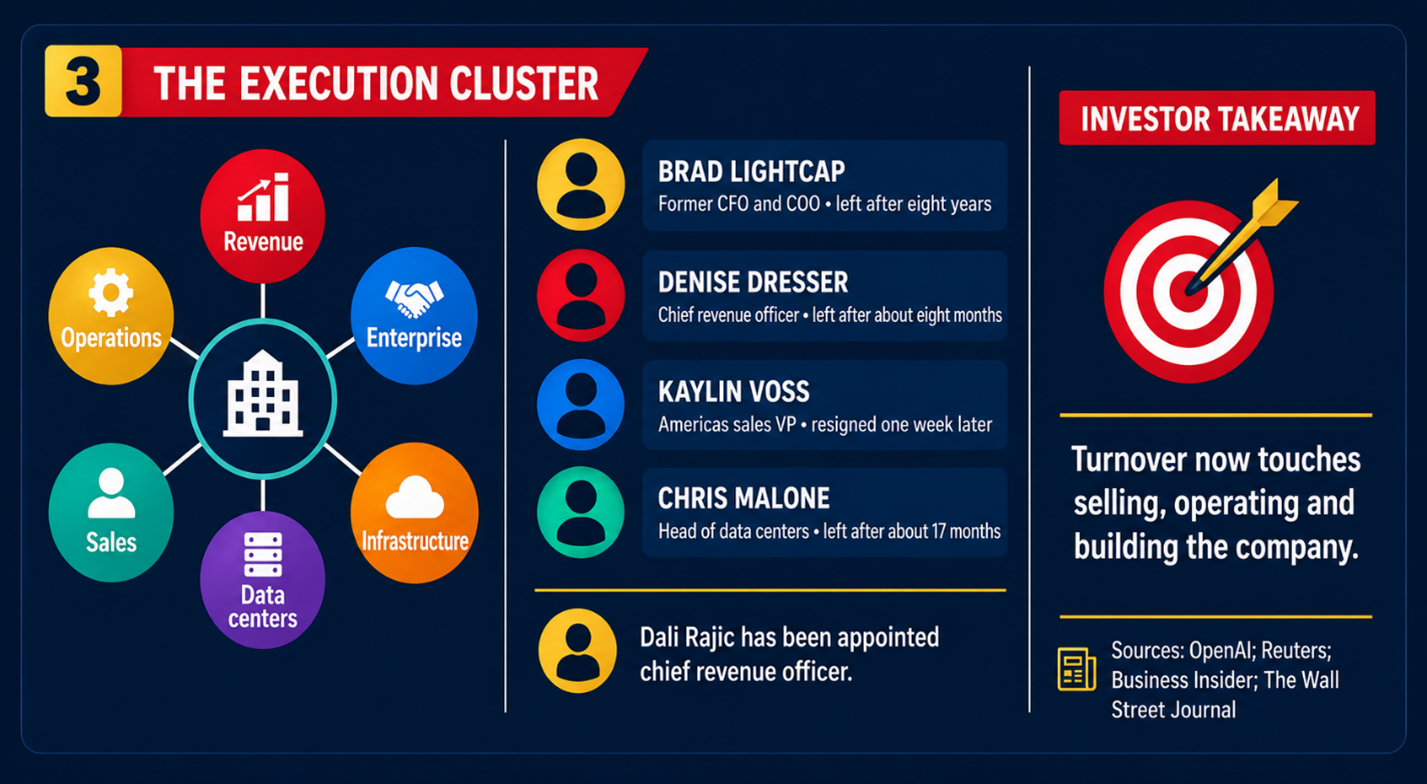
OpenAI is trying to convert extraordinary consumer reach into repeatable enterprise sales. Revenue leadership is the machinery that turns technological advantage into contracts, renewals and predictable forecasts.
Replacing one executive can be healthy. Rebuilding multiple layers of the same function while preparing for an IPO raises execution risk.
Just ask my colleague Chris Graebe.
As a startup investing specialist, he’s put his money in 35+ private companies. These were startups valued at just a few million dollars in total when he first invested.
Today, they’re worth a combined $1 BILLION and counting — including the few that didn’t work out.
And he always says the one thing he must see before he invests is a strong team, anchored by the right founder. That makes all the difference for early-stage investments in his experience.
To be fair, OpenAI President Greg Brockman has argued that the company’s visibility causes every departure to receive unusual scrutiny.
He has a point. Senior people move frequently across the AI industry — where top researchers have received compensation packages exceeding $10 million a year8 and rival companies have used nine-figure offers to recruit them.
Several departures also followed reorganizations or the closure of projects. That may reflect useful discipline.
But the issue is it also leaves investors in a lurch, trying to work out whether OpenAI is narrowing its strategy or repeatedly changing it.
OpenAI also retains an experienced core that includes Altman, Brockman, CFO Sarah Friar, CRO Mark Chen and chief scientist Jakub Pachocki.
That puts the responsibility on individual investors to decide whether that core represents a deep management bench … or a growing concentration of responsibility around a shrinking number of people.
Frontier AI Magnifies Key-Person Risk
There’s another angle investors need to consider, as well: How OpenAI fits into the broad industry.
See, an established software company can lose a senior product executive and still have all its documented processes, stable product cycles and a broad pool of experienced replacements.
Meaning a departure is disruptive, but not overly so.
But OpenAI is a Frontier-AI laboratory. And those operate very differently from standard software firms. Their research methods change rapidly, product priorities can shift with each model release and decisions about compute allocation, safety thresholds and deployment timing often rely on knowledge that is difficult to transfer.
That puts a lot more value within the leadership than in the product.
And we’ve seen exactly that impact on OpenAI in the past.
Former employees have formed or strengthened competitors — including Anthropic, which is looking ahead to its own IPO, and Mira Murati’s Thinking Machines Lab, where roughly two-thirds of the initial team came from OpenAI. 9
A departure doesn’t just remove institutional knowledge. It could also give it away to another laboratory with a capable recruiter and team builder.
And an IPO could exaggerate this issue.
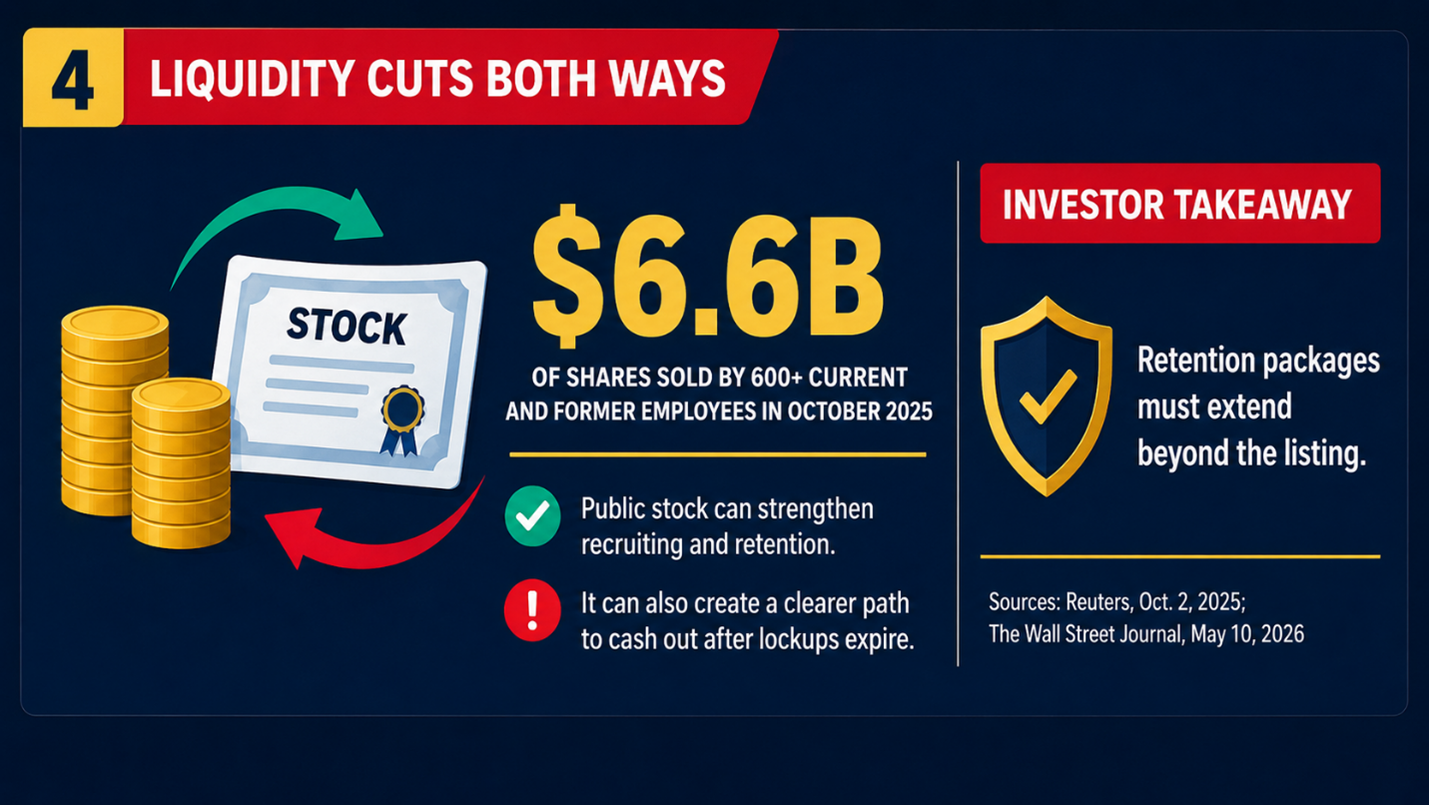
True, publicly traded shares give OpenAI a more liquid currency for hiring and retention. But those same shares also give existing employees a cleaner route to turn accumulated equity into cash after lockups expire.
Earlier employee share sales have already reduced some of the financial friction that might otherwise keep long-tenured staff in place.
Which means any potential IPO investor now needs to concern themselves with the design of retention packages, vesting schedules and succession plans.
The Confidential S-1 Leaves Little Else for Investors to Review
Here’s where things get even tougher for retail investors like us: OpenAI’s draft registration statement remains confidential.
The SEC allows companies to undergo nonpublic review10 before an IPO. Which means so prospective shareholders — you and I — can’t actually review OpenAI’s filing for risk factors, executive compensation, ownership table or management discussion.
Those disclosures will be unusually important.
Investors need to know which leaders are considered essential, how much equity they retain, what incentives extend beyond the offering and who inherits their authority if they leave.
We also need to see that financial controls, enterprise sales and safety oversight belong to durable institutions. Not individual execs that can take that durability with them on the way out.
Governance makes that question harder. OpenAI Group is a public benefit corporation controlled by the OpenAI Foundation. The Foundation holds special rights that allow it to appoint every director11 of OpenAI Group and replace them at any time. The public S-1 will have to show what voting rights outside shareholders receive and how the mission structure interacts with conventional shareholder accountability.
A shareholder with limited influence over the board has fewer tools to respond if management continuity deteriorates. In that structure, confidence in succession and internal controls deserves greater weight.
The size of the possible discount is already enormous. A 10% reduction from OpenAI’s $852 billion private valuation for combined governance and execution uncertainty would remove roughly $85 billion. That calculation is not a proposed fair value. It shows how quickly a seemingly modest change in investor confidence becomes consequential at OpenAI’s scale.
What Public Investors Should Demand
OpenAI should not be penalized mechanically for every departure. Health-related exits should remain separate from resignations over strategy, short executive tenures and reorganizations that eliminate oversight roles.
But the fact that investors have to split those hairs should be enough of a caution sign ahead of the IPO. Especially with the company’s financials still under wraps.
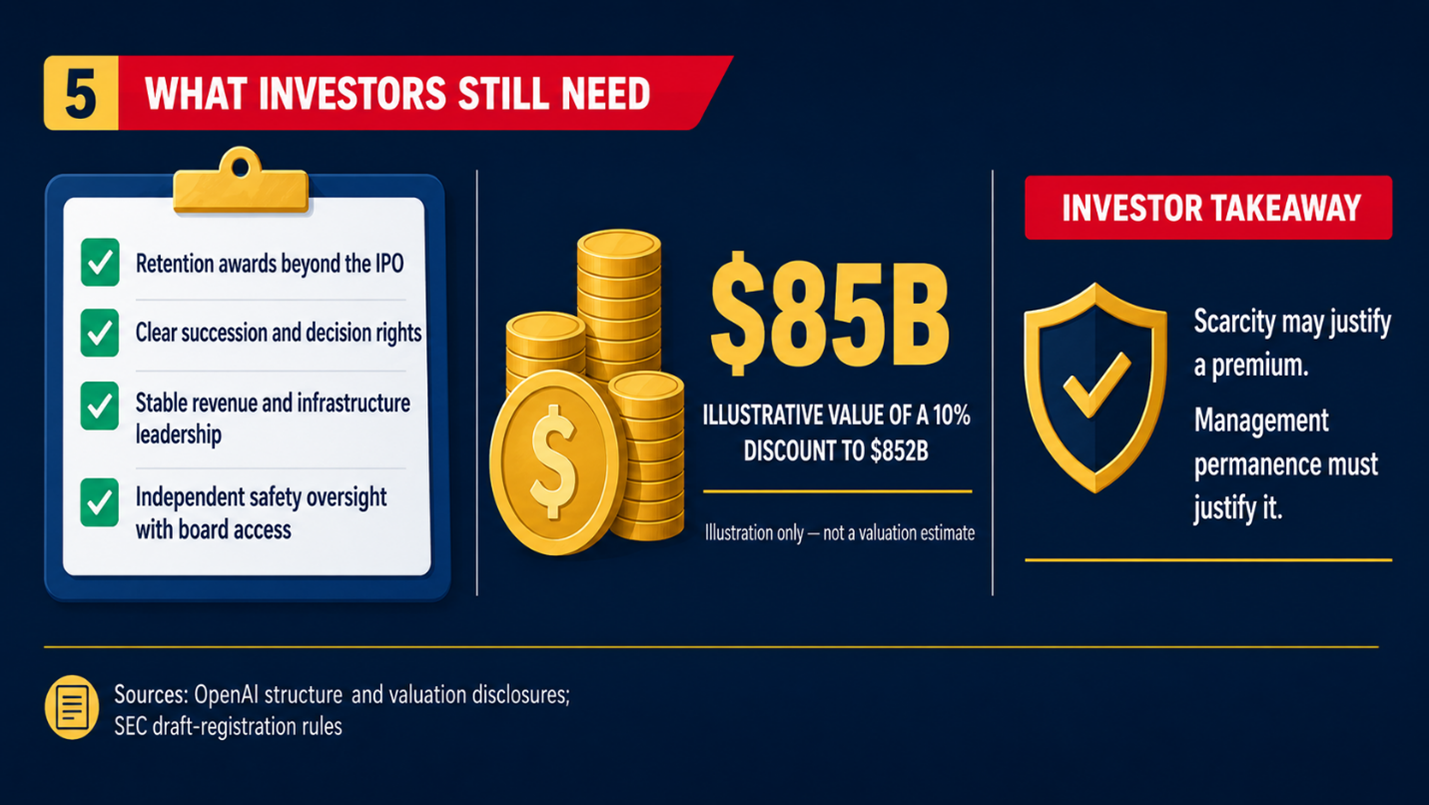
So, here’s what anyone interested in this AI play should watch when the public filing appears:
- How decision-making is divided among Altman, Brockman and the broader executive team,
- Whether senior retention awards extend meaningfully beyond the IPO,
- Whether key commercial and infrastructure roles remain filled,
- And whether safety functions have independent authority and direct access to the board.
They should also watch the tenure of the replacements.
Rajic’s appointment is constructive, but the relevant signal will be whether OpenAI can give him stable authority long enough to build a revenue organization. The same test applies to infrastructure and product leadership.
None of this is to say that OpenAI doesn’t still deserve a premium. It very well may.
After all, it has one of technology’s strongest consumer brands, enormous distribution and access to capital on a scale few companies can match. Rapid change may just be the cost of operating at the frontier.
But public investors deserve more than “may be” when their money is on the line.
They’ll be buying an organization expected to deploy hundreds of billions of dollars to serve consumers and governments, manage safety risks and produce reliable quarterly results at the same time.
A company that can’t deliver isn’t one worth investing in.
OpenAI’s eventual valuation will help establish what public markets are willing to pay for frontier-AI growth across the sector. If its offering receives a discount for concentrated authority and executive churn, that lesson will travel well beyond OpenAI.
The company’s technology may justify scarcity value. But its management system still has to justify permanence.
Best,
Jurica Dujmovic
P.S. As I said above, my colleague Chris Graebe sees leadership as one of the deciding factors when he looks at a private equity opportunity.
He’s walked away from impressive looking deals just because the team or founder didn’t quite pass muster. Even when the business was strong.
But now, he’s found a team that has blown him away. And they have the potential to become the indispensable player in the biggest tech revolution since AI.
To learn more about it, and how you can get first-day access to this deal, you’ll want to save your seat for Chris’ Fall 2026 Private Investment Summit.
This coming Tuesday, Sept. 8 at 2 p.m. Eastern, Chris will sit down and give you all the details.
This special summit is completely free to attend. Just let us know you’re coming, and we’ll save your spot.
1https://openai.com/index/accelerating-the-next-phase-ai/
2https://openai.com/index/openai-submits-confidential-s-1/
3https://www.businessinsider.com/executives-who-left-openai-in-2026-8
4https://www.wsj.com/tech/ai/openais-head-of-data-centers-has-left-company-6d24fd83
5https://www.reuters.com/technology/brad-lightcap-leaving-openai-2026-08-11/
6https://www.wsj.com/tech/ai/openai-chief-revenue-officer-to-depart-after-less-than-a-year-bbe1921a