 |
| By Marija Matic |
While macro headlines are fixated on oil price volatility and ceasefire tensions, the crypto market is carving out a new structural floor.
Bitcoin (BTC, “B+”) is trading strongly today, maintaining its grip on the $75k+ level and roughly 9% of two-week gains.
And in this show of strength, the gatekeepers are officially surrendering.
The $11 Trillion Sleeping Giant Awakes
Charles Schwab — the $11.77 trillion behemoth — has moved past the "exploration" phase when it comes to crypto.
It has now rolled out internal Bitcoin trading for employees. And a full public launch for its 39 million clients is just weeks away.

And this isn’t some knee-jerk move made out of FOMO.
By launching "Schwab Crypto" accounts — separate, dedicated entities linked directly to brokerage portfolios — Schwab shows it plans to go head-to-head against Robinhood and the high-net-worth dominance of Morgan Stanley.
The real "alpha" lies in the math of ownership. While their 75bps commission for direct buying is steep compared to a typical 2bps ETF fee, Schwab might be betting on the "HODL" cohort.
That’s crypto speak for long-term investors who can hold through volatility.
For any investor with a 5+ year horizon, buying direct — that is, through Schwab versus an ETF — might be the better play. This way, you can evade the recurring "drag" of an ETF expense ratio.
(Of course, the cheapest way to buy BTC is to do so yourself from a crypto exchange.)
Schwab’s own research is now legitimizing crypto allocations in a portfolio, suggesting that "moderate" investors can consider a 6.6% BTC and 2% ETH allocation.
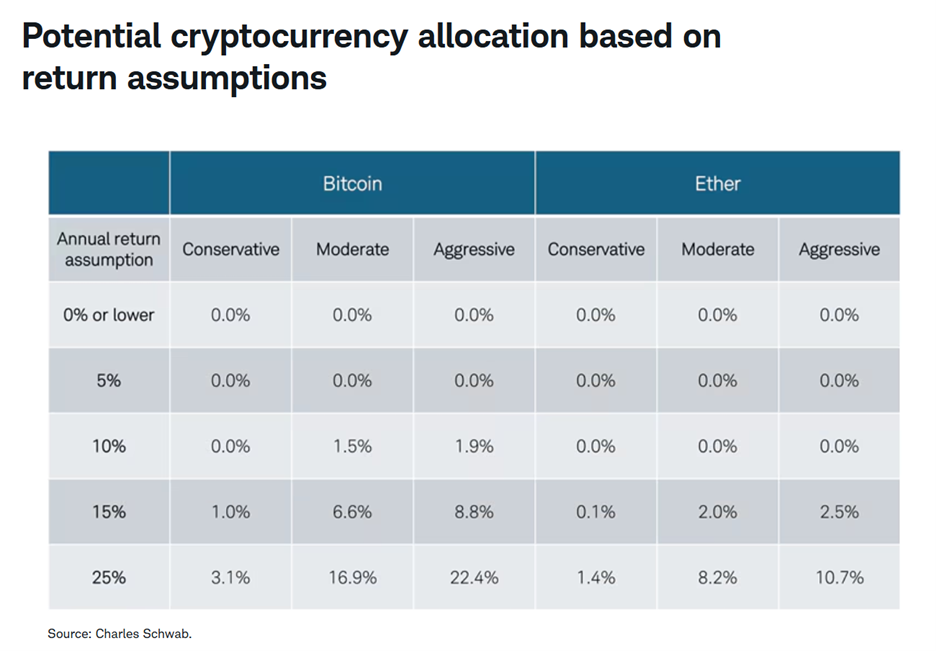
Aggressive investors could go up to an 8.8% BTC and 2.5% ETH allocation.
This sounds like the formal institutionalization of the "60/40" replacement, delivered to the largest retail capital pool on the planet.
Institutional Heavyweights: Saylor and Bitmine
Meanwhile, the "supply shock" continues to be exacerbated by two usual suspects:
- Strategy Inc. (MSTR), formerly MicroStrategy: Michael Saylor has officially overtaken BlackRock in terms of holdings. Strategy has purchased another 34,164 BTC ($2.5 billion) today, bringing the total treasury to over 800,000 BTC.
- Bitmine (BMNR): Bitmine has grown its Ethereum (ETH, “B+”) stake to 4.12% of the total supply, or 3.3 million ETH. This has generated an estimated $330 million in annual staking rewards and made Bitmine the No. 1 corporate ETH treasury globally.
Simultaneously, the regulatory "drag" is lifting.
A year into Paul Atkins’ SEC leadership, the focus has shifted to supporting prediction markets and clarifying secondary rules.
Beyond Bitcoin: The Latest Altcoin Action
However, the real momentum in the market was in the specialized sector.
That’s where EdgeX (EDGE, Not Yet Rated), Ethena (ENA, “B+”), and Venice AI (VVV, “B”) have surged 65%, 23%, and 12% respectively over the past week.
Of the three, I want to focus in on EDGE.
EdgeX is a decentralized perpetuals exchange. And its token has been commanding the spotlight over the past seven days thanks to its dominant price breakout.
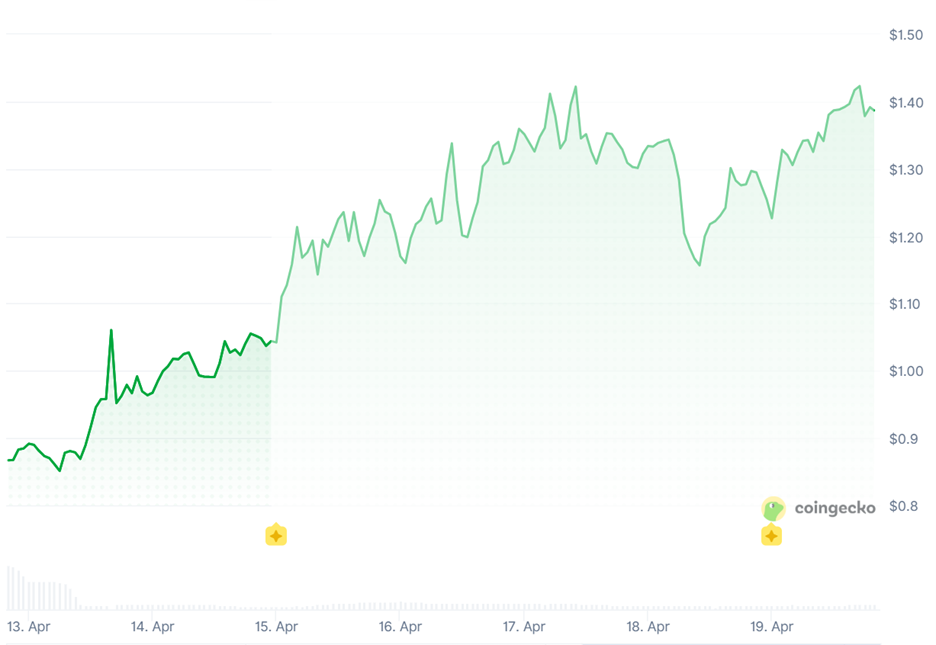
While Hyperliquid’s (HYPE, “D”) token remains the institutional gold standard of the space, EDGE is increasingly being positioned as the premier "High-Beta" alternative … with the upside of a rising challenger.
This price action is backed by a fundamental "flippening" in the perp DEX hierarchy.
Now, EdgeX has officially claimed the No. 2 spot in global perp revenue and the No. 3 spot for fees, trailing only Hyperliquid and Jupiter (JUP, “D+”).
The protocol’s secret weapon is its newly launched Parallel Execution Engine. This mechanism bridges the latency gap between DeFi and centralized exchanges.
With over $12.96 million in revenue generated over the last 30 days and an aggressive $13 million buyback program actively shrinking the token supply, EDGE is rapidly becoming the destination for traders looking to capture the next leg of the "Perp Summer" expansion.
And EdgeX isn’t the only high-beta play catching attention.
Canton Network (CC, “D-”) is an institutional project. Usage from partners like Goldman Sachs and BNP Paribas directly drives the token's Burn-Mint Equilibrium.
Put plainly, every time these institutions settle a tokenized repo or issue a digital bond, native CC tokens are permanently incinerated.
That’s an impressive deflationary measure.
Today’s Q1 update from Canton Strategic Holdings (NASDAQ: CNTN) marks a massive milestone: On-chain transaction growth is hitting escape velocity.
That means, with the network currently burning roughly $900,000 worth of CC tokens daily, the upcoming April 22 webinar is the one to watch.
It will likely confirm if the "burn" is finally outpacing the "mint," potentially flipping CC into a deflationary supply shock as billions in TradFi collateral migrate to these permissioned rails.
RAVE’s Spectacular Crash: A Lesson in Liquidity
Last week, I highlighted an impressive crypto wildcard: RaveDAO (RAVE, Not Yet Rated). Namely, we discussed the "RWA Entertainment" hype surrounding the project. Hype that saw its token soar a staggering 3,900% in seven days.
While the "real-world festival profit" narrative was enticing, the tokenomics were a minefield of low circulating supply and extreme concentration.
And that matters.
At the time, I warned that the action looked "dangerously overheated." And that traders were playing musical chairs.
Well, the chairs ran out faster than expected: After peaking at $27.88 on April 18 — and entering top15 cryptos by market cap — the token suffered a spectacular -97.6% drop to just 60 cents.
This serves as a stark reminder that in low-float, manipulated rallies, there is rarely enough room for an orderly exit.
The Final Word
We are witnessing the death of the "vaporware" era.
When an $11 trillion titan like Schwab starts coaching its clients on Bitcoin allocations …
And EdgeX siphons revenue from centralized giants …
The market is making a statement. It’s telling us it is shifting its focus to the "plumbing" of the new financial system.
It’s clear that the infrastructure of global finance is being rebuilt in real-time.
And while I can’t say who the winners will be, we do know what they’re doing right now — building high-velocity revenue machines so they can be the first and fastest to move through this new infrastructure.
That’s what savvy investors will have on their radar.
Best,
Marija Matić