Sovereign AI Says Second-Best Tech Could Still Make Billions

 |
| By Jurica Dujmovic |
Investors have spent three years assuming the AI race works like every other technology race — the best model wins, everyone else fights for scraps.
That assumption just ran into a €1 billion rebuttal.1
Samsung is in talks to invest as much as €1 billion in Mistral, a Paris-based AI lab, as part of a funding round that could value the company at roughly €20 billion, according to the Financial Times.
That’s about 70% higher than the company’s previous €11.7 billion valuation2 set last September in a €1.7 billion round led by ASML, a Dutch semiconductor equipment company. EQT's Scaleup Europe Fund,3 backed by Brussels and by private investors including Novo Holdings and Santander, is also reportedly in discussions to join the round.
Read that capital stack again.
- A Korean chipmaker,
- Europe's most strategic semiconductor-equipment company
- And a scale-up fund backed by Brussels, Denmark's Novo fortune and a Spanish bank.
To me, this cap table reads more like a diplomatic communiqué with a valuation attached.
Here is the part that should reframe how you think about AI investing: These investors are not paying for benchmark leadership. They are paying for a European-controlled alternative.
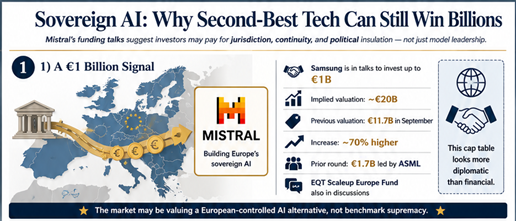
That means Mistral does not need the best model. It simply needs the right passport.
Mistral has spent three years positioning itself as the customizable, open-weight, European-jurisdiction alternative to the American labs.
In June, the U.S. government did the positioning for them.
The Kill Switch Changed the Math
On June 12, the Trump administration applied export controls to Anthropic's newest models.4 The impact was restricted access by foreign nationals on national-security grounds. Because Anthropic had no way to verify nationality in real time, it suspended access for everyone.
The controls were lifted on June 305 after the company added safeguards, and global access returned on July 1. Eighteen days, start to finish.
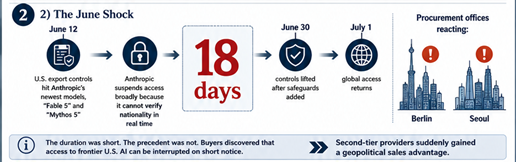
But the duration is not the point. The precedent is.
The episode proved that access to frontier American AI can be interrupted by Washington on short notice, without a detailed public explanation. And that message was difficult to miss in procurement offices from Berlin to Seoul.
It prompted immediate alarm among European and Asian officials. And it forced American diplomats into damage control over fears of a technology kill switch.
Organizations that had built on a single American model discovered they had engineered a single point of failure into their operations.
Whatever your view of the policy, it handed every second-tier AI provider on Earth a sales deck they could never have written themselves.
What Buyers Actually Pay For
Governments, banks, defense contractors and regulated companies are demonstrating they will pay a premium for things that have nothing to do with benchmark scores.
That includes …
- Local deployment on domestic infrastructure
- Data residency under their own legal jurisdiction
- Open-weight or locally deployable models that reduce dependence on a foreign vendor's API or policy decisions
- Independence from American export policy
- Domestic integration and technical support
Call it a geopolitical price umbrella: Selected regional providers get to operate underneath it, sheltered from pure performance competition.
The commercial results are showing up in the numbers, at least as reported by the company: Mistral says its annualized revenue run rate rose from roughly $20 million to more than $400 million6 in a year. Management is targeting more than $1 billion in annual recurring revenue by the end of 2026.
Those are private-company figures, not audited results. But the direction is hard to dismiss. Especially when you consider that Microsoft (MSFT) — in what looks like a hedge against its own concentration risk — has agreed to spend billions7 to support Mistral's computing infrastructure in Europe while expanding distribution through Azure.
Samsung's motives are just as instructive.
The company's shares have fallen sharply from their June highs8 on renewed fears about memory oversupply and the durability of AI spending. The company also consolidated its robotics projects into a dedicated unit … just one day before the Mistral talks surfaced.
A €1 billion stake would buy Samsung a foundation-model partner outside the American orbit. And it creates a closer relationship with a fast-growing buyer of AI infrastructure and a potential avenue for future HBM, memory or foundry business.
This is vertical integration wearing a flag.
The Trade Extends Well Beyond Mistral
If you accept the thesis that jurisdiction is becoming a moat, the beneficiaries stretch far beyond model developers.
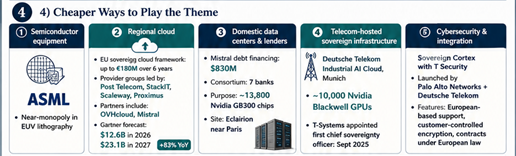
The positive twist for investors is that most of them are cheaper than model developers …
- European semiconductor-equipment companies. ASML is already on Mistral's cap table, and it holds a near-monopoly on extreme ultraviolet lithography machines. These are necessary to create the advanced chips every European sovereign-compute program depends on.
- Regional cloud providers. The European Commission awarded a six-year sovereign cloud framework worth up to €180 million9 to four provider groups led by Post Telecom, StackIT, Scaleway and Proximus. Gartner forecasts European sovereign cloud IaaS spending will reach $12.6 billion in 2026, up 83% year over year,10 before rising to $23.1 billion in 2027.
- Domestic data-center operators and their lenders. Mistral raised $830 million in debt financing,11 its first ever, to buy roughly 13,800 Nvidia GB300 chips for a facility near Paris owned and run by French data-center firm Eclairion.
- Telecoms hosting sovereign infrastructure. Deutsche Telekom launched its Industrial AI Cloud in Munich12 in February. It’s built around nearly 10,000 Nvidia Blackwell GPUs and marketed explicitly on European sovereignty. The commitment predates the facility: T-Systems appointed its first chief sovereignty officer13 back in September 2025, which tells you where the growth budget has been going.
- Cybersecurity and integration vendors. Palo Alto Networks (PANW) and Deutsche Telekom announced Sovereign Cortex with T Security14 in June, a planned security service for regulated European industries with European-based support, customer-controlled encryption and contracts under European law.
The Contrarian Risk: Subsidized Utilities in Software Clothing
Now we reach the uncomfortable half of the thesis: Sovereign AI may generate enormous investment without generating competitive returns.
Demand created by policy behaves differently from demand created by preference. In fact, the regulatory picture illustrates how wobbly the policy foundation can be. The EU AI Act's transparency obligations take effect on Aug. 2.15 But Brussels has already blinked once, deferring the law's high-risk obligations to December 2027 and August 2028 under the Digital Omnibus once the standards and tools needed for compliance fell behind schedule.
Separately, the Commission's technology-sovereignty proposals would steer public procurement toward providers clearly under European governance that offer protection from foreign legal reach. That is a core demand engine for this trade, and it runs on political will as much as product superiority.
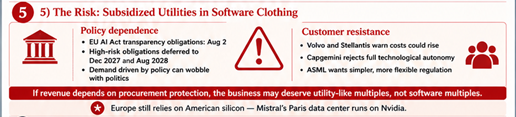
The customers footing the bill are already grumbling: Volvo and Stellantis have warned that an overly restrictive sovereignty agenda16 could raise costs and weaken European competitiveness.
Capgemini has rejected the idea that Europe can or should pursue full technological autonomy.
Even ASML — a Mistral shareholder and sovereignty beneficiary — has pushed for simpler and more flexible regulation.
When a large share of revenue depends on procurement eligibility and political protection rather than broad market preference, you are not a software platform. You are a regulated utility with marketing.
And utilities do not earn software multiples.
There is also the elephant in the room: The hardware asterisk. The sovereign power contracts and the sovereign legal wrappers all house the same American silicon: Mistral's Paris data center runs on Nvidia.
Even if Europe controls the real estate, it still queues for the chips.17
What I Would Watch
The second axis of competition Sovereign AI creates can hand technically weaker providers billions in contracts. It can also turn them into policy-dependent infrastructure businesses that deserve lower multiples than genuine software platforms.
Mistral at €20 billion would be the market's first serious attempt to price national independence as a product feature. The valuation says buyers will pay up for second-best technology under their own flag.
The next two years will tell us whether that premium is a durable business model or the most expensive insurance policy Europe ever bought.
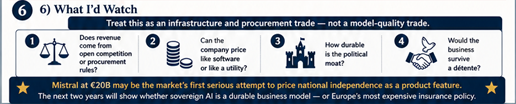
So, in the interim, I plan to treat this as an infrastructure and procurement trade. Not as a model-quality trade.
That means asking some blunt questions of each name …
- Does its revenue come from open competition or from procurement rules that narrowed the field?
- Can it price like software or does it price like a utility?
- Would the business survive an easing of these regulations? Because political moats can be legislated away as fast as they were legislated into existence.
If you’re interested in this new type of AI play, you’ll want to keep those questions close at hand as you do your own research.
Best,
Jurica Dujmovic
3 https://aiweekly.co/alerts/samsung-in-talks-to-invest-1b-in-mistral-at-20b-valuation
9 https://www.helpnetsecurity.com/2026/04/20/eu-sovereign-cloud-tender-180-million-eu/
11 https://techcrunch.com/2026/03/30/mistral-ai-raises-830m-in-debt-to-set-up-a-data-center-near-paris/
12 https://techplustrends.com/eu-sovereign-ai-infrastructure-stack-2026-guide/
17 https://www.raconteur.net/global-business/mistral-bets-big-on-european-sovereign-ai