The Bear Market Low Is In According to 4 Key Bitcoin Signals

|
Key Takeaways
|
 |
| By Juan Villaverde Reviewed by: Beth Canova |
Nobody rings a bell at the bottom of a bear market.
If they did, everyone would buy.
Instead, the bottom usually feels like the worst day ever. Prices are low. The news is bad. Most people have given up.
That's why I trust data over feelings. And especially now, the data has something important to say.
For months, I’ve been hard at work with the rest of the Weiss Ratings team to create more avenues to listen to the on-chain data directly.
The first one is an indicator I call Fair Value, which I introduced to you a few weeks ago.
If you haven't read that piece yet, start there. But put simply, it tells us whether the average BTC holder is underwater or sitting in gains.
That tells us whether the market is overbought or oversold.
Today, I want to show you three more of my favorite indicators I’m working on. They’re not ready to reveal to everyone yet. But what they have to say is too good to not share with you.
Indicator No 1: Exchange Inflows
Let's start with a simple question …
Crypto purists and whales promote self-custody almost religiously. So, why would anyone move their BTC onto an exchange?
Answer: Mostly to sell.
Exchanges are where you trade. So, the amount of money flowing into exchanges tells you how many people are getting ready to sell.
My exchange inflow indicator tracks that flow in dollar terms.
I'm showing Bitcoin here because it's the benchmark, though the indicator works on altcoins, too.
X Marks BTC’s 3-Standard Deviation Low
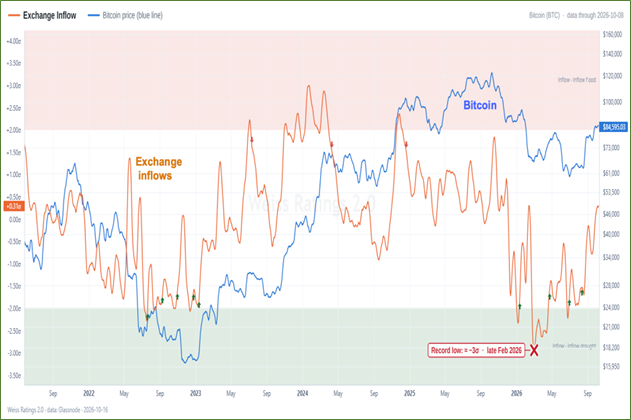
Here's what I found …
- When a lot of Bitcoin pours onto exchanges, it tends to line up with major cycle tops on my forecasting model.
It doesn't always mean a bull market top. But it's a strong signal on its own.
The other side is where it gets interesting.
- When inflows dry up, it means almost no one is sending coins to sell.
And that tends to happen near bear market lows.
In late February 2026, we saw the biggest drought on record. The indicator fell to about three standard deviations below normal.
Think of a standard deviation as a measure of how unusual a reading is. One deviation is one step outside of normal. Three means we’re looking at something extremely rare.
Think about what that means: The people who wanted out had mostly left. Buyers stopped showing up.
That’s exactly what happens at a low. And sure enough, Bitcoin’s price bottomed on Feb. 5, 2026.
It also rhymes with what the Fair Value indicator showed at the time.
Different tools. Same message.
Indicator No. 2: Profit Rank
The second indicator is more complex under the hood: On-chain profitability shows how many holders are sitting on a gain. Or a loss.
To measure it, we need to know what price people paid. And the blockchain doesn't say that directly.
But it does show when a coin first moved to a new address.
So, we treat that as the moment someone acquired it. That gives us a cost estimate for each coin.
It may sound too simple. It isn't.
That's the whole point of the tools I'm building. They take hard ideas and make them simple.
And it works very well.
Compare each coin's cost with today's price, and you can see how much of the market is in profit.
I turn that into a rank from zero to 100. Zero would mean no coins are in profit. 100 would mean all of them are, which suggests a cycle top.
Only 4% of BTC Owners in the Black — the Lowest on Record
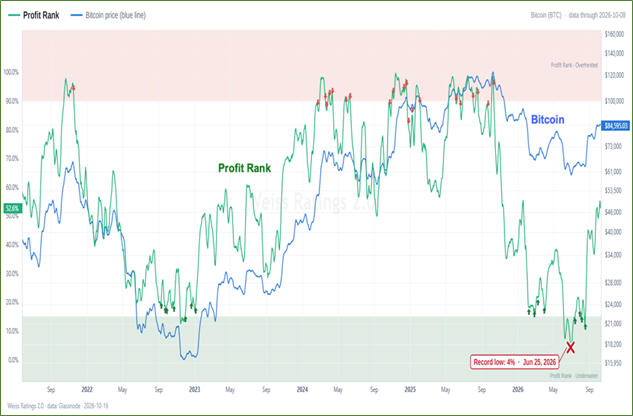
But where this indicator shines is at spotting bottoms.
On June 25, 2026, it hit 4 — the lowest reading in the indicator's history. And it came on the exact day of the price low.
Notice the timing, too. Fair Value and exchange inflows bottomed in February — when BTC hit its bear market low in terms of price.
Profit rank bottomed in June. That’s when the cycle was ready to bottom, and the February low was retested.
Indicator No. 3: The Options Market
This one is a personal favorite.
An option is a contract that lets you bet on where price goes ...
- A call pays off if price rises.
- A put pays off if price falls.
Traders also use puts as insurance. Which means option prices can also reveal how nervous traders are.
My indicator blends two ideas.
The first is skew. It asks a simple question: Are puts more expensive than calls? When traders fear a crash, they pay up for protection. Which means puts get pricey.
The second is term structure. It compares fear across contract dates. Because when panic prevails, short-term contracts get much more expensive than long-term ones.
I blend the two into one reading. Think of it as the crypto cousin of the CBOE Volatility Index (VIX), Wall Street's fear gauge. It's not quite the same thing. But it gives you a similar kind of signal.
Here's what makes it special: It only calls lows. When it spikes, fear is running high. And extreme fear tends to show up at bottoms, not tops.
Options Outlook versus Bitcoin
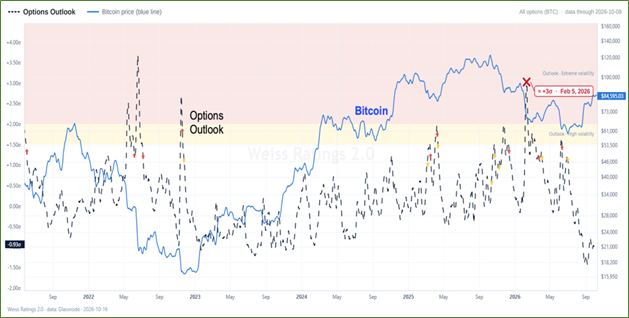
On Feb. 5, 2026, the indicator spiked to about three standard deviations. It wasn't the highest reading ever. But it was a major spike.
And it came right on the first low.
Four Tools. One Message
Let's pull it together.
- Fair Value showed BTC was at its most oversold ever on Feb. 5.
- Exchange inflows hit the deepest drought in history in late February.
- Profit rank hit its lowest reading ever on June 25.
- And the options outlook showed extreme fear on Feb. 5, just as it did at the first low in 2022.
Four tools. Four angles — valuation, selling, profits and fear.
And they all agree: The bear market low has already taken place.
Here's My Takeaway
Don't wait for some headline to tell you the bear market is over.
By the time the news says it, the turn is already behind us.
Instead, look for tools that agree with each other.
One indicator can mislead you. But when valuation, selling, profits and fear all point the same way, pay attention.
And if you've been waiting for a lower low, ask yourself what evidence you're waiting for.
The data says the last one has already happened.
Now, it’s time to look ahead.
For that, I encourage you to join me on Tuesday, Nov. 10 at 2 p.m. Eastern for my urgent briefing, The Next Great Crypto Bull.
In it, I’ll show you the latest readings from these indicators. And which coins I believe will move faster and further than BTC as the bull market kicks off.
It’s free to attend. All I ask is that you RSVP here.
I hope to see you there!
To your wealth,
Juan Villaverde