 |
| By Juan Villaverde |
I explained last week how the Federal Reserve’s latest rate cut was already priced in by the market.
But that doesn’t mean the Fed didn’t give us any surprises!
Indeed, what no one expected was the fact that the Fed effectively stopped its years-long Quantitative Tightening program … and moved in the exact opposite direction!
If you pored over the meeting notes and don’t recall reading the term “Quantitative Easing,” don’t worry.
It wasn’t in there.
That’s because it’s too politically charged a term these days.
But what the Fed is doing is essentially the same thing — if you look past the word salad Fed bureaucrats famously use to obscure their real intentions.
Like previous episodes of money printing going back decades, this new round is specifically designed to help Uncle Sam keep the lights on. By printing money to finance Washington’s ever-growing fiscal deficits.
So, what do Fed officials call QE in 2025?
They call it: RMP — an acronym for Reserve Management Program.
It’s all about “reserves,” you see. Nothing to do with money printing. Or financing unsustainable deficits.
Or so they would have you believe.
In reality, the only material difference I can see between old fashioned QE and RMP is … what the Fed intends to spend its freshly printed money on.
This time, it’s buying short-term government debt. Whereas in post-2008 QE programs, the Fed focused mostly on buying long-term debt.
Some might say this is a distinction without difference.
But there’s a reason the Fed is doing this.
In recent years, the U.S. Treasury has mostly been issuing short-term debt. This started under President Biden’s Treasury Secretary, Janet Yellen. President Trump’s appointed Secretary, Scott Bessent, merely continues that proud tradition for two key reasons.
First, banks and other financial institutions prefer bonds with short-term maturities. That’s because markets consider them “cash-equivalent” — like dollar bills that pay interest.
Second, the Fed has confirmed that we are now in a declining interest-rate environment. And issuing short-term bonds positions the Treasury to refinance at lower rates just three to 12 months down the road.
That saves interest expenses. To take full advantage, Secretary Bessent is flooding the market with short-term debt. And lately there hasn’t been much appetite for it.
Liquidity — especially on the shorter end of the yield curve — has been drying up. With not enough left to lend in the private sector.
How do I know this?
For one, Bitcoin (BTC, “B+”) is the most liquidity-sensitive asset on the planet. The fact that it sold off sharply is all the proof you need that liquidity has been scarce.
This sharp contraction in liquidity — something I’ve discussed before — is the main reason Bitcoin didn’t exactly have a stellar second half of 2025 — too much borrowing from Uncle Sam.
Here’s the evidence:
TGA Shows Liquidity Drought Ending
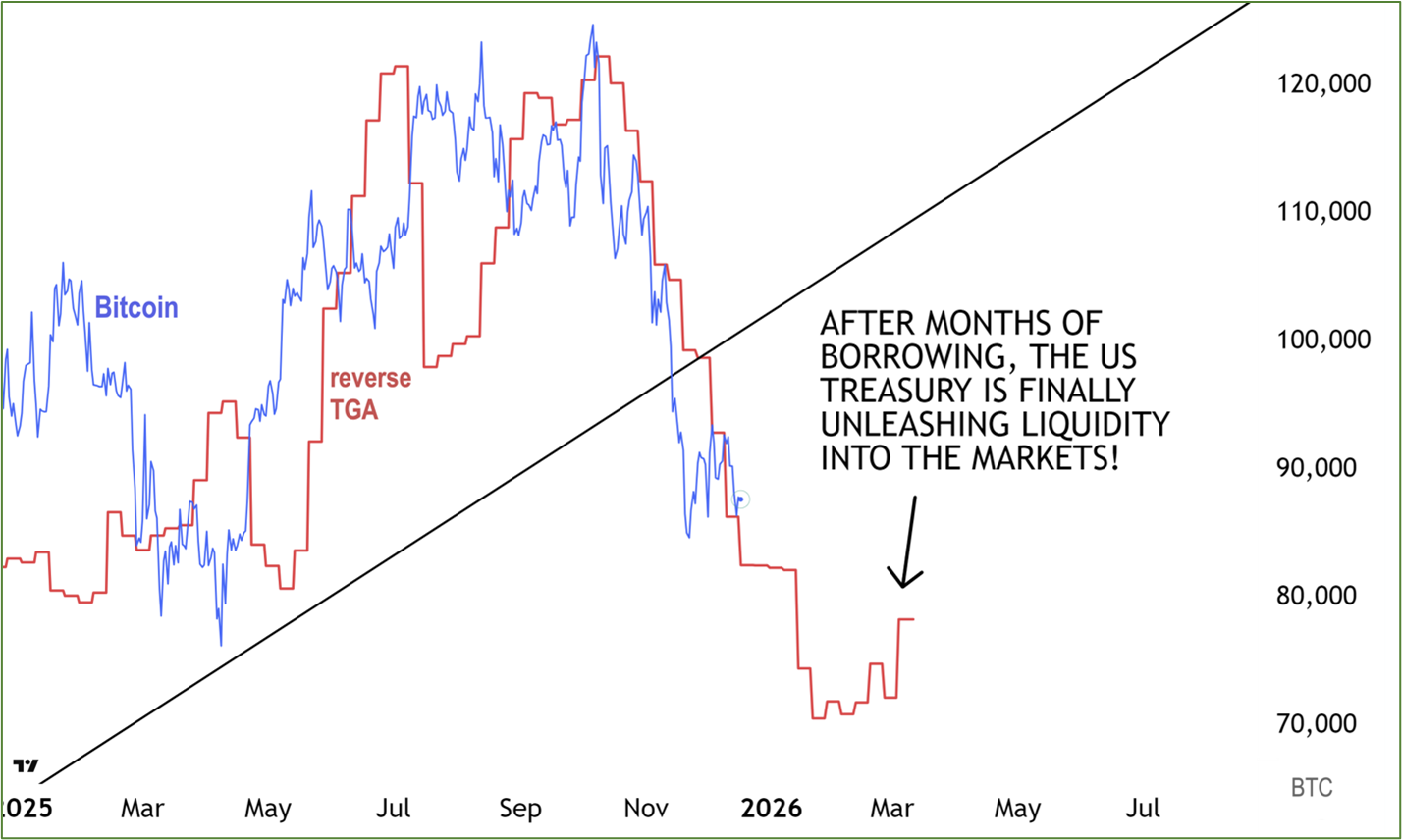
As you can see, Bitcoin visibly reacts to changes in the TGA — with an 84-day lag.
Lately, the Treasury has been on a borrowing binge. But since the Fed wasn’t printing the money, that borrowing had to come straight from the private sector. Every dollar borrowed drained liquidity — and Bitcoin paid the price. Literally.
Now focus on the right side of that red squiggly line. It’s going up.
That means the Fed is now willing to print the money the Treasury needs to spend. So, the Treasury can finally drain the TGA.
And that’s going to be a major positive for Bitcoin in 2026.
Why the Policy Shift?
The U.S. Treasury borrowed so much money in recent months, that it strangled not just Bitcoin, but global funding markets as well. So, the Fed stepped in, restarted the money-printing presses.
And called it a “technical adjustment” for financial-market plumbing reasons.
Now, it’s hardly incorrect to say reckless government borrowing and spending can destabilize the system. But framing the issue that way diverts focus from the central problem: the U.S. government’s utterly reckless and unhinged fiscal policy.
Which has reached the point where it threatens the stability of the entire global financial system. That is, unless the Federal Reserve is there to bail it out.
Bottom Line: QE Is Bullish for Bitcoin
Because the monetary printing presses are warming up again. And with the Treasury finally having spent all the money it borrowed over the past few months, liquidity is set to surge again in 2026.
The same forces that crushed liquidity — and crypto — in the second half of 2025 are now reversing.
And Bitcoin will be the prime beneficiary.
That’s why I’m already on the hunt for the next best entry opportunity for BTC.
My Crypto Timing Model has highlighted late January to mid-February as the next likely significant cycle low. That outlook is bolstered by Central Bank Liquidity, which shows its own low near Feb. 12.
As we get closer, I expect my Crypto Timing Model will flash a bright green “buy” signal, as prices near that low should represent a great entrance opportunity.
If you want to receive specific alerts like this from my model, I suggest you check out my Weiss Crypto Investor.
Best,
Juan Villaverde