The Hidden Risk to Search for Before You Invest in DeFi

 |
| By Marija Matic |
I’ve been in crypto since the very beginning.
And in all these years, I have never once been rugpulled by a DeFi project.
Until now.
Last week, I told you about The Crypto Scam That Even Smart Investors Could Miss. And I said how I was one of those smart investors. That I missed it, too.
How?
Because I gave a blackbox strategy the same trust I’d give a pure DeFi play.
That’s not to say it was blind trust. I dove deep into my research and didn't spot a single red flag.
But there is a fundamental difference between how the two strategies operate. And that changes the risk profile in a way I didn’t calculate.
So today, I want you to understand what these two strategies are. And how they can change your approach when you look for your next DeFi opportunity.
What Blackbox Strategies Actually Are
Blackbox strategies are also known as off-chain strategies. And they’re almost always a hybrid model.
They begin on the blockchain, where you deposit stablecoins into a smart contract vault.
Here’s the kicker: Some or all of that capital will then leave the blockchain to be put to work elsewhere.
Then, it’s often deployed into …
- Funding rate arbitrage on centralized exchanges,
- Market making,
- Private credit,
- Or real-world assets like gold and bonds.
The defining characteristic of this setup is visibility. Or rather, the lack of visibility.
From the exact moment funds exit the on-chain vault, they disappear from the public eye. In place of real-time cryptographic proof, investors have to rely on a user dashboard, a monthly PDF report, or a periodic attestation from a third-party auditor stating the money is safe.
This lack of visibility is exactly why the crypto industry calls them "blackbox" strategies.
It’s a normal thing in TradFi. But in crypto, where “verify, don’t trust” is standard operating procedure, it’s a novelty.
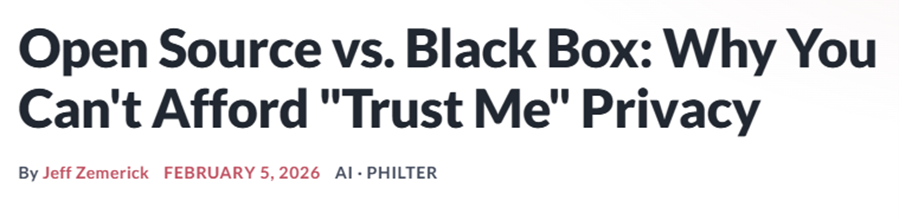
As users, we can see what goes in and what is supposed to come out. But the inner workings remain hidden.
And an increasing number of products in the market today follow this exact hybrid blueprint: A reassuring, perfectly audited smart contract on the outside … wrapped around a completely invisible off-chain strategy on the inside.
In a pure DeFi setup, you are primarily trusting the math and the smart contracts.
If the code is secure, your funds are generally safe regardless of the team's personal ethics.
But the blackbox set up shifts the risk profile from the code to the human beings behind it.
The secure smart contract only protects the front door. Once the funds move off-chain, you have to put your trust directly in the team's operational integrity, their internal security protocols, and their honesty.
You get exposed to human counterparty risk the moment the asset leaves the blockchain.
Why Focusing More on Pure On-Chain Strategies Makes Sense
That’s not to say pure on-chain strategies are risk-free.
Smart contracts can have bugs. And markets can always move against us.
The difference is that the structural risks are completely visible. And that matters for three key reasons.
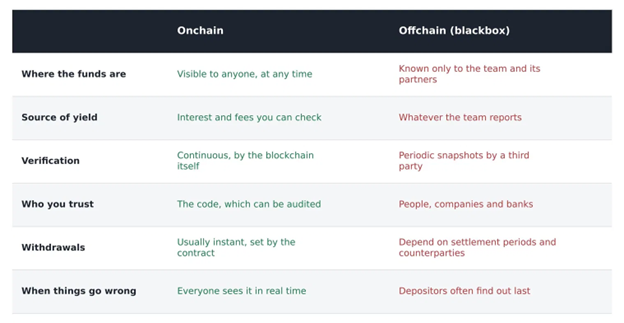
The first is transparency.
With a pure on-chain strategy, nobody needs to tell you whether the money is there. You can check it yourself, at any moment.
Liquidity is the second.
On-chain positions can usually be exited within seconds. If liquidity is in the pool, nothing stops you from pulling your funds out immediately.
But off-chain positions often come with settlement periods.
The third is that bad news cannot be hidden.
If an on-chain lending market builds up bad debt, the whole market sees it the same day. With a blackbox strategy, problems can sit unseen for months.
The Nightmare of Vetting Blackbox Teams
Vetting a pure DeFi project is straightforward because the code tells the story.
If it’s well audited, there’s typically no need to trust the team at all.
Vetting a hybrid, blackbox strategy is entirely different. And frankly, much more difficult.
When a strategy goes off-chain, you are no longer just auditing smart contracts. You are trying to audit human character, operational security, and future intentions.
On paper, Altura ticked every single box.
- It presented itself as a UK-based protocol led by former Fidelity and PwC staff.
- It had recently wrapped up a successful $4 million fundraising round.
- Its vault was audited seven times,
- And its vault token was accepted as collateral on some of the most respected and strict DeFi protocols.
The trust went far beyond paperwork.
The CEO, Ranveer Arora, held face-to-face and Zoom meetings with some of the biggest names in the industry, many of whom effectively vouched for him.
Even Native Insurance — the project that insured the vault — was receiving industry recognition at the same time.
There was simply no obvious red flag left to find.
A team can look completely legitimate, run clean code on the outside, and still leave users stranded months later.
Why Verifiers Must Level Up
Because human vetting has its limits, the industry has turned to third-party data verifiers to bridge the gap.
But the Altura situation exposes the critical weak points in those verification tactics.
Altura’s reserves were tracked by Accountable, a well-known proof-of-solvency provider. Their dashboard showed around 105% coverage just before the wind-down.
This highlights the biggest issue with the current landscape: many hybrid systems rely on lagging data pipelines or static snapshots.
The web dashboard can look perfectly healthy.
But without real-time updates, a lag could mean that the actual off-chain funds are already being mismanaged or moved behind the scenes.
In Altura’s case, the money was initially there. But when the problems arose, Accountable stopped cooperating with them.
This sudden breakdown in active verification left a dangerous blind spot. And gave someone the space needed to take away the money while going into complete radio silence.
If a verifier can simply walk away or pull its service the moment a protocol faces pressure … it leaves investors entirely exposed to the exact human counterparty risk they were trying to avoid.
The Lesson for You
Hybrid strategies are here to stay. There’s no putting that genie back in the bottle.
But they shouldn’t deserve your investment dollars until off-chain tracking becomes fully transparent and automated.
The good news is that we won’t have to wait for long. The first generation of automated off-chain verifiers is now live and testing the grounds.
The biggest player in this space is Chainlink (LINK) Proof of Reserve (PoR).
Instead of relying on a human accountant to upload a PDF once a month, Chainlink connects decentralized oracle networks directly to off-chain APIs, bank accounts, and institutional custodians.
If a hybrid protocol claims to hold millions in gold, real estate, or corporate bonds, Chainlink can automatically pull that off-chain balance data and push it onto the blockchain.
More importantly, they will enable Automated Circuit Breakers. Protocols use this data to write "if/then" rules directly into their smart contracts.
For example, if the off-chain reserves ever drop below the on-chain token supply, the smart contract could instantly trigger a panic button to automatically freeze minting, borrowing, or trading.
All without waiting for team approval.
Bottom Line
It’s encouraging to see verifiers finally working on better ways to monitor blackbox strategies. And with tools like Chainlink, industry standards look set to improve.
Until they do, however, you’ll want to carefully review the platforms and pools you use in your DeFi strategies.
To reduce risk as much as possible until blackbox strategies have increased visibility, that may mean focusing on pure on-chain strategies.
Where every dollar is visible. And you can exit whenever you choose.
Best,
Marija Matić