 |
| By Mark Gough |
Chainlink (LINK, “C+”) is one of the first on-chain oracles.
Simply put, that means it connects data from the real world to the blockchain. This function is the backbone of the smart-contract ecosystem. And it’s what allows smart contracts to get more complex and interact with other marketplaces outside of crypto.
In the past cycle, LINK failed to pull headlines. So while it rallied nicely from its previous bear market lows (near $5.26) in the last bull run, it wasn’t able to break above its all-time high near $53.
As of writing, LINK is trading near $9.23. That’s down roughly 70% from its recent high of $30.94, and 83% from its all-time high.
By price alone, this looks like a coin the market forgot about, even taking the macro situation into account.
But that isn’t the whole picture.
And if you’re only looking at price, you could miss the strongest thesis in crypto right now.
Because Chainlink’s role appears to be expanding beyond crypto-native utility. Now, it could be the key to the infrastructure that will make on-chain real-world assets, or RWAs, competitive with their TradFi counterparts.
The institutions writing the checks on Wall Street, in Frankfurt and in Tokyo see that.
They’re not ignoring Chainlink. They are building on it.
And institutional adoption is already making impressive gains, with names like Swift, FTSE Russell, S&P Global Ratings, JPMorgan (JMP), Mastercard (MA), Walmart (WMT) and more as partners.
When institutions like these make moves, investors like us should listen.
Big Players Add Chainlink to Their Toolkits
Chainlink has enabled $28.6 trillion in cumulative transaction value since the start of 2022.
Here’s why …
1. CCIP & AI Valuation
A leader in cross-border settlements, Swift completed what it described as a landmark milestone in digital asset interoperability earlier this year, thanks to Chainlink.
Building on Chainlink’s cross-chain infrastructure, Swift ran tokenized bond settlements across both blockchain networks and traditional banking systems.
Those were real U.S. bonds …
Sent across real banks …
Using Chainlink’s infrastructure. Because the technical layer underneath it all was Chainlink’s Cross-Chain Interoperability Protocol, or CCIP. It acts as a bridge between blockchains and the Swift messaging infrastructure that over 11,000 banks already use every day.
The key detail: Not one institution had to replace a legacy system.
They simply used Swift’s existing rails, as they always do. But now, those rails are powered by Chainlink to enhance the process with the blockchain’s near-instant settlement capability.
This was not the first test either. Prior rounds brought in Citi, BNY Mellon, Euroclear, Clearstream, Lloyds Banking Group and UBS.
The program is now in production-grade territory. That means the big companies that move most of the global capital will be stress testing the rails to see just what Chainlink can do for them.
And this latest trial added an impressive new feature: an AI validation layer for corporate actions data.
The result was near-100% accuracy on multilingual corporate disclosures.
This solves real-world issues that matter when dealing with cross-border payments. Errors in corporate actions processing cost the industry billions annually.
Chainlink is building a cryptographically verified, on-chain golden record that eliminates the error rate.
2. DataLink: The Bloomberg Terminal of On-Chain Finance
Alongside CCIP, Chainlink has built something called DataLink. It is an institutional-grade data publishing service that pipes traditional finance’s most important data directly on-chain.
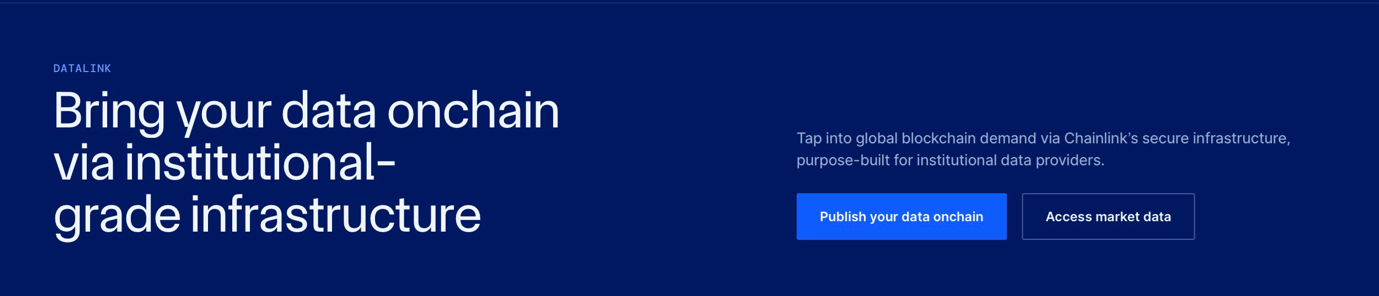
FTSE Russell — the global index provider with over $18 trillion in assets benchmarked — is now publishing the Russell 1000, Russell 2000, Russell 3000 and FTSE 100 indices on-chain via DataLink, across more than 40 public and private blockchains.
The same benchmark data that underpins the majority of institutional portfolio construction in traditional finance is now accessible to on-chain applications 24/7.
And it’s not the only one. Deutsche Börse Market Data + Services has partnered with Chainlink to bring real-time data from Eurex, Europe’s largest derivatives exchange, on-chain. Eurex recorded over 2 billion traded contracts in 2024, with €3.6 trillion in open interest.
Deutsche Börse will also use DataLink to bring other exchanges, such as Xetra, 360T and Tradegate, on-chain for the first time, as well.
S&P Global Ratings will use DataLink to publish its Stablecoin Stability Assessments. This marks the first time DeFi protocols and smart contracts can access S&P’s independent credit analysis directly.
And Tradeweb will publish its FTSE U.S. Treasury Benchmark Closing Prices on-chain via DataLink. These are the official closing prices registered under EU and UK Benchmark Regulation, now live across blockchains.
Think about what that list actually is: The data that powers global TradFi … is now being directly fed into on-chain applications.
Meaning DataLink is quietly becoming the Bloomberg Terminal of DeFi.
The Wider Institutional Footprint
- JPMorgan — partnered with Ondo Finance (ONDO, “D+”) — used Chainlink as the cross-chain orchestration layer for the first real delivery-versus-payment settlement.
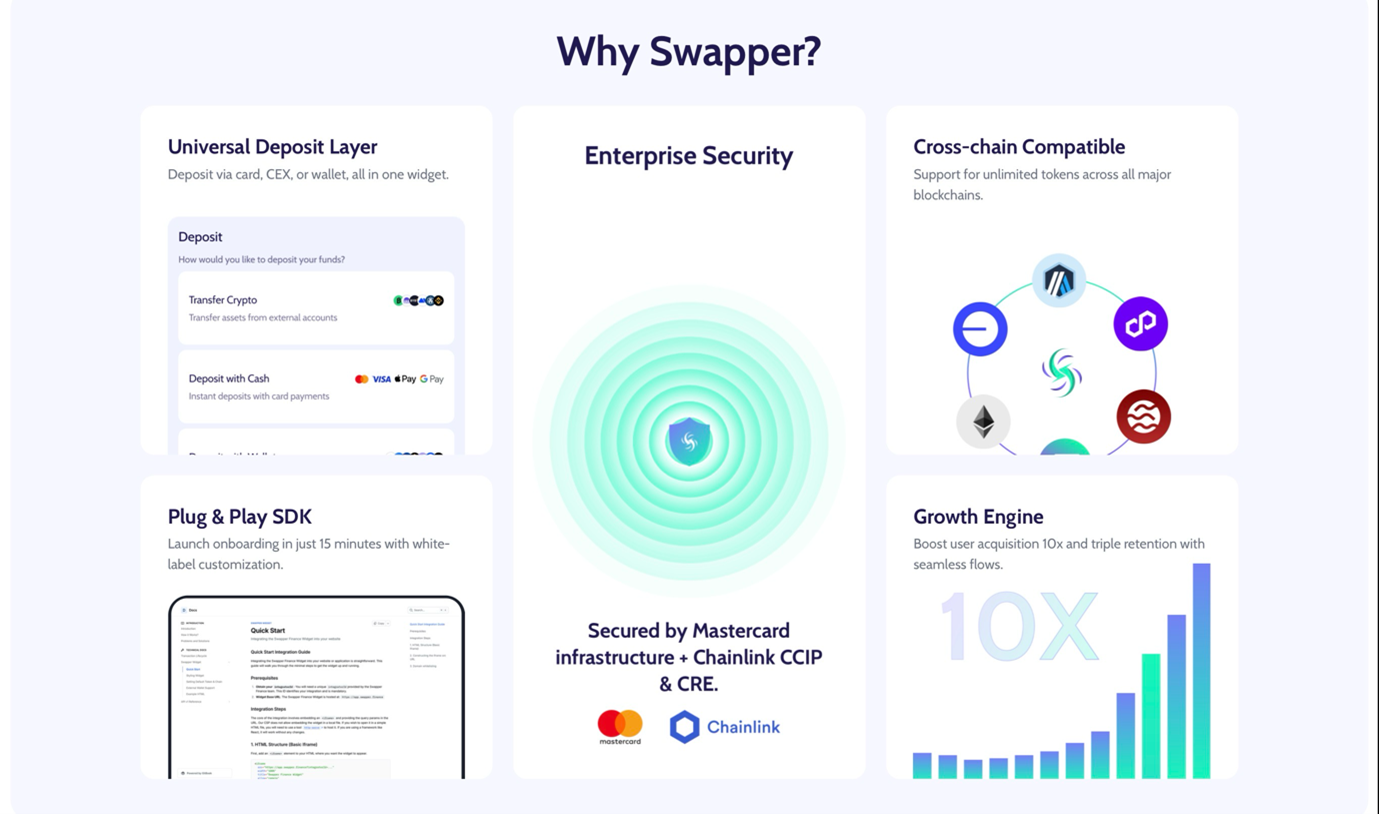
- Mastercard’s 3.5 billion cardholders can now buy crypto directly on-chain via Swapper Finance, a Chainlink-powered app.
- Walmart’s OnePay — a fintech super-app — added Chainlink to its crypto offerings, alongside nine other assets.
- Coinbase selected CCIP as its exclusive interoperability provider for all Coinbase Wrapped Assets. That represents a combined market cap of approximately $7 billion.
- SBI Group in Japan adopted Chainlink as its exclusive infrastructure solution for digital assets across the APAC region.
- The U.S. Department of Commerce is publishing official macroeconomic data directly on-chain via Chainlink oracles.
- Brazil’s Drex CBDC pilot used Chainlink’s infrastructure to connect Brazil’s central bank network with Hong Kong’s Ensemble platform in the first cross-border, cross-chain CBDC settlement.
- Bitwise’s CLNK ETF launched on NYSE Arca, opening LINK to brokerage and IRA accounts for the first time.
The Token Demand Mechanism
Clearly, demand for Chainlink’s products is there.
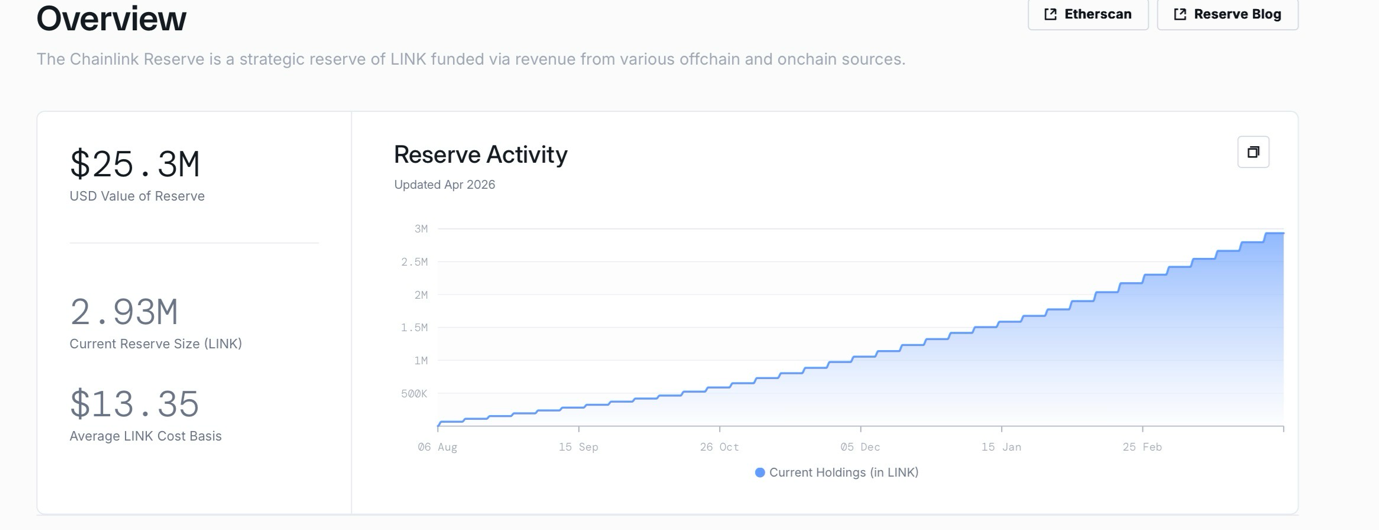
And that should be reflected in its token price. That’s because Chainlink operates a reserve wallet that converts protocol fees — both on-chain and off-chain revenue from enterprise contracts — directly into LINK tokens.
So, every institution that pays to use CCIP, DataLink or any other Chainlink service is indirectly buying LINK through this mechanism. Supply is being removed from circulation as adoption grows.
As of April 2, 2026, that reserve holds 2.93 million LINK tokens, accumulated entirely through network usage.
And yet, LINK’s price remains subdued.
Beyond the external, macroeconomic factors, part of that is because the banks and institutions paying for Chainlink services are not necessarily buying the token directly.
The reserve wallet mechanism partially addresses this, but it does not eliminate the concern.
Now, LINK is bearish across all major time frames.
The 50-day and 200-day moving averages are both falling and sitting above the price. The monthly chart tells the story clearly …
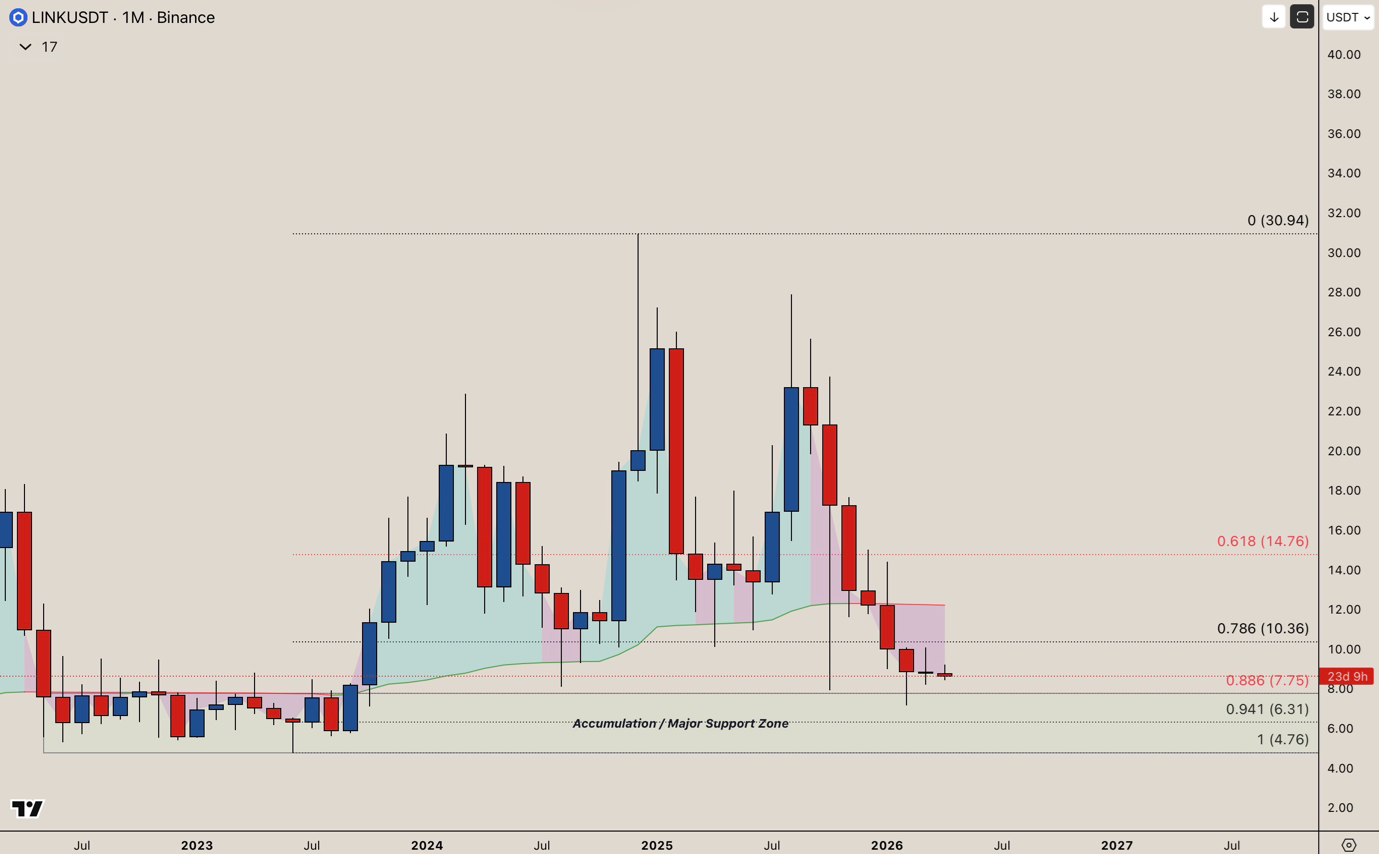
After topping out near $30 in early 2025, Chainlink has spent the better part of a year unwinding. Now, it’s testing the deepest Fibonacci retracement levels of the entire 2023-2025 cycle.
Current price is pressing into the $8–$9 support zone, a level that has absorbed multiple tests since February. The 0.886 fib ($7.75) sits just below, with the full retracement at $4.76.
That’s the floor of what the chart labels the Accumulation / Major Support Zone, the same base that launched the 2024 rally.
Here are the levels that matter:
- On the downside, the immediate line in the sand is $7.75. A clean daily close below it opens the door to $6.50–$5, where long-term accumulation interest historically steps in.
- To the upside, $10–$11 is the first resistance wall that’ll need to be cleared. A volume-backed close above it would be the first credible signal of a trend shift, with the 0.618 fib at $14.76 as the initial target. That level also corresponds with the January 2026 high. Short liquidation cascades would likely accelerate the move through that zone.
- If LINK can break above the 0.618 fib level near $14.76, the chart opens up toward a retest of the 2024-2025 highs in the $26–$30 range.
Bottom Line
Chainlink is a battle-tested network that has survived several bull/bear cycles. And now, it’s building real infrastructure that’s sorely needed to bridge the gap between markets and increase institutional adoption and utility.
All with token demand that didn’t exist in prior cycles.
However, the broad trend remains bearish. And setups like LINK’s can take time to play out.
And in that time, LINK’s price can swing. A lot.
Savvy investors may want to keep LINK on their radar. But more than that, they’ll want to plan their entrance and exit carefully.
LINK happens to be one of the blue-chip cryptos that has earned a spot in Juan Villaverde’s Weiss Crypto Investor portfolio in cycles past.
In fact, in the previous cycle from 2020 – 2022, Juan’s long-term investors had the chance to grab 312% gains on LINK!
That’s thanks to Juan’s Crypto Timing Model’s precise “buy” and “sell” alerts.
To see how the model will approach LINK — and other top cryptos — in this cycle, you should watch Juan’s recent briefing here.
Best,
Mark Gough