 |
| By Beth Canova |
In just about one month, U.S. citizens will head to the polls for the midterm elections.
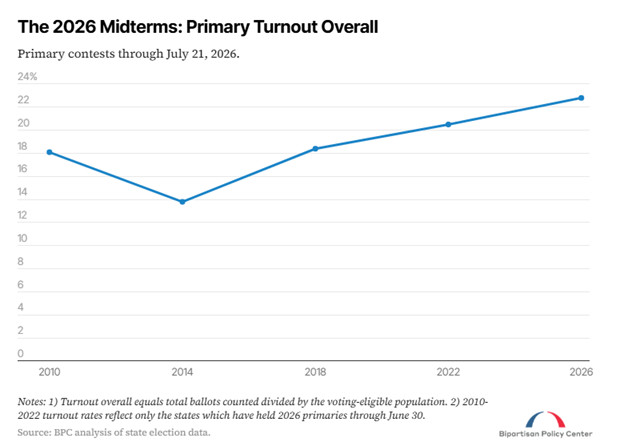
With control of Congress on the line and key races slated across several states, more voters turned out for their respective primary races this year than at any point in the past 16 years.
If that trend holds up, this midterm battle may be one of the biggest we’ve seen in a long time.
But another issue may loom over the vote. One not on the ballot …
Trust.
According to a recent poll by the Associated Press-NORC Center for Public Affairs Research and USAFactsSome, only 34% of Americans trust the government when it releases certified election results.
About 60% trust the government “only a little” or “not at all.”
Further undercutting the tenuous trust is the question of privacy.
Ballot secrecy is a relatively new notion in the history of U.S. elections, but provisions for it exist across all states. The reason is simple — to avoid influence ahead of the vote and repercussions afterwards.
Yet a recent case in Georgia shows how hard that can be in the digital age.
Back in 2022, a software vulnerability was discovered in the machines the state uses in its elections. One that leaves it open to attacks.
To be clear, a hacker wouldn’t be able to change votes. But it would allow people to see how their family, neighbors and colleagues voted. And now with the rise of AI, fear that this vulnerability will finally crack wide open have resurfaced.
This leaves lawmakers and election boards with a critical question:
How do we make elections easy to verify … without making our votes easy to trace?
What Blockchain Could Do
For crypto natives, this sounds like a familiar problem. One we’ve already answered for trustless financial transactions thanks to blockchain technology.
At its core, a blockchain is a record of data.
But unlike a normal database, it can be shared across many computers. New records — blocks —are added to a chain. And once they are added, changing old records is very hard.
That is why blockchain works so well for crypto transactions.
You don't need one bank to keep the master record. The network keeps a record of itself. One that verifies each individual block as its added and can be reviewed by everyone.
Now think about voting.
In theory, a blockchain could create a record that shows a ballot was cast and counted. Think of it acting like a virtual ballot box.
A voter might get a private tracking code. That code could let the voter check that his or her ballot made it into the final count.
Election officials could also have a record of when data was added.
And an attacker could have a much harder time going back later and changing that record without leaving signs behind.
Those are real benefits.
But there is a catch.
A blockchain can protect a record after it reaches the chain. But it can't prove the information was right when it went in.
Imagine a piece of malware infects your polling machine. You vote for Candidate A. But the malware changes your choice to Candidate B before the vote reaches the blockchain.
The blockchain may then do its job very well … and create a permanent record of the wrong vote.
Similar hacks — including malware that have infiltrated verification processes and changed approved transaction amounts — have happened in the past. So the concern is more than just hypothetical.
In short, blockchain may help with the record. But it’s not the magic solution some crypto natives may have hoped.
In fact, the National Academies found that the blockchain could introduce new and unique vulnerabilities. It also warned that blockchain alone does not provide ballot secrecy.
Its findings have been played out for real in the few states that tried to roll out digital election access.
West Virginia was an early leader in this push.
During the 2018 midterms, some military and overseas voters were allowed to vote through a mobile app called Voatz. The system used blockchain as part of its process.
The goal made sense. A soldier stationed thousands of miles from home may have trouble getting a paper ballot back on time. And late counting of mail-in ballots has long been a point of contention.
But a vote on a phone, sent and verified through the blockchain, could make the process much easier all around.
In theory. But MIT researchers later studied the Voatz app. They reported flaws that they said could let an attacker alter, block or learn a person's vote.
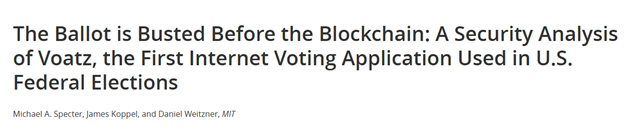
West Virginia stopped using the app shortly after the report came out.
Yet the state has not given up on digital voting. Today, certain military and overseas voters in West Virginia can still use an online portal to return ballots.
And as of June 2026, 32 states, Washington, D.C., and the U.S. Virgin Islands allowed at least some voters to return ballots by electronic means. Mostly this rule applies only to military voters, citizens who are overseas or voters with disabilities.
That is a long way from letting everyone vote on a blockchain.
Lawmakers Aren’t Done Yet
Colorado offers another clue about where this could go.
In 2024, lawmakers considered a bill that would have built distributed ledgers into the state's election process.
Voters would have received random tracking numbers. Election data would have been entered into shared ledgers. And the public would have been able to use those records to help check that their votes were counted.
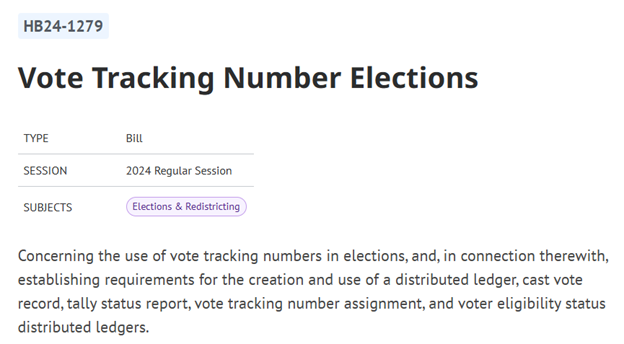
That bill did not pass. But the idea matters.
It shows that lawmakers are thinking about blockchain as more than a way to vote from a phone.
And that may be where this technology has its best shot.
Blockchain does not have to replace paper ballots. Instead, it could help create records around an election.
And it could give voters another way to check parts of the process.
That is a very different idea from telling 150 million Americans to vote through an app.
Here's What to Watch
Don't expect blockchain voting to sweep the nation in 2026.
That is one reason election experts remain wary of online voting.
The real story is smaller. Which means your focus needs to narrow. And your horizon needs to expand.
With only a handful of weeks left until the 2026 midterms, don’t expect an election process overhaul any time soon. But there are two years until our next presidential election.
And that’s when we could see changes.
Watch the states. Look for new bills that use distributed ledgers for ballot tracking, election records or audits.
And pay close attention to systems that combine a paper record with digital proof.
That could become the key test.
Because the biggest opportunity for blockchain may not be replacing the ballot box.
It may be giving voters a better way to trust what happens inside it.
If that becomes the narrative going forward, crypto investors will be well positioned to place their bets on the networks most likely to make that happen.
Best,
Beth Canova