 |
| By Jurica Dujmovic |
Let’s say you decide to build a tech-focused investment portfolio.
Naturally, you’d want a fair amount of exposure to AI. But, as a savvy investor, you know to diversify your holdings.
So, you buy a chipmaker, a cloud provider, a data-center operator, a networking company and an AI software business.
Five companies. Different products. Several ways to profit from artificial intelligence.
That sounds diversified.
But I would ask one more question before getting comfortable: How many of those businesses rely on the same customers to keep spending?
Is Your Portfolio Really Diversified?
This question matters more than you may realize. Because as we speak, AI companies are building increasingly close financial relationships.
A supplier can also be an investor in its customer. A customer can receive the right to buy shares in its supplier.
Several businesses can build their growth plans around the same expansion.
The International Monetary Fund put the broader risk in focus in its latest Global Financial Stability Report. It warned that disappointing AI investment or profits could trigger a domino effect that’ll manifest as a market correction.
You can’t control the market. But you can control what you’re exposed to, and the level of exposure. Which is why your first step when evaluating your AI holdings is to take a hard look at how many of your positions depend on the same spending.
Consider Amazon and Anthropic.
One is a public FAANG stock. The other is a leading private AI company with a highly anticipated IPO.
But a closer look reveals these two are more intertwined than you may think.
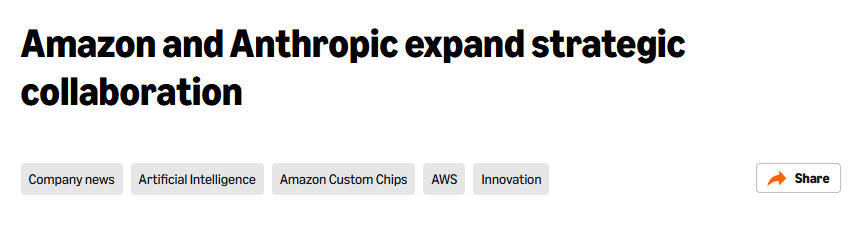
In an expanded partnership announced this year, Amazon said it would invest another $5 billion in Anthropic, with up to $20 billion more in future investments. Those amounts were additional to $8 billion previously invested. Anthropic would secure up to 5 gigawatts of capacity using current and future generations of Amazon’s Trainium chips.
The relationship has a straightforward commercial rationale. Anthropic needs computing capacity. Amazon supplies it and benefits if Anthropic succeeds.
But Amazon also has two kinds of exposure to the same business …
- The value of its investment
- And the business generated by serving Anthropic as a customer.
Those interests can reinforce each other during an expansion. They can also come under pressure together.
Which is why, if you own Amazon, watching how Anthropic’s IPO performs will be informative.
A different arrangement connects AMD and OpenAI.
In an October 2025 securities filing, AMD disclosed a warrant — that is, the right to buy shares under certain conditions — that would allow OpenAI to purchase up to 160 million AMD shares for one cent each. Vesting depends on milestones, including purchases of AMD computing hardware.
That is not the same as AMD lending OpenAI money. It is an equity incentive tied to a commercial relationship.
That said, it does still connect the fortunes of both companies.
Broadcom provides an especially clear illustration of the underlying business risk.
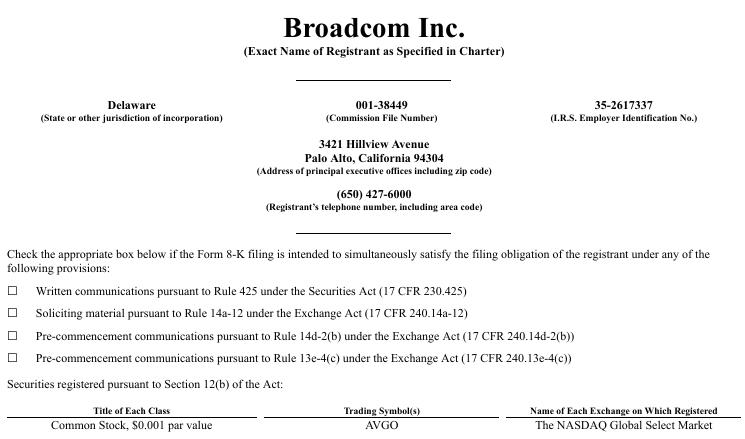
Its April 6 filing described an expanded collaboration with Google and Anthropic. Beginning in 2027, Anthropic would access approximately 3.5 gigawatts of computing capacity through Broadcom as part of a broader commitment.
The filing explicitly states that Anthropic’s consumption of that expanded capacity depends on its continued commercial success.
That qualification deserves as much attention as the size of the deal.
A supplier can announce an enormous opportunity. Whether that opportunity turns into sustained business still depends on the customer’s ability to support its plans.
Find Real Sector Diversity
None of these arrangements, by themselves, establishes improper accounting or artificial demand.
Suppliers have legitimate reasons to help promising customers grow. And long-term commitments can make expensive infrastructure easier to plan and finance.
So, your research needs to go deeper than just seeing connections and projections that rely on the same assumptions.
Here’s where to start …
First, I would identify the customers behind each company’s expected growth.
Two suppliers selling different products to the same major buyer offer some business diversification. But they still share that buyer’s spending risk.
Second, I would examine how expansion is funded.
Cash generated by existing operations, new borrowing and fresh equity investment create different obligations and vulnerabilities.
A company that can finance its plans internally has more flexibility than one that must repeatedly return to investors.
Third, I would distinguish announced opportunities from business already producing cash.
This is a step seasoned crypto investors know well. A planned deployment, a conditional commitment and a completed sale should not carry the same weight in an investment case.
Finally, I would review overlap across the entire portfolio.
Owning an AI stock directly and through several funds increases exposure to that company. Owning different companies that depend on the same customers creates a similar concentration.
Bottom Line
This does not mean all AI businesses face equal risk. Their balance sheets, other customers, contract terms and valuations differ.
Those differences need to remain part of the analysis.
What it does mean is that buying another ticker is not enough to truly diversify your portfolio.
I remain interested in the businesses AI can help build. But an investment case also needs to account for what happens when spending arrives later or grows more slowly than expected.
Before you add another AI position, stop and ask if it really brings a different source of earnings … or just increases dependence on the same growth you already have exposure to.
That answer will tell you more about diversification than the number of stocks on your account statement.
Best,
Jurica Dujmovic