
 |
| By Mark Gough |
When investors think about Wall Street, they tend to picture names like BlackRock (BLK), Goldman Sachs (GS) or JPMorgan (JPM).
But few think about the company that sits behind almost every trade.
The Depository Trust & Clearing Corporation (DTCC) processes and settles the overwhelming majority of U.S. securities transactions. It handles well over $100 trillion worth of securities each year.
It is one of the most important pieces of financial infrastructure in the world.
So when the DTCC announces a new blockchain pilot, it’s worth paying attention. When it starts moving towards production, it would be short-sighted not to look closer.
Earlier this month, the DTCC announced the next phase of its tokenization initiative.
It will bring together some of the biggest names in finance — BlackRock, JPMorgan, Goldman Sachs, Vanguard, Nasdaq and the New York Stock Exchange — to demonstrate how tokenized securities can operate within existing market infrastructure.
The important point isn’t that another blockchain pilot has taken place. These are the institutions responsible for running today’s financial system.
And they’re beginning to upgrade the plumbing rather than replace it.
Ondo Isn’t Trying to Replace Wall Street
This is where Ondo Finance (ONDO, “C-”) stands out.
Instead of replacing Wall Street, it builds products that integrate with it. Its tokenized U.S. stocks are designed to connect blockchain infrastructure with traditional market infrastructure.
This way, investors can access familiar assets through blockchain rails while remaining compatible with existing financial systems.
That might not sound as exciting as previous crypto narratives. But if tokenization becomes a multi-trillion-dollar industry, interoperability could prove far more valuable than speculation.
And the winners won’t necessarily be the companies issuing every tokenized asset.
They may be the companies building the infrastructure that allows those assets to move seamlessly between traditional markets and blockchain networks.
That’s exactly where Ondo is positioning itself.
And not just within the U.S., either. The company recently announced a strategic partnership with SBI Holdings, one of Japan’s largest financial services groups.
The partnership aims to expand tokenized real-world assets into Japan while exploring the use of SBI’s JPYSC stablecoin for settlement and collateral.
This is more than just a partnership: Major financial centers around the world are beginning to prepare for the same structural shift.
Every new market that embraces tokenized assets expands the potential opportunity for platforms already building the infrastructure.
JPMorgan Shows What Comes Next
Perhaps the clearest sign of where all this is heading came from JPMorgan.
As part of the DTCC initiative, the bank demonstrated how tokenized holdings linked to the Invesco QQQ Trust (QQQ) could be used as collateral while remaining connected to traditional ownership.
That may sound like a technical exercise. It isn’t.
See, collateral sits at the center of modern finance. If tokenized securities can move more efficiently while remaining fully compatible with existing markets, it opens the door to faster settlement, improved capital efficiency and entirely new financial products.
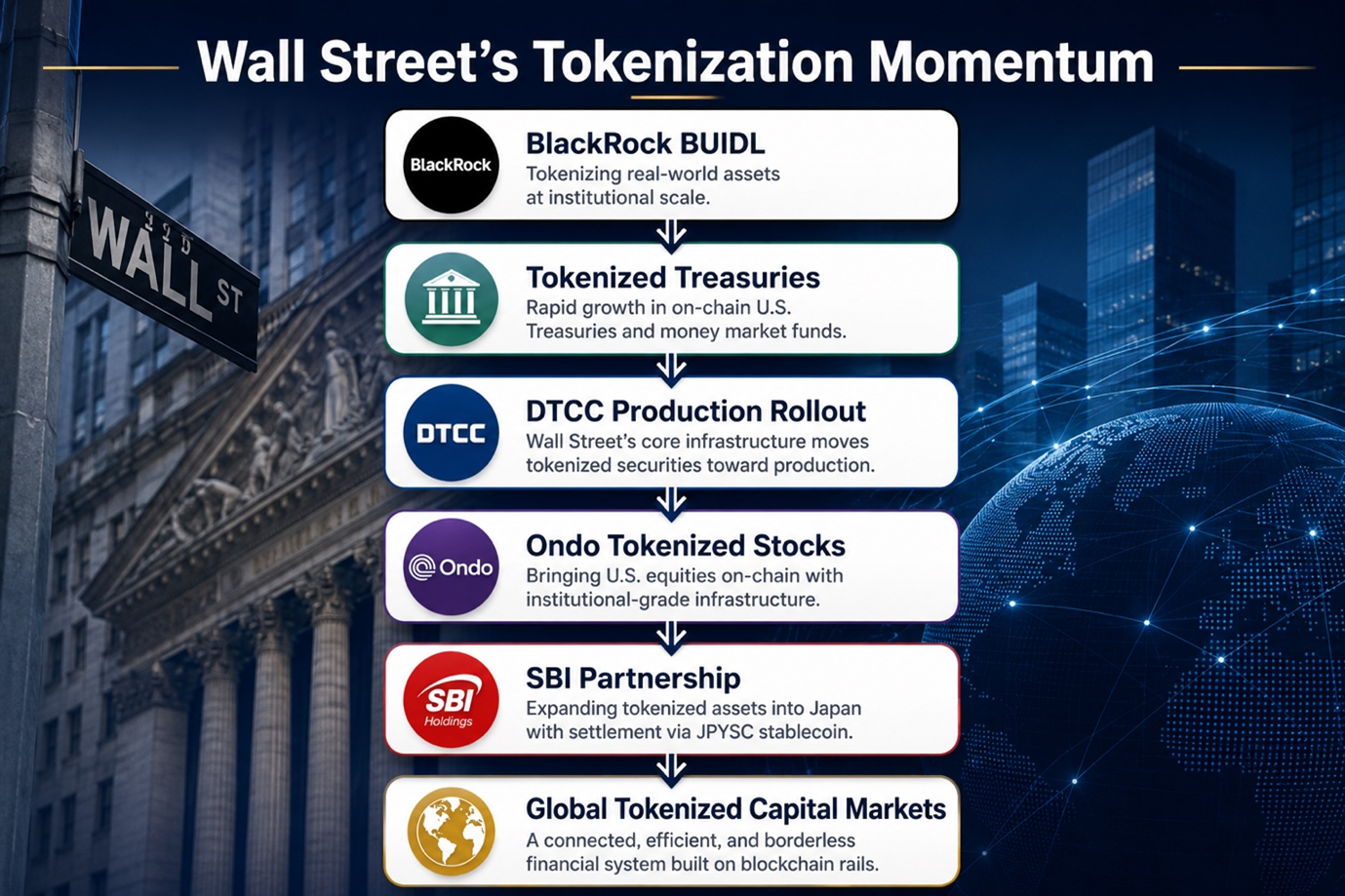
This is no longer about proving blockchain works. It’s about improving how financial markets work.
We’ve Been Watching This Theme for Months
Tokenization has been one of our highest-conviction, long-term themes in Weiss Crypto Daily this year.
Each announcement looked relatively small on its own. But now, we’re starting to see how they’ll connect.
And what we see is that Wall Street isn’t making one big leap into blockchain. It’s taking hundreds of small steps, each one reducing friction and making tokenized assets a little more practical than they were before.
That’s how major technological shifts usually happen: Gradually … then all at once.
None of these developments guarantee Ondo’s success in particular. (That said, I personally am long-term bullish on it.)
Competition in tokenized finance is only going to increase, and many of the world’s largest financial institutions are investing heavily in their own blockchain strategies.
But that’s also why this week’s developments matter. Because they’re another sign that tokenization is moving beyond theory.
It’s slowly becoming real financial infrastructure.
If this trend continues over the coming years, trillions of dollars’ worth of traditional assets could eventually move on-chain.
The biggest winners won’t necessarily be the institutions issuing those assets.
They could be the companies building the rails that connect traditional finance with blockchain.
That’s why we’ll continue to watch this story closely.
Best,
Mark Gough