This AI Crypto Is Making Millions. Here's the Catch ...

 |
| By Mark Gough |
One of the dominant conversations of 2026 has been AI.
And when it comes to talking about investing in artificial intelligence, the discussion typically begins with chips, data centres and the companies that are building the models.
But I think it’s far more interesting to explore another part of that business. One that the blockchain can uniquely fill …
Providing the information those models need.
Think about it: You can build the most powerful AI system. But it still needs useful data to learn from. And when someone asks it about something happening today, yesterday’s information might already be out of date.
That’s why big tech is willing to spend big to gather the most data possible.
Grass (GRASS) is building a business around that demand.
Its network helps collect public web data for AI and enterprise customers. And it uses internet bandwidth contributed by ordinary users.
And that's what makes Grass interesting right now. Unlike many AI tokens out there, Grass has an actual business. One that generates real revenue. The only question left is whether enough of that value flows back to GRASS holders.
How Grass Actually Works
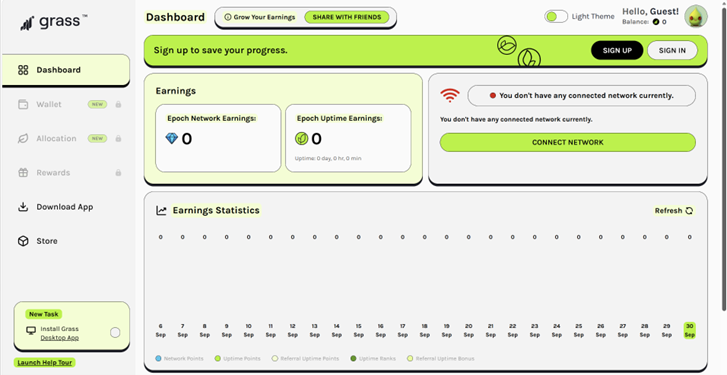
Most of us pay for a broadband connection. But we typically only use a fraction of its capacity throughout the day.
Grass lets participants lend some of their unused bandwidth via an app. In return, they’re rewarded with stablecoins, pegged to the dollar.
The network then uses those connections to access and aggregate publicly available information.
The infrastructure behind the app directs requests, checks bandwidth, and converts public web data into structured datasets.
The commercial rationale is simple: Gathering information is only the first step, because customers need it organized, filtered, and presented in a useful form.
The appeal for me is that Grass could become a regular supplier to AI companies.
That would mean Grass can turn customers like Google, Meta (META) and OpenAI into repeat business.
The Latest Revenue Figures Deserve Attention
Grass recently published a revenue summary from Regen Financial, dated Sept. 17, covering Grass DataCo.
Total revenue reported hit $32.1 million.
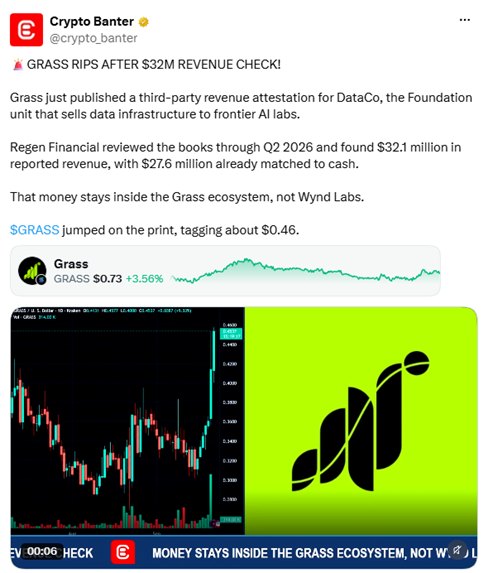
But the breakdown is important …
- The revenue for the first half of 2026 is listed as $14.53 million, of which $11.35 million has been verified through cash receipts.
- For the period from March 14 to Dec. 31, 2025, the corresponding amounts were $17.59 million and $16.24 million.
The difference between reported revenue and cash received requires attention. Because the summary describes timing differences involving work awaiting invoicing and invoices awaiting payment.
That doesn’t automatically indicate a problem, but it is something to watch closely.
There is also a significant limitation since this was a due-diligence engagement and not an audit, and Regen has given no assurance opinion.
The most recent figure for the first half is less than the approximately $17 to $18 million figure given in Grass's July update. Since the public documents do not clearly explain this discrepancy, I will use the September figure.
Even with those caveats, I would much rather see real cash coming in the door than another crypto project selling us projections.
Where the Business Could Grow
Grass's next opportunity will be to help AI systems obtain new information as they are in use. The project calls this Live Context Retrieval, or LCR.
Think about an AI assistant that checks a product’s availability, researches a company announcement, or compares current prices.
Those tasks require access to information that can change quickly. Grass can provide that access.
In July, management set out plans to roll out this market and projected that revenue from training data for the full year 2026 would be in the range of $65 to $75 million.
That said, this is just management’s guidance, not revenue already in the bank.
The real numbers will depend on current commercial opportunities turning into actual customers.
If Grass can provide that information reliably and at a competitive price, it might extend its customer relationships beyond its training datasets.
I wouldn't place much value on that expansion until we’ve seen evidence of products reaching customers, repeated usage, and extra revenue. A favourable market is of no use unless the business is able to win customers in it.
What Does That Mean for GRASS Holders?
I’ve said before one of the most important features for a crypto project to have is a way to connect revenue to token price.
Without that, you could own a crypto with no real connection to the growth of the platform.
Grass states that customer-contract revenue is received by Grass DataCo, which is a wholly owned subsidiary of the Grass Foundation.
This arrangement makes it clear where the commercial income is located.
But that still doesn’t tell us what an individual GRASS holder actually gets.
You’d think, then, that holders would benefit from platform utility. But as of writing, it doesn’t.
The rewards for Grass’s Stage 2 participants are paid in USD Coin (USDC). Possessing GRASS has no impact on eligibility. The project states that the distribution results in no extra GRASS emissions.
This means no extra tokens need to be issued for this payment. That’s good because it means rewards don’t act as an inflationary force. But those payments should not be confused with income earned simply by holding GRASS.
Based on a review of the current tokenomics, there’s no solid mechanism connecting platform revenue to token price.
An earlier official treasury update disclosed $250,000 in open-market purchases, following a previous $100,000 allocation. Those tokens were described as reserves supporting incentives, operations, and token utility.
That’s helpful. But it’s a one-time deal.
Here’s what I’d want to see: a measurable link between commercial success and the demand for GRASS.
The amount, frequency, and reason for future purchases would help establish that link.
Supply Still Matters
GRASS has a maximum supply of 1 billion tokens. Its allocation includes 25.2% for early investors and 22% for contributors, alongside community and foundation allocations.
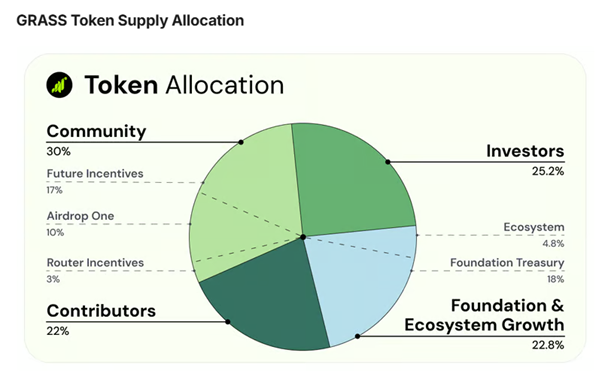
Investors therefore need to track tokens becoming available for circulation as well as the business’s revenue.
To that end …
- A fixed maximum supply does not mean the amount available for trading remains constant. The allocations currently in place can be released, which would increase the amount holders can sell.
- And an unlock also doesn’t mean those tokens will automatically be sold. What matters is whether market demand can absorb the additional supply.
I would also look at customer concentration, the cost of gathering and processing data, and whether Grass can maintain its competitive position.
Revenue is growing, that’s clear. But the devil is in the details — margins and repeat business will determine how sustainable that growth really is.
What I’m Watching Next
The next things to watch are simple:
- updated financial results,
- an explanation of the difference in the first-half revenue figures,
- evidence of LCR adoption,
- And clearer reporting on how commercial income supports the token.
Grass has now given us something real to evaluate.
The next question potential investors need to answer is how much of that commercial success ultimately flows through to GRASS holders.
Right now, that connection remains murky.
But if it becomes clearer, it could turn Grass from an interesting AI project into a much stronger long term investment case.
Best,
Mark Gough
P.S. As Grass proves, finding the next big crypto project requires a lot of research. Even promising platforms have skeletons that potential investors need to uncover.
The same is true for newly listed stocks. In fact, in the past 15 years, only 10% of all IPOs generated positive results for first-day investors.
But Startup Investment Specialist Chris Graebe has developed a system with Weiss Ratings’ data to help you target them. He calls it Apex IPO.
Testing showed it beat the average IPO 25-to-1!