 |
| By Mark Gough |
A $3,500 price target for Aave (AAVE, “C-”) sounds ridiculous.
At first.
But once you start digging into the numbers, the question becomes less about whether the target sounds aggressive …
And more about what would have to happen for Aave to justify a valuation of that size.
Because while investors continue to chase AI tokens, memecoins and the latest market narrative, Aave has quietly become one of the most important financial businesses in crypto.
And now Wall Street is starting to pay attention.
Standard Chartered Sees a Massive Opportunity
Aave is a decentralized finance (DeFi) protocol that allows users to lend, borrow and earn interest on cryptocurrency assets without traditional banks or intermediaries.
According to reports citing a recent research note1 from Standard Chartered’s Head of Digital Assets Research Geoff Kendrick, the bank believes decentralized finance could grow to approximately $2.7 trillion by 2030.
Kendrick has also reportedly initiated coverage on Aave and suggested its token could rise to $3,500 by the end of 2030.
The significance is hard to ignore.
Major financial institutions are no longer debating whether DeFi survives. They’re trying to estimate how large it might become.
And if DeFi grows into a multi-trillion-dollar market, lending will likely sit at the center of that ecosystem.
That’s where Aave enters the picture.
The Largest Lending Protocol in Crypto
At its core, Aave is a lending marketplace.
Users can deposit assets, earn yield, borrow against collateral and access liquidity without selling their holdings.
That may not sound revolutionary. In fact, it isn’t. Lending sits at the center of every financial system.
Banks lend.
Brokerages lend.
Money markets lend.
Capital markets depend on lending.
The novelty of Aave is that it decentralizes the process to bring lending to the crypto ecosystem without middlemen.
Basically, Aave uses code and smart contracts — agreements that are algorithmically programmed to activate only if certain conditions are met — to facilitate these functions rather than physical branches and employees.
That’s why many investors increasingly view it as one of the most important pieces of infrastructure in decentralized finance.
The Numbers Are Becoming Hard to Ignore
According to DefiLlama, Aave currently boasts:
- $12.67 billion Total Value Locked (TVL)
- $934.6 million annualized fees
- $123.5 million annualized revenue
- $122.2 million annualized earnings
- Approximately $1.16 billion market capitalization
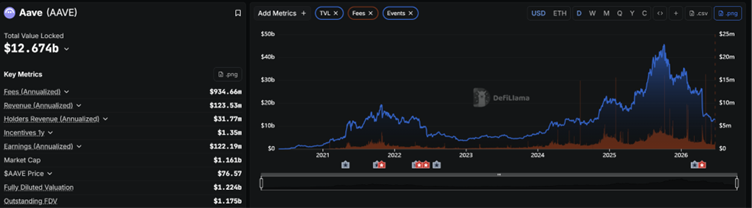
Those figures are remarkable. Many publicly traded companies would be thrilled to generate more than $120 million in annual earnings.
Yet Aave currently trades at a valuation of roughly $1.16 billion. That implies an earnings multiple of approximately 9x–10x.
In traditional finance, that would hardly be considered expensive.
To me, this suggests that the market may still be valuing Aave as a speculative crypto asset … even as its revenue generation and earnings profile increasingly resemble those of traditional finance companies.
The current numbers also do not fully capture what Aave has already proven it can handle.
During the 2025 bull market, Aave’s total value locked — a measure of usage for DeFi platforms based on how much capital users lock into it — climbed to nearly $46 billion.
That shows the scale to which decentralized lending can grow when capital starts flowing back into the sector.
Why Standard Chartered Thinks AAVE Could Reach $3,500
The key to Kendrick’s thesis appears to be operating leverage.
If more assets flow into DeFi, then naturally more of those assets will be used for lending, borrowing and collateral. In which case, Aave’s revenue should grow alongside that activity as it is the leading decentralized lending platform.
Unlike many crypto projects that rely primarily on speculation, Aave’s business model is directly tied to economic activity on the platform.
More deposits can lead to more borrowing.
More borrowing can lead to more fees.
More fees can lead to more protocol revenue.
And if more of that value eventually accrues to AAVE holders, the token becomes easier to value using traditional financial logic.
Standard Chartered also reportedly highlighted several additional catalysts:
- Growth in tokenized real-world assets
- Expansion of on-chain lending markets
- A potential restart of Aave’s token buyback program
- The Horizon initiative, which aims to support borrowing in a permissioned environment using tokenized real-world assets as collateral
- Continued growth in stablecoins and institutional DeFi participation
That creates a potential flywheel:
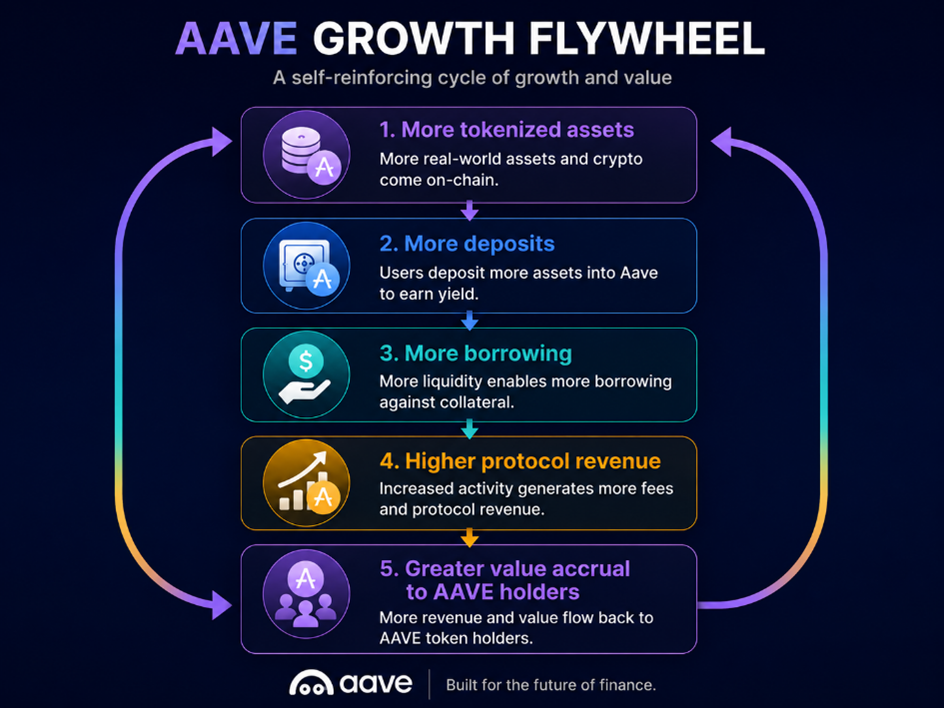
That does not guarantee a $3,500 price target.
But it does explain why institutions are beginning to model outcomes that seem almost impossible through today’s lens.
The Next Phase Is Already Underway
One of the biggest misconceptions surrounding Aave is that its growth story is largely complete.
The data suggests otherwise.
One of Aave’s most overlooked growth engines is GHO, the protocol’s native stablecoin.
Stablecoins have quietly become one of the fastest-growing segments of the digital asset market. They are now being used for payments, trading, treasury management, settlement and cross-border transfers.
As adoption grows, stablecoins will require deeper lending markets, liquidity pools and collateral systems.
That creates another potential growth avenue for Aave beyond its core lending business.
And Aave Labs has already released extensive research and governance proposals outlining the next evolution of the protocol through Aave V4.
The architecture aims to improve capital efficiency, strengthen risk management, simplify governance and further integrate GHO throughout the ecosystem.
More importantly, adoption is already occurring.
Current Aave V4 metrics show:
- More than $140 million in TVL
- Over $58 million in active loans
- Growing fee generation
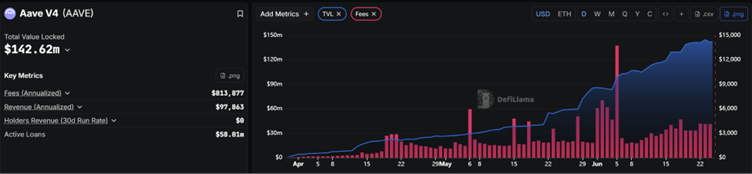
The absolute figures remain small compared to the core protocol. But at this stage, I’m focused more on the direction Aave is trending in.
Users are actively moving capital into the next phase of the ecosystem. That is often where future growth begins.
What Would $3,500 AAVE Actually Mean?
A $3,500 AAVE price would imply a market capitalization of roughly $55 billion based on the current token supply.
That sounds enormous.
Until you compare it with traditional finance.
- JPMorgan has a more than $700 billion market cap
- Goldman Sachs’ is approximately $250 billion
- And BlackRock boasts an approximately $150 billion market cap
A $55 billion valuation would position Aave among the most valuable crypto platforms, underscoring its potential to rival traditional finance giants and inspire ambition among investors.
But it would still be a fraction of the size of the world’s largest financial institutions.
To be honest, though, the real question we need to answer isn’t whether AAVE can reach $3,500. It’s whether decentralized finance becomes a meaningful part of global finance over the next decade.
If Standard Chartered’s reported vision of a $2.7 trillion DeFi market proves even partially correct, lending infrastructure will likely play a central role in that future.
And today, Aave sits firmly at the center of that story.
Is Aave Becoming the JPMorgan of DeFi?
The comparison is not about size.
It is about function.
Traditional financial institutions sit at the center of capital markets because they facilitate borrowing, lending, liquidity creation and capital allocation.
Aave is attempting to provide many of those same services through decentralized infrastructure.
Of course, risks remain.
Regulatory uncertainty continues to exist.
Competition remains fierce.
And adoption will not occur in a straight line.
But unlike many crypto projects, Aave has survived multiple market cycles, maintained its leadership and continued to grow its ecosystem.
That track record deserves attention.
Best,
Mark Gough
1 https://cointelegraph.com/news/tokenization-push-defi-assets-trillion-2030-standard-chartered