 |
| By Beth Canova |
When Apple (AAPL) wants to reward its shareholders, it does something most investors barely notice: It buys back its own stock.
Fewer shares in the market means each remaining share is worth a little more.
It is one of the quietest ways a mature company hands cash back to the people who own it.
Now picture a business that does this with almost every dollar it earns. No board vote. No press release. Just daily, automatic buy backs.
That business is not listed on the New York Stock Exchange. It is a crypto exchange called Hyperliquid (HYPE, “D+”).
And the story here is not the rally in its token, HYPE. It is the machine running underneath it.
Think about it this way …
Bitcoin corrected for most of the past month. Much of the market fell with it.
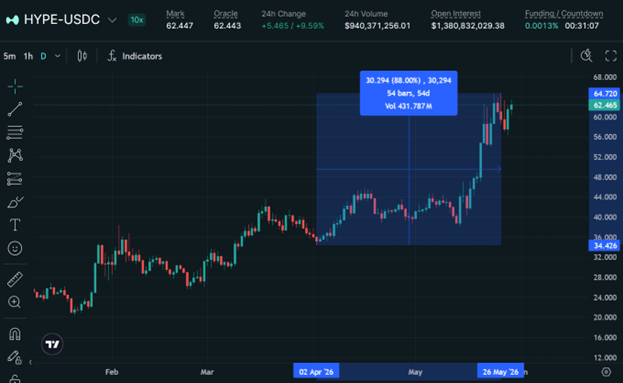
But HYPE bucked the trend. It went the other way with enough momentum to hit a record high.
That’s because it used one of TradFi’s oldest tricks. Hyperliquid takes almost every dollar it earns and spends it buying back its own token.
Here’s the kicker: Wall Street has spent years dismissing crypto and its products. But now, it’s trying to buy in.
What Hyperliquid Actually Is
Hyperliquid is a crypto exchange.
But it doesn’t just let traders by crypto for spot, or real-time, prices. Rather, it’s a perpetuals exchange, where traders can bet on crypto prices with leverage.
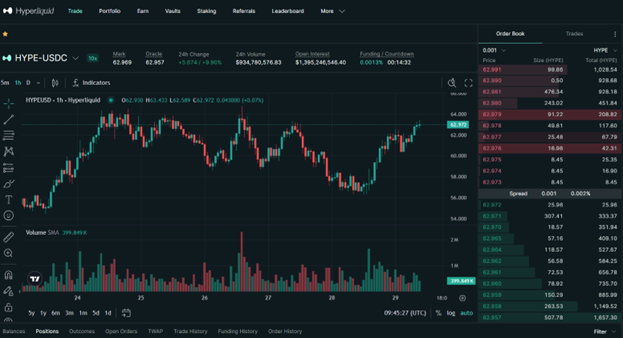
This is done through perpetuals, or perp, contracts. These are contracts on the blockchain that execute “if/then” functions. If your bet that the price rises or falls is right, then you earn.
Think of them like options in the traditional market, but without the monthly expiration date.
The final piece of the puzzle is that Hyperliquid is decentralized. The difference from Coinbase or Binance — which offer their own perpetuals trading to non-U.S. residents — is custody. Trades settle on Hyperliquid's own blockchain, and the trader holds the money the whole time. No company sits on your balance.
In 2025, roughly 78% of all crypto trading volume came from perpetual futures. Hyperliquid now handles about 70% of all on-chain futures trading. On a normal day, it clears more than $8 billion in trades.
And it got there without a dollar of venture capital.
The Buyback Machine
This is where it stops looking like crypto and starts looking like a blue-chip company.
Most exchanges keep their trading fees as profit. Hyperliquid does something stranger …
It sends roughly 97% of those fees into an automated fund with one job: buy HYPE on the open market and pull it out of circulation.
No human picks the moment. It runs every day. The protocol earns about $1.3 billion a year in fees, and nearly all of it goes back into the token.
So far the fund has spent more than $1.3 billion buying HYPE. It now holds over 44 million tokens.
It is a stock buyback that never stops. Apple and other giants spend tens of billions a year doing the same thing. Hyperliquid just does it with a bigger slice of a smaller business, on autopilot.
The more people trade, the more it earns. And the more of its own token it takes off the market.

Why Wall Street Showed Up Now
In short, Hyperliquid is a company that took no outside money and built a business earning over $1 billion dollars a year. And it turns almost ALL that value over to the people who hold its token.
It’s no wonder that, after years dismissing crypto built a product, Wall Street now wants an in.
Fortunately, that gives investors who aren’t yet comfortable opening crypto accounts or navigating DeFi the chance to gain exposure, as well.
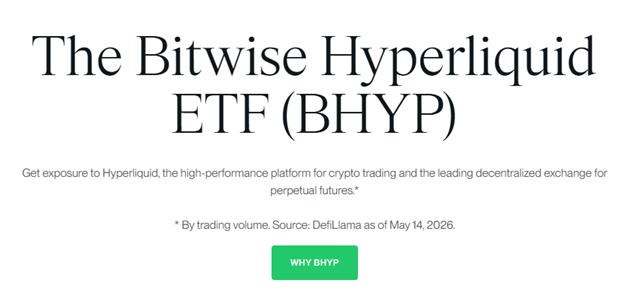
For years, owning a token like this meant opening a crypto account most older investors never wanted near their money. That changed on May 15 when Bitwise, an asset manager, launched the Bitwise Hyperliquid ETF (BHYP) on the New York Stock Exchange.
It trades inside a normal brokerage or IRA account, like any stock fund.
And the structure has a twist that fits the story: Bitwise uses 10% of its management fee to buy and hold HYPE itself. The wrapper feeds the same buyback engine.
In two weeks, this fund pulled in more than $55 million.
Now, look at the timing. Money was leaving Bitcoin and Ethereum ETFs throughout May. That liquidity didn’t disappear. It kept flowing into this one.
Crypto expert Mark Gough saw the trend a while back. And he told his Next Crypto Superstars members to load up back then.
That’s how they were able to bag two rounds of gains on HYPE this year.
Bottom Line
At more than $13 billion, HYPE sits among the fifteen most valuable cryptocurrencies. But after an impressive run that brought it to a new all-time high — in the middle of a broad-market correction — a pause would be normal.
Indeed, HYPE now trades near $59, roughly 21% off its new high.
That is a sign of opportunity. But before you jump in, there are risks you’ll want to be aware of. Namely, token supply.
Only about a fifth of all HYPE tokens are in circulation today. The rest unlock over time.
That means there’s a wall of future supply waiting in the wings. And it can press on the price no matter how strong the buybacks are.
Not only that, but within the U.S., perpetuals exchanges sit in a regulatory gray area for now. If the U.S. market is unlocked, that could be a boon for Hyperliquid. But if regulators shut it down, American traders — and their liquidity — will stay locked out.
Here’s what all this boils down to …
Like any crypto, HYPE remains a speculative play. And with uncertainties around future unlocks, the token will likely stay volatile.
That said, the model behind it is starting to look familiar: It looks a lot like the companies already sitting in your retirement account. And that stability could be its golden egg.
After all, it already got HYPE to new highs in the middle of a much bigger correction.
With HYPE’s price naturally cooling off after hitting a new all-time high near $75 to trade near $59 at the time of writing, savvy investors may want to look for entry opportunities for themselves.
And if you’re not all-in on crypto yet, that BHYP fund could be your traditional path to HYPE exposure … without needing to worry about becoming a crypto expert overnight.
Best,
Beth Canova