 |
| By Mark Gough |
Something important just happened for altcoins.
But these aren’t simple ETFs. They go beyond giving off-chain investors and institutions mere price exposure.
They include staking.
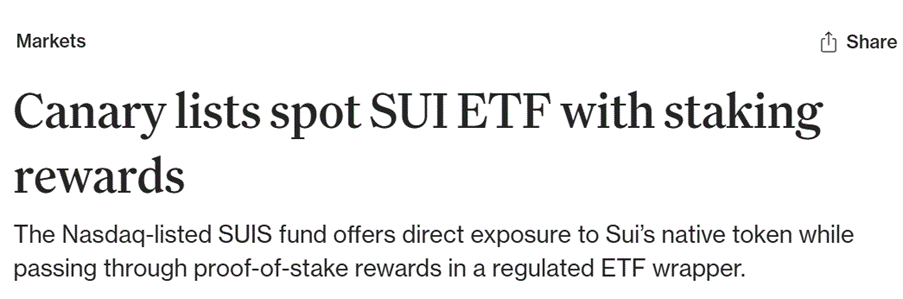
The Grayscale Investments Sui Staking ETF (GSUI) began trading on the NYSE Arca, while the Canary Capital Staked SUI ETF (SUIS) launched on the Nasdaq.
Through them, you can add a spot Sui (SUI, “B”) ETF to your brokerage account and earn on-chain staking rewards inside the fund.
No wallets. No validators. No self-custody. No messing around with private keys.
That’s a real milestone.
Adeniyi Abiodun, Co-Founder and CPO of Mysten Labs, the original contributor to Sui, framed the moment this way: “This launch unlocks exposure for investors who believe in the technology powering that innovation.”
It is important to note, however, that this bullish development came about in a very fragile market.
So let’s talk about what this actually means.
What These ETFs Actually Do
Both ETFs follow a simple structure: They buy spot SUI and stake it on the network.
The rewards from which are reflected in the ETF’s net asset value (NAV). You trade the ETF like any other stock, and benefit from the staking that happens in the background without needing to lift a finger.
That’s it.
If you’ve ever tried staking yourself, you know it involves:
- Picking validators
- Understanding lockups
- Managing unbonding periods
- Accepting slashing risk
Institutions don’t want that operational complexity. So, these ETFs abstract it away.
From a pension fund’s perspective, this turns SUI into something much more familiar: Digital infrastructure exposure with income.
And that framing matters.
Why Staking Changes the Psychology
Bitcoin ETFs offer price appreciation. That’s it.
But now, altcoin ETFs offer you the chance to earn more through staking. And on the Sui network, yield at the time of writing sits between 5%-7% APY.

That’s real yield. Not theoretical. Not marketing language.
Inside the ETF structure, those staking rewards accrue daily and compound into the fund’s NAV. So now, the investment pitch changes to crypto growth potential inside a regulated wrapper, plus 5%–7% network income.
For a traditional allocator, that change makes all the difference: A mid-single-digit yield starts to put SUI in the same conversation as high-yield bonds, dividend equities and infrastructure-style allocations.
All of which makes SUI feel less like speculative beta. And more like infrastructure exposure with income attached.
Now, let’s be clear — a 7% staking yield does not eliminate volatility. But it absolutely changes how institutions think about holding time horizons.
The Timing: Let’s Be Honest
Now for the uncomfortable part: This launch isn’t happening during a euphoric bull market. And that reality will impact how this bullish news will play out in SUI’s spot price.
Bitcoin has been under pressure. Altcoins have been weaker. Risk appetite isn’t exactly overflowing. And SUI itself is trading well below prior highs.
Launching an altcoin ETF into that backdrop is … ambitious. Early trading volumes have been respectable but not explosive.
And that’s okay.
Structural shifts don’t always start with fireworks. But there are a few indicators I’ll be watching that will tell the real story in time. They are …
- AUM Growth: If these ETFs push toward $100M+ quickly, that’s a signal. If they stagnate below that level, it suggests institutions are still cautious.
- Volume Expansion: Sustained growth in daily trading volume would confirm real participation.
- On-Chain Metrics: If SUI’s TVL and ecosystem usage keep rising while ETF flows increase, that’s alignment. And alignment creates durable moves.
A Realistic Look at Risk
The SUI ETFs are an easy way to get access to a promising Layer-1 growth play.
But for crypto investors like us, owning the underlying asset outright means you don’t have to pay a middleman to custody your crypto. And if you’re comfortable in the realm of DeFi, you can even stake SUI yourself for even higher yields.
Before you jump in, however, it’s important to acknowledge the risks. And I see three main ones shaping Sui’s path in the near future …
1. Sui is still speculative.
SUI is still a high-beta Layer-1. That means whatever move Bitcoin (BTC, “B+”) makes, Sui will follow in greater magnitude.
For example, if Bitcoin drops 10%, SUI can easily drop more.
And while it seems BTC has indeed made its 320-day-cycle low — as my colleague Juan Villaverde pointed out recently — this risk should remain a top consideration for any altcoin trader.
After all, a 6% staking yield doesn’t protect you from a 25% drawdown.
2. Staking lockups exist.
Staking is a huge draw with these new ETFs. But staked tokens don’t become liquid instantly. There’s an unbonding period, which can introduce friction in volatile conditions.
3. ETF adoption is not guaranteed.
Sui’s ETFs need capital participation to thrive. If they can’t grow their holdings, if there is weak demand, liquidity could stay thin. Which means volatility can amplify.
Bottom Line
Something important shifted last month.
The infrastructure for a strong SUI rally is now in place. And in markets, infrastructure changes tend to matter.
Even if you have to wait to see it reflected in the price.
If SUI has been on your radar, you may want to look for your next entry opportunity.
Best,
Mark Gough
P.S. In speculative altcoin trading, thorough research and patience are the two pillars of success.
The same is true in private equity investing.
My colleage Chris Graebe specializes in those kinds of pre-IPO opportunities. And while there’s no guarantee that a private company will go public … he says that more companies have been making it to the IPO stage in the past few years.
He’s already walked his Deal Hunters Alliance Members through one successful IPO. And it gave them a chance to grab 777% gains on their initial early investment.
Now, you can learn about the next private Alpha Round deal Chris is targeting. Before it potentially goes public. Chris explains it all right here.