Trump Wants Hyperliquid in America. Kraken May Have Found the Way In

 |
| By Mark Gough |
One of the world's biggest cryptocurrency exchanges wants to bring decentralized trading technology to American investors.
But not by building the infrastructure itself. Rather, Payward — the parent company of centralized exchange Kraken — is looking to Hyperliquid (HYPE), a competitor, to fill the role.
It's an unusual arrangement.
Kraken has spent years building its trading business. While Hyperliquid has emerged as one of crypto's most successful decentralized derivatives platforms.
Now the two could work together to open a substantial new market for Hyperliquid.
And the implications could extend well beyond cryptocurrency trading. This could potentially establish a model for bringing public blockchain infrastructure into regulated financial markets.
Trump Wants Hyperliquid in America
During a White House meeting with financial and technology executives on Aug. 19, 2026, President Trump unexpectedly referenced Hyperliquid.
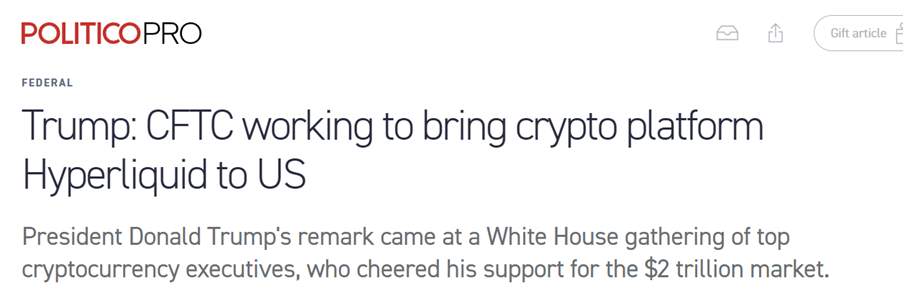
Speaking about the administration's efforts to bring more cryptocurrency activity into the United States, he said:
"I understand that Mike is also working to bring Hyperliquid into the United States in a fully compliant and legal fashion."
He was referring to Michael Selig, chair of the Commodity Futures Trading Commission (CFTC) — the regulator that oversees American derivatives markets.
It was an extraordinary endorsement for a decentralized trading platform. Especially considering that U.S. customers cannot ordinarily access it through its existing interface.
Hyperliquid's HYPE token rallied after the comments, as investors weighed what access to the world's largest financial market could mean for the project.
But political support alone doesn't create a regulated trading business.
Somebody still needs to provide the necessary licenses, customer accounts, compliance systems, and clearing arrangements.
That is where Kraken's parent company comes in.
Kraken's Parent Has a Plan
On Sept. 16, Payward announced its intention to introduce on-chain perpetual futures markets for American customers, starting with Hyperliquid.
For those unfamiliar with perpetual futures, these derivatives let traders speculate on rising or falling asset prices without buying the underlying assets. Unlike traditional futures contracts, they don't have a fixed expiry date.
They are particularly popular in cryptocurrency markets, where traders use them to hedge positions or obtain leveraged exposure.
Then, two days ago on Oct. 26, Hyperliquid publicly supported the proposed arrangement. It identified Payward as its intended first CFTC-regulated HIP-3 market deployer.
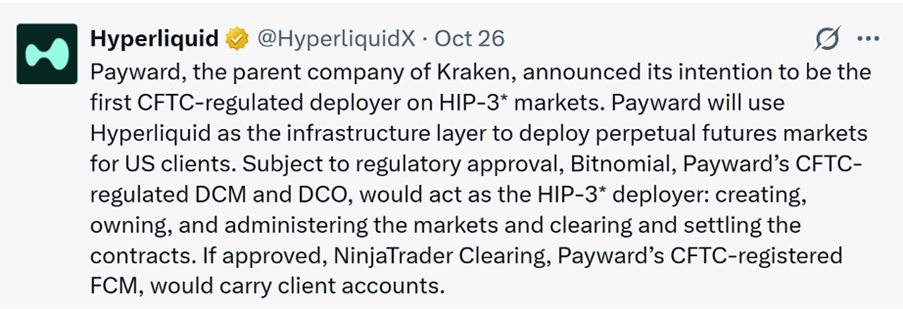
The structure brings together several businesses already operating under Payward.
- Bitnomial Exchange would operate the markets,
- Bitnomial Clearinghouse would handle clearing and settlement.
- NinjaTrader Clearing would carry customer accounts.
- And Hyperliquid would supply the underlying blockchain trading infrastructure.
Historically, much of this activity has developed outside the U.S. because of regulatory restrictions.
Payward's proposal attempts to address that problem by combining regulated American financial businesses with Hyperliquid's existing technology.
The companies plan to use a permissioned version of Hyperliquid's HIP-3 framework, which lets independent operators create their own perpetual futures markets.
In practice, a regulated operator could decide which approved customers can access its markets while using Hyperliquid's blockchain to process trading activity.
The technology is still being tested. And the arrangement requires regulatory approval.
Nevertheless, it offers a potential route into a market Hyperliquid has largely been unable to serve.
Hyperliquid Is Already a Serious Trading Business
Hyperliquid doesn't need the American market to prove demand for its technology. It already has a substantial trading business.
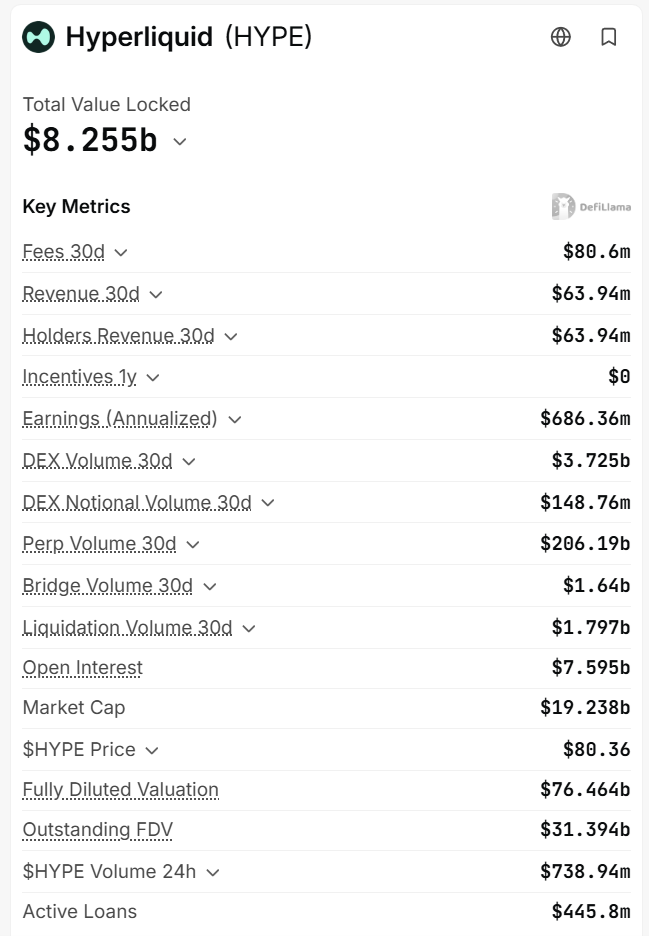
According to DefiLlama, as of Oct. 28:
- Daily perpetual futures trading volume was around $7 billion.
- Perpetual futures open interest stood near $7.8 billion.
- Total value locked was approximately $8.3 billion.
- Protocol revenue over the previous 30 days was approximately $64 million.
That last figure is particularly interesting.
Many cryptocurrency projects still depend heavily on token incentives, speculative interest, or promises of future adoption.
But Hyperliquid is already generating considerable revenue from trading activity.
Its reported protocol revenue over the preceding 30 days equates to an annualized pace of more than $750 million, although actual annual revenue will depend on future market activity.
That's not a projection I'm suggesting investors should take for granted.
This is still the crypto market. And trading revenue can change significantly as volatility, leverage, and investor participation fluctuate.
But it demonstrates the scale the platform has already achieved.
A regulated expansion into the United States could add another source of activity.
Why Would Kraken Work with a Competitor?
Kraken already operates a substantial cryptocurrency trading business. Its parent company reported 6.6 million funded accounts as of June 30, 2026.
It has established customer relationships, operational infrastructure, and regulated entities that can offer financial products.
Hyperliquid brings something different.
It has developed a high-performance blockchain designed specifically for financial trading, including an on-chain order book that matches buyers and sellers.
Instead of spending years recreating that technology, Payward could potentially build products on infrastructure that’s ready to go. One that already handles billions of dollars in daily trading activity.
There's a useful comparison with traditional finance.
A stockbroker doesn't need to own the New York Stock Exchange to offer its customers access to American equities.
It needs the appropriate licenses, market connections, and systems to facilitate trading.
Payward appears to be pursuing a similar model, but with the underlying infrastructure running on a public blockchain.
And Hyperliquid wouldn't necessarily be limited to Kraken.
If the model proves successful, other regulated brokers and exchanges could explore deploying their own markets using the same technology.
That's a much bigger opportunity than simply adding another trading product to Kraken's platform.
What Could This Mean for HYPE Investors?
Hyperliquid's native token, HYPE, has a more direct economic relationship with platform activity than many cryptocurrencies.
Trading fees support the protocol's economic model, including its Assistance Fund, which converts fees into HYPE. The protocol's documentation states that the fund's HYPE is burned, permanently reducing the token supply.
There is also a staking component.
Under the existing HIP-3 framework, market deployers must stake 500,000 HYPE, although that requirement may change as the system develops.
Both mechanisms matter for the long-term investment case.
As trading activity increases, the fee mechanism can support additional token burns. Meanwhile, more independent market operators could increase demand for HYPE used as staking collateral.
However, Payward's proposed deployment economics have not yet been finalized.
We shouldn't assume every dollar traded through an American market will generate the same revenue contribution as Hyperliquid's existing markets.
There is also valuation to consider.
At $81 per token — the trading price as I write — HYPE has a circulating market capitalization of around $19.5 billion and a fully diluted valuation near $77.5 billion, according to DefiLlama.
Those numbers tell us investors are already assigning considerable value to Hyperliquid's future growth.
The opportunity is substantial, but so are expectations.
Continued revenue growth, adoption by outside market operators, and effective token value capture will determine whether that valuation is justified.
A Bigger Opportunity Beyond Cryptocurrency
There’s another reason this development caught my attention: The endorsement was extraordinary.
Hyperliquid's HIP-3 infrastructure isn't restricted to cryptocurrency trading.
Independent operators can create perpetual markets that reference other assets, as long as they establish appropriate pricing mechanisms and market rules.
That could open the door to markets covering commodities, equities, and other financial instruments.
We've already seen growing interest in trading traditional financial assets through blockchain-based platforms. Now imagine a regulated brokerage offering customers access to some of those markets. All while the trading infrastructure operates on a public blockchain.
The customer might never need to interact directly with a decentralized application. They would just open their brokerage account and trade an approved product.
That could be one of the more practical routes towards broader blockchain adoption.
Instead of asking millions of people to change how they access financial markets, the technology becomes part of the infrastructure supporting services they already use.
Of course, approval for cryptocurrency perpetual futures would not automatically authorize trading in every other asset class. Each market would face its own regulatory and operational requirements.
But a successful first deployment could establish a useful precedent.
What to Watch Next
There are still hurdles to overcome.
Payward needs regulatory clearance. Hyperliquid's permissioned-market functionality must be production-ready. And the companies need to demonstrate that the finished product can operate reliably.
We also need to see which contracts are offered, how competitive their pricing is, and whether American traders actually use them.
For HYPE investors, I'd recommend you watch …
- How new trading activity feeds into protocol revenue,
- Token burns,
- And demand for market-deployer staking.
Those figures will better measure success than the announcement itself.
A few years ago, much of the cryptocurrency industry was trying to convince traditional financial institutions to take blockchain technology seriously.
Today, we can see those results pay off.
Established financial companies are now exploring how to incorporate that technology into their own products.
Kraken's parent company working with Hyperliquid is another example of that shift.
If regulators approve the arrangement and the markets attract meaningful trading activity, the implications could extend well beyond these two companies.
And that's what makes this development worth following.
Best,
Mark Gough