Unravel the Mystery Behind Crypto’s Lost Communities
 |
| By Jurica Dujmovic |
I’ve been involved in crypto since its early days. Long before mainstream adoption was anything more than a pipe dream.
And while it’s incredible to see where the market has come since then, I find myself often considering what’s been lost.
Namely, the community.
Before TradFi institutions tried to tame the Wild West of crypto, major protocols lived on community participation.
I’m not just talking about the memecoin fanatics. These communities were full of users and developers who genuinely believed in a project’s promise and utility.
In bull markets, they celebrated victories loudly. In bear markets, they continued to support projects enough to get them through to the next rally.
Today, that environment is mostly a memory.
The market now runs on delegation mechanics, emergency committees and automated execution.
The shift hasn’t been subtle. But investors aren’t penalizing projects for it.
They just stayed silent.
Governance data across Q4 2025 and early 2026 shows us that participation is down. And on-chain power — once highly decentralized — has now concentrated.
Yet protocol performance hasn't suffered.
Follow the Numbers
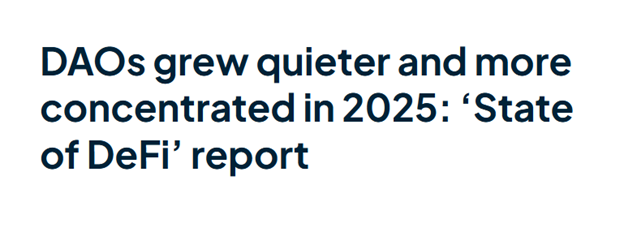
DL News’ 2025 State of DeFi analysis documented the macro trend: DAOs became quieter and more concentrated throughout the year.
Fewer voters. Fewer proposals.
Meanwhile, a working paper published in August 2025 quantified the power distribution — the top 10% of voters control roughly 76% of voting power in major DAOs, with single addresses often commanding over 37% alone.
By December, Ethereum Name Service (ENS, “C”) governance discussions explicitly referenced these concentration metrics as structural risks worth monitoring.
It didn’t take long for us to see the impact of this shift in real time.
On Dec. 27, Uniswap (UNI, “B-”) executed UNIfication.
This activated protocol fees, established automated token burns and began to internalize Maximal Extractable Value (MEV) through auction mechanisms.
The vote passed with 125.34 million UNI in favor. But the outcome was decided primarily by professional delegates treating governance as operational work rather than community expression.
Markets barely reacted. The protocol kept generating fees. Liquidity stayed put.
This is the dense, complicated part of crypto. The side that most investors don’t see.
But knowing how the sausage gets made — and being able to step into the kitchen yourself — isn’t just important. It’s a core part of crypto’s ideology.
And it’s one that’s being left behind.
All in the name of efficiency.
When Seconds Matter More Than Votes
Crisis moments reveal where real decision-making power sits. And it’s in these moments where the real impact of this shift comes to light.
During the Jan. 20, 2026, Makina Finance exploit, attackers used flash loans to manipulate pricing data in the protocol’s DUSD/USDC Curve pool.
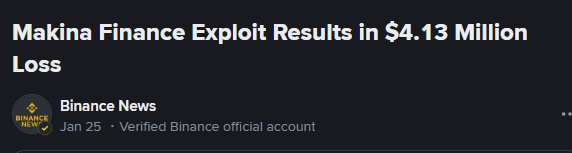
With that, they were able to drain roughly 1,299 ETH (about $4.1 million at the time) in value.
CoinDesk reported that an MEV bot participated in the event, capturing value during and after the transaction as the attack unfolded.
Why is this important? Because it underscores how execution-layer actors and automated strategies can respond faster than any governance process can.
In this situation, no governance vote by token holders happened in real time. Instead, outcomes were determined by transaction ordering and automated decision flows.
This begs the question …
Who Gets to Make the Big Calls?
When stakes are high, do token holders decide outcomes?
Or do external legal entities, holiday-period coordination decisions and core development teams drive the process?
Each project will have to answer that for itself. And major established projects have already made their answer clear.
Uniswap's UNIfication mechanics, for example, treat execution ordering and automated value capture as first-class design concerns.
Overall, the system optimizes for machine-legible economic rules rather than community deliberation.
Lido (LDO, “C”) tries to straddle the line. But its Lido’s Dual Governance mechanism also prioritizes efficiency over community.
Put simply, this framework lets stETH holders delay or block governance enforcement by signaling opposition. It creates explicit veto signaling and staged execution delays tied to measurable thresholds.
These mechanics function as systemic risk controls. They give holders a structural way to influence execution timing rather than presuming mass governance engagement.
Think of it as a compromise … without returning to full community governance.
I anticipate we’ll continue to see governance frameworks that increasingly assume coordination through constraints and incentives, not social consensus.
Where This Leaves Investors
As an old-school crypto purist, I can’t say I am in favor of taking power away from community input.
But as an investor, I can see the opportunity this shift creates.
Projects banking on a “strong community” used to be enough. And governance tokens not only gave you a voice in the community, but also a piece of the protocol’s success.
Now, however, things have changed. And the coordination shift reveals two likely winning groups:
- Projects that reduce governance dependencies gain a big advantage. These will be able to respond more quickly to market changes and can scale more easily.
- Delegate services and governance tooling represent an emerging market. After all, someone has to maintain those more efficient frameworks. And Arbitrum's incentive program shows protocols will pay for reliability.
- That means governance tooling providers, legal coordination infrastructure projects and off-chain control structures are currently underpriced compared to their increasing operational importance.
As you look ahead for the opportunities 2026’s market has in store, I hope you’ll keep these considerations at the forefront of your research.
The last thing you want is to bet big on a project that no longer fits in the current crypto environment.
Best,
Jurica Dujmovic