Wall Street Is Buying One Crypto It Swore It’d Never Touch
 |
| By Beth Canova |
For nearly a decade, the same Wall Street firms that custody your IRA refused to touch privacy coins.
That is, crypto tokens that can hide the details of the transaction. The transaction itself is verified and recorded on the blockchain. But who paid, who got paid and the exact amount are obscured.
With that set up, it’s no wonder TradFi institutions have steered clear. The regulatory implications were a wild card nobody wanted to test.
That changed quietly.
On May 14, a public company traded on Nasdaq disclosed that it now holds 314,185 Zcash (ZEC, “B-”) tokens, one of the leading privacy coins in crypto.
That stake represents roughly 1.88% of the entire circulating supply.
The company is Cypherpunk Technologies (CYPH). Its anchor investors include the Winklevoss twins, who committed $50 million to the launch.
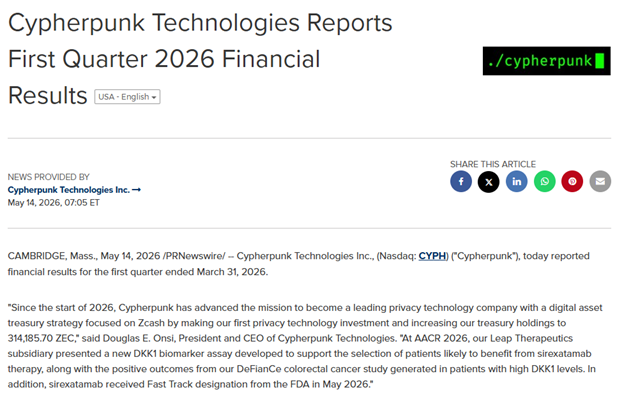
The privacy coin that compliance lawyers wrote off as untouchable is now being treated as portfolio infrastructure.
But that’s not the story. The real insight for investors is why this change happened … and who the buyers actually are.
What Zcash Actually Is
Zcash launched in 2016 on the same design as Bitcoin (BTC, “A-”). The same 21-million-coin cap. The same proof-of-work mining,
But there’s one important difference: Bitcoin records every transaction on a public ledger anyone can read.
Zcash, on the other hand, offers a section option. Users choose to obscure the sender, the receiver and the amount transferred, while still proving the payment was real.
It does this with zero-knowledge proofs. In plain terms, the network can confirm a transaction is valid without revealing who was involved or how much moved.
Think of it like a numbered Swiss account. The bank proves your balance to the regulator. The customer record stays private.
That optional privacy is the key.
Other privacy coins can’t offer transparency at all. But ZCash bridges privacy with regulatory compliance.
What Cypherpunk Is Actually Doing
Cypherpunk Technologies is doing for Zcash what MicroStrategy did for Bitcoin.
It is a publicly listed company using its balance sheet to accumulate a single crypto asset. The treasury crossed 290,000 ZEC in late April. By mid-May it reached 314,185.
Management has stated the goal is 5% of the network supply, roughly 835,000 ZEC.
The average cost sits near $338 a coin. At today's price around $530, the position is worth roughly $166 million, and the company is not hedging it.
But like Strategy and BTC, Cypherpunk is not alone.
Digital Currency Group — the parent of Grayscale and Genesis — lists ZEC among its largest holdings, per a recent Wall Street Journal disclosure. And Grayscale itself reopened its Zcash Trust for private placement and filed to convert it into a spot ETF.
Multicoin Capital co-founder Tushar Jain confirmed on May 5 that his fund has been quietly accumulating ZEC since February.
Four institutional buyers, same asset, same quarter.
When the smart money talks, savvy investors listen.
Why the SEC Decision Unlocked This
ZCash isn’t a new project. Its technology has worked for nine years. And the focus on privacy isn’t recent, either.
So what happened this year that lit a new fire under ZEC?
The conversation around regulation shifted.
On Jan. 15, 2026, the SEC formally closed a nearly two-year investigation into the Zcash Foundation.
No enforcement action. No settlement.
For institutional capital, that one decision moved Zcash from "open investigation, do not touch" to "defensible position." A registered investment adviser can now hold ZEC for a client without a federal probe hanging over it.
That is the door that opened the flow.
Technical Setup
ZEC is up 787% year over year. The rally peaked near $642 in mid-May, then pulled back into the $400s.
That cool-off is healthy after a parabolic run.
On the upside, $642 is the resistance to clear before the next leg.
Here’s the key for investors: Today's price is still more than 80% below ZEC’s all-time high.
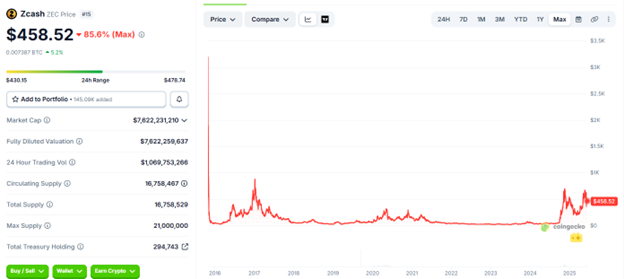
The institutional bid is new. The chart history is not.
Where ZEC Goes from Here
Take the price out of it. The real story still stands.
MicroStrategy never changed a line of Bitcoin's code when it started buying in 2020. It changed who was allowed to own it.
A public company put Bitcoin on its balance sheet, and corporate America had a template to copy.
Cypherpunk is running that same playbook on the one corner of crypto Wall Street swore it would never touch.
A public company built the treasury. A venture firm built the position. A regulated asset manager filed for the ETF. The SEC stepped out of the way.
All inside six months.
The 948% is already in the rearview. ZEC may hold these levels or give back another 30%. The charts will argue about that part.
The part that does not reverse is the door: Privacy coins spent a decade locked on the wrong side of it. It is open now.
Wall Street is no longer asking whether privacy belongs on chain. It is deciding which asset gets to carry it.
And so far, ZCash is one of the leading contenders.
Best,
Beth Canova
P.S. Every investor knows the value of a diversified portfolio. But diversification goes beyond what type of stocks or crypto you hold.
It’s also about what marketplaces you have exposure to.
But one type of investment doesn’t have direct market exposure. And many don’t realize it can have a place in their portfolios, either: Private equity.
That’s where startup investing specialist Chris Graebe shines. With four successful exits under his belt — including one which saw a potential 777% return — he knows how to separate startups with real potential to see strong exits … from the ones that’ll waste your time.
To learn about the latest contender to catch his eye — a space play poised to benefit from SpaceX’s big IPO — click here.