Wall Street Wants to Trade Like Crypto. Avalanche Holds the Key
|
Key Takeaways
|
 |
| By Mark Gough Reviewed by: Beth Canova |
The New York Stock Exchange is preparing to launch a blockchain-based securities trading platform.
That’s already exciting enough.
But what really caught my attention in this announcement is its partner: The NYSE has chosen Avalanche (AVAX, “B”) to help make it happen.
The NYSE Is Building a Blockchain-Based Trading Platform
Traditional stock exchanges operate during defined trading hours. And settlement occurs through intermediaries and existing market infrastructure, typically one business day after a trade is made.
Blockchain technology has the potential to reduce that gap considerably.
It could reduce settlement delays, counterparty exposure, and operational complexity for institutions who want to move securities between participants.
That’s massive for asset managers and funds.
And it’s the driving force behind the tokenization narrative.
Which explains why the NYSE wants to build its new platform. So tokenized securities can trade more like crypto … without needing to be hosted on a crypto platform.
Earlier this month, Ava Labs announced that Avalanche had been selected as the backbone of this endeavor. All transactions on the tokenized NYSE platform will be verified and settled on the Avalanche blockchain.
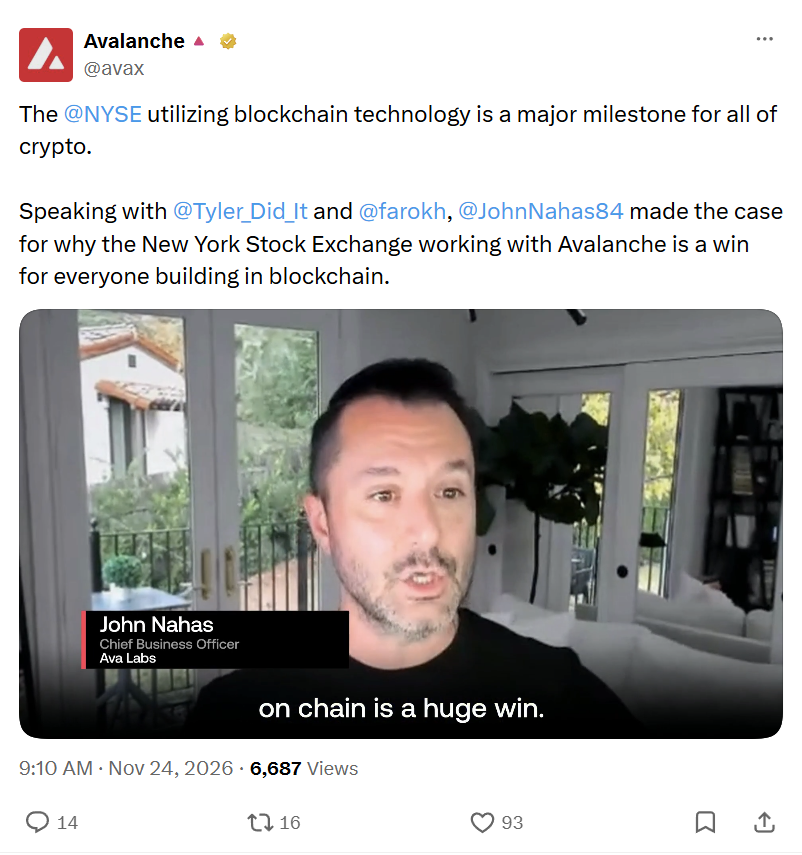
The platform is reportedly aiming for a Q4 2026 launch. But the actual launch date will be governed by regulatory approvals and operational readiness.
Why the NYSE Chose Avalanche
Avalanche's architecture has always been one of its more attractive features. At least, from an institutional point of view.
Instead of running every application on a single public blockchain, Avalanche lets organizations build dedicated Layer-1 networks with their own operating rules.
This gives businesses greater control over transaction processing, network participation, costs and compliance.
For financial institutions, those capabilities are vital.
A regulated trading venue can't operate in the same way as a typical decentralized exchange, where anyone can connect and participate anonymously. It must establish who can trade, who can validate transactions and how the network complies with financial regulations.
Dennis Lee — head of digital issuance at the NYSE — explained that the exchange needed technology capable of delivering reliable settlement, predictable costs and control over network participation.
And Avalanche allows them to do just that. Which could put Avalanche in an important role as tokenized securities markets develop.
Rather than competing solely to attract individual tokenized assets, Avalanche could help support the infrastructure connecting them.
What Does This Mean for AVAX?
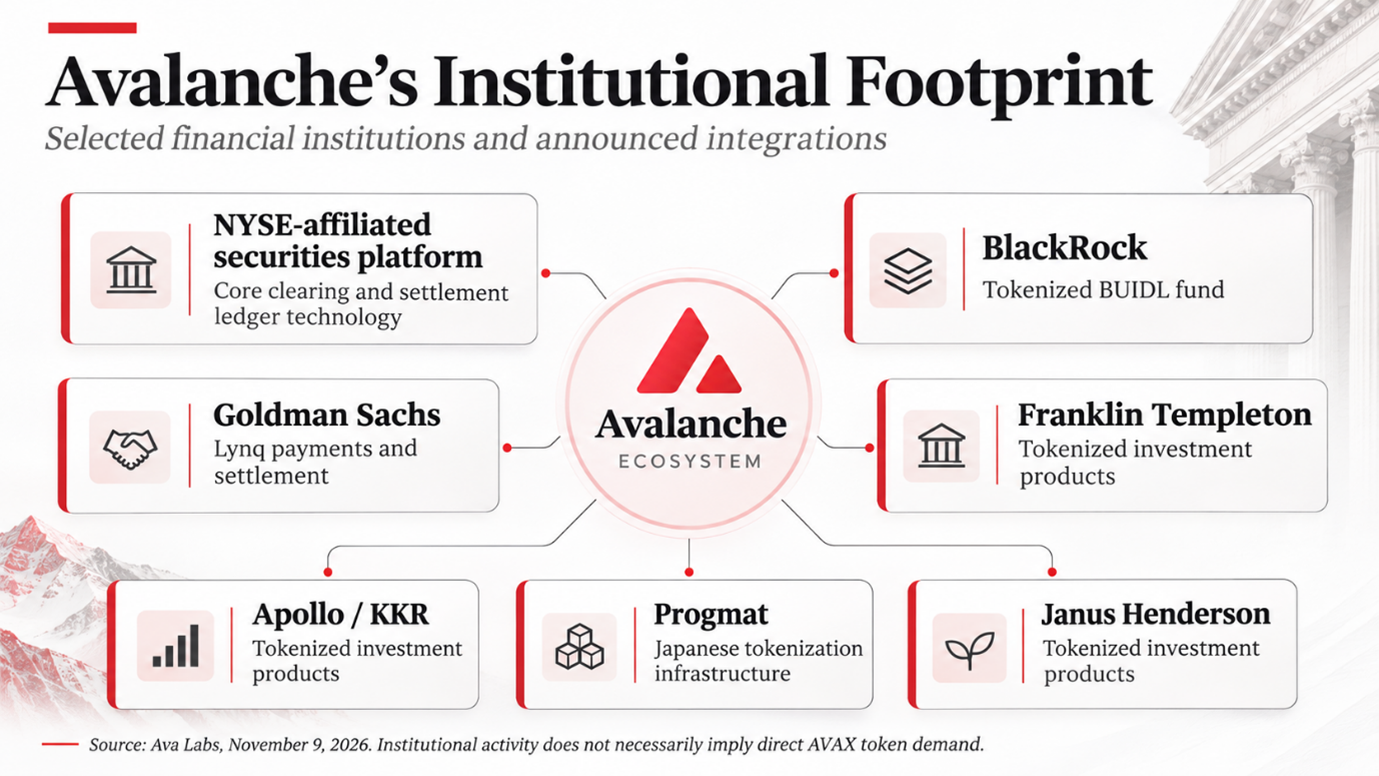
We need to separate two things: the commercial adoption of Avalanche technology and the economic benefits flowing to its token, AVAX.
The first has received a considerable boost from the NYSE announcement.
The second still needs closer examination.
AVAX, as Avalanche's native token, is used for transaction fees, staking and other network functions.
That’s a strong case for utility and continued adoption.
But it’s undermined when you understand that Avalanche's dedicated Layer-1 networks — the very benefit that attracted institutions — can operate with their own fee structures and native tokens.
Which AVAX is not needed for every transaction.
True, those networks still create some demand for AVAX through validator registration and network fees. And under Avalanche's current fee structure, dedicated Layer-1 validators pay approximately 1.33 AVAX per month, with those fees burned.
But that doesn't mean every dollar traded or settled on an Avalanche-based platform translates into greater AVAX demand.
We still don't know enough about the NYSE platform's final architecture, transaction fees or its direct economic relationship with AVAX.
Those details will be important as the project develops.
Still, there's a broader opportunity here. And the development shouldn’t be brushed off just because we’re still filling in the pieces.
If Avalanche can support regulated securities settlement at institutional scale, it could encourage other banks, exchanges and financial infrastructure providers to adopt similar technology.
That matters.
The more institutions that build on Avalanche, the stronger its position becomes in the institutional blockchain market.
Bottom Line
For as bullish as the headline is, the announcement did little to pull AVAX out of the broad market correction. The token is still down about 25% over the past 30 days, and will likely continue to move with the market.
That means patience for any interested investors. For now, the key developments to watch include …
- Regulatory approval of the NYSE platform,
- Launch confirmation,
- And details on how settlement activity will interact with AVAX.
I’ll also want to see if the announcement encourages more financial institutions to develop infrastructure using Avalanche.
Regarding the technical outlook, I want to see AVAX reclaim the $7.80–$8 range. From there, a stronger recovery above $9 — along with stronger spot trading volume — would increase my confidence that buyers are returning.
The investment thesis is more interesting, no doubt. But take care not to load up until the market gives a compelling reason to do so.
Best,
Mark Gough