Washington Just Opened a New Door for DeFi Trading in the U.S.

|
Key Takeaways
|
 |
| By Beth Canova Reviewed By: Dawn Pennington |
Perpetual futures are smart contracts on the blockchain.
Think of them like options contracts. They let you bet on the future price of a crypto asset, and you can use leverage to do so.
The big difference is that there’s no expiration date. Which means you can hold your positions indefinitely. As long as you have the collateral to support it, that is.
They’re not just a sidenote in the market. They are the single most-traded instrument in crypto.
Which is why many in the U.S. are frustrated by their limited access.
According to CoinGecko’s State of Crypto Perpetuals Report 2026, centralized exchanges (CEXs) processed $85.3 trillion in perps trading volume in 2025 alone.
But only a limited offering is approved for trading in the U.S.
And decentralized exchanges (DEXs) that offer perps trading are geo-blocked entirely. Like Hyperliquid (HYPE, “D”).
In 2025, it commanded over 60% of the DEX perp trading volume in 2025, which came in at $6.38 trillion. And it remained in the top marketplace as of April 2026, though new competitors have pulled users away.
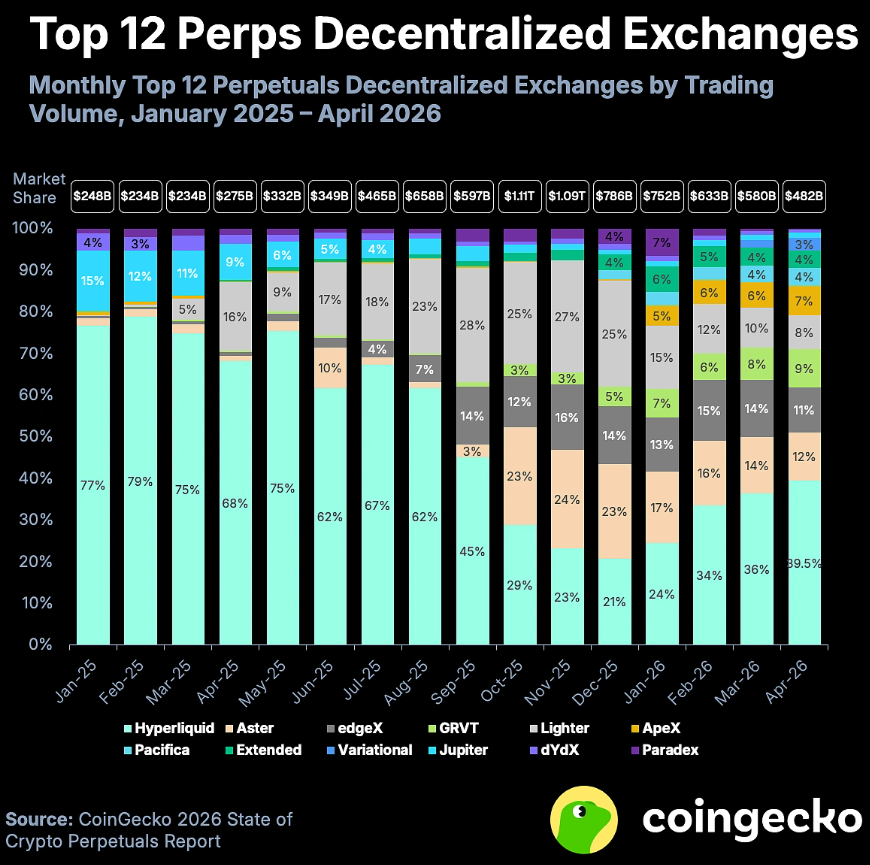
I’ve written about this platform before. And how it dominates this popular sector of the crypto market.
Most importantly, we’ve covered the push from within the White House to open access for U.S. residents.
Yesterday brought us the latest development.
And while the news may sound like a small change in policy, it could have a big impact.
Washington Lays Out Two Paths Forward
On Thursday, Nov. 19, Michael Selig, chair of the Commodity Futures Trading Commission (CFTC), spoke at a crypto forum in Washington.
He wants more on-chain perp trading to come stateside. His reasoning is simple and straightforward: If the U.S. shuts out new trading tools, the business may just move overseas.
But even with his support, his remarks made one thing very clear…
Crypto exchanges can use blockchain technology. But they still need to follow the same rules as other trading firms.
Which is why he laid out two ways for platforms like Hyperliquid to reach U.S. traders.
The first is to become a licensed exchange.
That means meeting federal rules on how trades are run, how customer funds are kept safe and how risks are managed.
The second is to work with an exchange that already has those licenses.
This path could be much faster. It could mean Hyperliquid can continue to use its own infrastructure … while a licensed partner handles the parts that fall under U.S. rules.
Some Crypto Firms Are Already Moving
This isn't just talk. We’ve already begun to see firms take Selig up on his new path forward.
Kraken's parent firm, Payward, has laid out plans to use Hyperliquid's blockchain tools through the regulated U.S. exchange Bitnomial.
The plan still needs approval.
But it shows how a crypto firm could bring new trading tools to Americans without having to build every part from scratch.
And there's another major name in the mix: Intercontinental Exchange (ICE, “B-”). The parent firm of the New York Stock Exchange has also backed plans to build regulated markets using Hyperliquid-based tools.

That matters.
When large firms start to use DeFi technology, it shows that blockchain is no longer just a tool for small crypto startups.
It’s on the path to becoming a key part of how the wider financial market works.
Why This Could Be Good News for Crypto
There are three big reasons investors should watch this trend.
First, it could bring more traders into DeFi.
If U.S. firms gain approval to offer these products, more people may be able to use them through regulated and more familiar channels.
That could help the market grow. Especially as DeFi has mostly remained out of reach to most retail investors thanks to its unfamiliarity.
Second, it could bring more cash into blockchain-based trading.
More traders and firms could mean more activity on the networks that run these markets.
True, more activity does not always mean a token's price will rise. But it does meant more liquidity in the crypto ecosystem, ready for when prices do run.
And third, it could help build trust.
Clear rules may make it easier for large firms to use blockchain tools. That could lead to more new products and more ways for people to take part.
Of course, there are risks.
Leverage can turn a small price move into a large loss. The past few weeks of selling, for example, have in part been sparked by waves of forced liquidations of futures.

Not to mention, even licensed platforms can face outages, bad trades or other issues.
But the overall trend — the push toward extending the umbrella of regulation to cover a key area of crypto — cannot be ignored. Especially when it has the potential to further legitimize and increase access to the wide world of DeFi.
What You Should Watch Next
The CFTC has opened a door.
Now, our job is to watch for which firms can walk through it.
- Look for formal CFTC approvals. A plan to launch is not the same as a license to trade.
- Next, watch firms like Backpack, Kraken and Hyperliquid for news on new U.S. products.
- And last, keep an eye on real use of these networks. Growth in users, trades and fees can tell you more than hype or headlines alone.
You don't need to trade futures to gain from this trend. The bigger chance may lie in the tools that make blockchain trading work.
And as more firms bring those tools into the U.S. market, DeFi could move one step closer to the financial mainstream.
Best,
Beth Canova