Washington’s Debt Gamble Could Send Bitcoin Higher

 |
| By Juan Villaverde |
After a historic surge over the past few weeks, crypto markets have calmed considerably.
Bitcoin has been trading around $78,000 and change since Friday, Aug. 21.
In this brief lull, I want to talk about what triggered Bitcoin’s most recent run: The U.S. Treasury.
Specifically, Treasury Secretary Scott Bessent’s strategic initiative to shift government borrowing toward shorter maturities.
The plan is to increase the buybacks of long-term bonds from $2 billion to $4 billion. The move will be funded by issuing more short-term debt.
I've already made the case last week that this amount is insignificant.
Alongside the U.S.’s national debt ($40 trillion,) $4 billion is barely a rounding error. And unlike the Federal Reserve, the U.S. Treasury can't print money directly. It can only "buy back" debt by issuing new debt. (More on that in a moment.)
In a sense, what the Treasury is doing here is using its credit card (short-term debt) — to pay its mortgage (long-term debt).
So, the total debt load doesn't change.
And yes, doing this is as reckless as it sounds. Especially if it becomes standard operating procedure. Which I'd argue it already has.
Now, the trade-offs for the government are a bit different than they would be for you or me.
In normal times, short-term government bond markets carry a lower interest rate than long-term debt.
That's called the "term premium."
Investors demand higher compensation for lending money over years rather than months.
That's exactly what's happening here: By borrowing short and buying back long, the Treasury is artificially lowering the average interest rate it pays. But that's not actually why this is reckless.
Here's the real issue: If you borrow money for 30 years at a fixed rate —essentially what a Treasury bond represents to the government — you don't have to worry about rising rates for the entire life of that loan.
It works just like your fixed-rate mortgage. Borrow once, and your interest rate is locked in.
But what if instead, you borrow the same amount every three months?
Well, then you’d have to refinance at whatever the prevailing rate happens to be each time.
In other words, running the government on short-term debt means its interest costs will fluctuate constantly with current market conditions.
That's a terrible bet if you expect rates to rise, since your cost resets every few months.
But it’s a good bet if you expect rates to fall.
And that's the entire wager here. By engaging in these tactics …
The Treasury Expects Rates to Come Down
When I say the government "expects" rates to fall, I'm being generous. "Hopes" is the most accurate word.
It isn't willing to lock in long-term borrowing at current levels. With the national debt at $40 trillion, it's not hard to see why.
But rates aren't actually coming down.
The 2-year yield has moved from around 4.6% to about 4.8%. That’s dangerously close to the psychologically critical 5% level. (I'd expect another intervention if we get there.)
Chances are rates won't fall anytime soon. While the Treasury tries to force them lower, Washington is simultaneously engaged in a foreign war that's directly impacting energy markets (which is inflationary).
And at the same time, waging trade disputes globally (also inflationary).
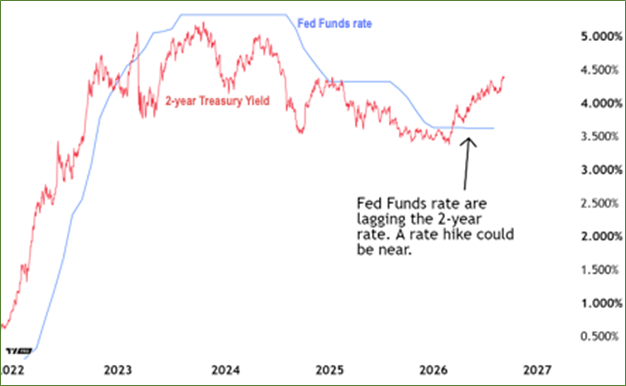
I've argued repeatedly that the Federal Reserve, which actually sets interest rate policy, is more likely to hike in the coming months than cut.
Why?
Because the Fed Funds rate tends to track closely with the 2-year Treasury yield. And that 2-year rate sits near 4.4% as of this writing, well above where the Fed is currently pinned.
Here's the chart as a refresher:
Fed Funds Hike Overdue
All this points to one conclusion: The government is desperate to keep interest rates artificially low.
And the White House has installed a Fed Chair who appears reluctant to do his job … while at the same time, leaning on manipulative debt tactics to hold down its borrowing costs.
None of this will work.
At the current pace, inflation is set to rise; borrowing costs are set to balloon. And the Treasury is likely to keep leaning on short-term debt to finance its deficits.
That last point is the one that actually matters to us as crypto investors.
That’s because …
T-Bill Issuance Anticipates Bitcoin's Price Path
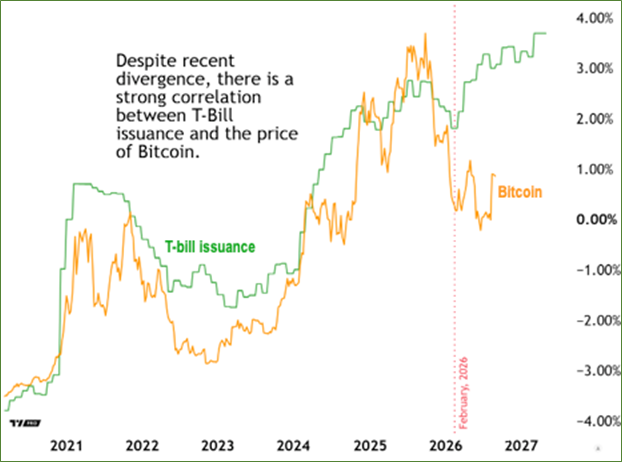
After a brief pause in the first half of 2025, the Treasury began to ramp up T-bill issuance in July 2025. Then, 35 weeks later, in October 2025, crypto's bear market began.
And 35 weeks after that ramp-up started, crypto found its low in February 2026. (See the red dotted vertical line above.)
Admittedly, the correlation has weakened somewhat since that February bottom, with T-bills mostly climbing while Bitcoin traded sideways.
Even so, this chart is genuinely relevant.
Think of it as illustrating a key macro tailwind: The more the Treasury borrows via short-term credit, the higher I'd expect crypto prices to eventually go.
Does Bitcoin need to do some catching up here?
Absolutely.
But the underlying mechanics are essentially identical to Fed money printing. The Treasury can't print money directly. But it can indirectly. By offering short-term debt that commercial banks eagerly absorb.
(In a fractional reserve banking system — like the one the U.S. has — every time a new loan is made, the money supply goes up.)
By the way, printing money to buy paper yielding 3.5% to 4.0% is a great business for commercial banks. Because they get a guaranteed yield, on money created out of thin air!
So, when the Treasury issues short-term paper, it's essentially using the banking system to print the money it needs. Treasury QE. And Bitcoin reacts to it much the same way it would react to the Fed doing the printing directly.
Why does the Treasury's buy-back announcement matter so much to me?
Because of what it signals. The government just told markets there's considerably more money printing on the way, and soon.
That's bullish for crypto.
It tells us that even though Bitcoin has cooled since it’s last run, there’s more gas in this market as we move forward.
Just another macro indicator confirming that this is the accumulation zone. More upside is ahead. This is your chance to get ready for it.
Best,
Juan Villaverde
P.S. To see when my Crypto Timing Model suggests you load up for your long-term crypto investments, click here.