Watch These Bitcoin Indicators for the Next Move
 |
| By Juan Villaverde |
I’ve said for a few weeks now that I expected support near $60,000 — which corresponds to the Feb. 5 low — to hold.
And despite last week’s bloody sell off, that is exactly what happened.
Bitcoin tested $60,000 before bouncing sharply back up to $64,000.
As I write, it sits near $64,000, up some 2% since SpaceX’s long-awaited debut on the Nasdaq just a few hours ago.
Neither Bitcoin’s correction nor the bounce was unexpected.
As you can see (below), the JpM2 pointed to a bounce on or around June 5.
And that's exactly what we got:
BTC Does Almost Exactly What JpM2 Suggests
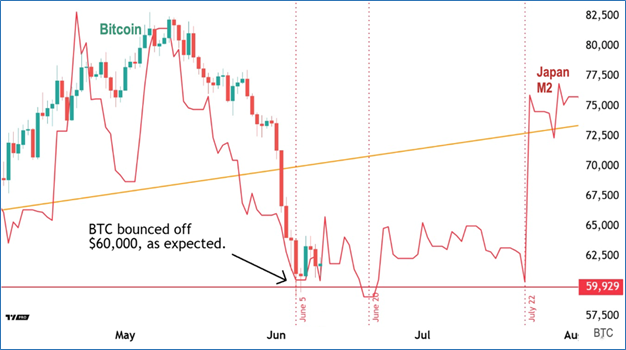
The black arrow here points to how BTC sold off into June 5, bounced off that level, and is now attempting what looks like a rally.
In fact, Bitcoin is following Japanese liquidity closely. So closely that one has to wonder how long that tight correlation will last.
For now, we'll assume it holds. If it does, I expect a test of $65,000 shortly.
Notice how JpM2 shows a weak bounce into June 11–15 before heading lower once again, with the actual low arriving around June 20.
At that point, we may see $60,000 crossed over again. But I don't expect prices to fall much further.
Why is that? Because what you see JpM2 tracing out between June 5 and July 22 is what I've described as a mostly sideways rounded bottom.
That’s when prices fall into an initial low, then tread water in a volatile range. Until the cycle turns higher again.
And Bitcoin has a long history of making this pattern going all the way back to 2015.
According to my models, this second retest of support (the first was between February and March) — could very well be the final consolidation phase before prices lift off.
Just as February-March was a grind, I expect June-July to follow a similar trend. And that's a good thing.
As I've said many times, crypto bear markets end in apathy, not chaos.
What JpM2 is describing is exactly that: After prices dramatically retest $60,000 last week, they meandered sideways, aimless and directionless.
I don't even expect to see $70,000 between now and late July.
Instead, what we're looking at is a tight, low-volatility consolidation range.
And as volatility diminishes, so too does the probability of new crashes or fresh lows.
By late July, if this forecast is correct, most market participants will have stepped away entirely. No leverage, no panic selling.
Now, why do I believe this June–July consolidation could be the final capitulation before prices firm up into Bitcoin's next bull market?
Because of my new forecasting model.
Bitcoin's Long Cycle: The 4-Year Cycle Forecast
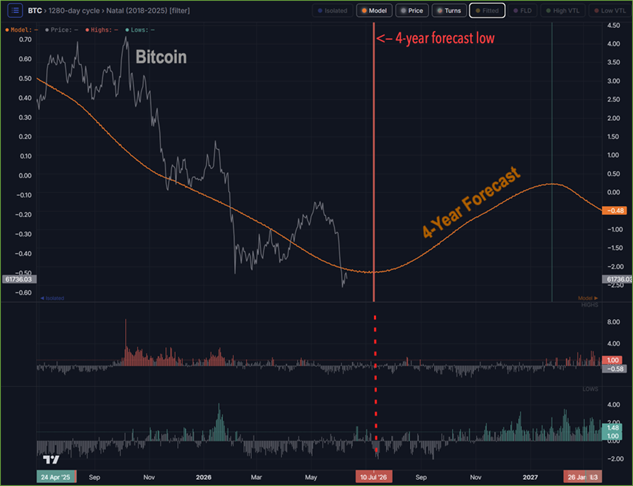
Crypto cycles stack particularly neatly. As a cycles analyst first and foremost, that’s how I ended up focusing on crypto.
But despite its 98% correlation to price action, I don't rely very heavily on the largest cycle forecast, the 4-year Bitcoin cycle.
The reason for caution is simple: Bitcoin is still so new, only a few iterations of its 4-year cycle exist. And limited iterations mean limited forecast confidence.
On top of that, even when this model is correct, it can still be off by two or three months. For instance, it predicted Bitcoin's 4-year cycle top in late April 2025.
However, Bitcoin actually peaked between May and October. So, the margin of error is meaningful.
Nonetheless, its forecast for the current 4-year low (marked by the red vertical line above) is July 10, 2026.
That's a bold call, when you consider this model was trained only on data from 2018 to 2022.
But it’s not one I’d ignore considering how it aligns with what my model suggests will be the 320-day-cycle low (as bottoms often overlap) and what our liquidity indicators are saying.
When reviewed as a whole, the data tells me our likely bottom window will be mid-to-late July.
And we’re getting close …
My colleague Marija Matić told me yesterday about the activity she sees on the blockchain.
Thanks to its transparent nature, we can see what the big players are doing in real time.
And we’re seeing long-term Bitcoin holders load up over the past couple of weeks.
I believe we’re entering the accumulation phase.
That’s not to say a rally is imminent. But it is time for you to begin your preparations.
To see my model’s approach for long-term investors, click here.
Best,
Juan Villaverde